Thursday, March 31, 2016

#RevokeGlyphosate Action


Tune into RT.com for a LIVE interview regarding the glyphosate in even organic wine report.
https://youtu.be/MBCyl1W-mq0

Above You Tube Zen Honeycutt discusses Glyphosate and RoundUp chemical cocktail, "pesticide foods" and GMO-glyphosate foods with Dr. Giles Eric Seralini


https://youtu.be/jthp2HNnriI  Dr. Stephanie Senneff What Glyphosate is and how it is killing us.


Please continue to call the EPA to revoke the license of glyphosate at 703-308-8187and share with any farmers you know, the benefits of eco agriculture. Check outwww.advancingecoag.com.

News!

Widespread contamination of glyphosate in wine, including organic.
Conventional wines tested show to have 28X higher levels of herbicide glyphosate!


vineyard.jpg

MAA article and report
http://www.momsacrossamerica.com/glyphosate_contamination_in_wine
This is not an attack on organic, organic is still the best option. We must fight for organic.
The only way to stop the contamination of organic is for farmers to stop using it.
Please call the EPA and ask for the cancellation of the license of glyphosate.
703-308-87187


Action Alert!

After the conference call with Alexis Baden Mayer of OCA, we are asking all our members to please call YOUR Senators this coming week,  202-224-3121, every day if you can.
Ask them to please honor state laws and allow Vermont's GMO labeling law to stand, and to NOT pass any other bills pertaining to GMO labeling before Vermont's law goes into effect.  The fact is that any bill, the DARK Act or the Merkley bill, would allow for a 2 year delay in GMO labeling per federal regulations.  We cannot wait that long.

Dark_act_cloture_stopped.png
The Pro GMO lobbyists continue to try to work a deal to stop federal, mandatory, clear GMO labeling!

Please visit our website, Health Solutions Store and Donate if you can support our work!
Thank you!

Moms Across America
http://www.momsacrossamerica.com/

Monday, March 28, 2016

VT STATE MARKET AND US PUBLIC DRIVING GMO LABELS NATIONWIDE


CQ NEWS
March 28, 2016 – 5:00 a.m.

GMO Legislation Could Fade as Companies Roll Out Labels
By Ellyn Ferguson, CQ Roll Call

The likelihood of action on a stalled Senate bill to block states from mandating the labeling of genetically modified food may be dimming now that leading food manufacturers have already started labeling to comply with Vermont's mandatory law due to take effect July 1.
Campbell’s Soup Co. and Mars are changing labeling nationwide on all their products with GMO [genetically modified organisms] ingredients to avoid violating the state of Vermont's requirements that has inadvertently become the national standard.  Even companies such as General Mills Inc., ConAgra Foods and the Kellogg Co. that back industry efforts in Congress to override state laws and create one national standard are jumping on board to avoid the $1,000 a day per product fine in Vermont, a state with 626,000 residents.
Story Photo
Mars Label on Peanut M&M's Candy  (CQ Roll Call)

​“We stand firmly with the coalition working on this issue in Washington. In order to comply with the VT law we had to label nationally because we have a national distribution system,” General Mills spokesman Mike Siemienas told CQ Roll Call via email.
But Scott Faber, of the Environmental Working Group, which has pushed for mandatory labeling, said the companies' actions lessen the chances of voting for labeling legislation. “We’d rebel if Congress said that consumers now have to wait on hold or fumble through websites now that companies have actually changed their packages and the democracy still stands,” Faber said.
By the time the Senate returns from its recess on April 4, at least a dozen companies are expected to have announced similar steps. This could make pending Senate legislation on the issue moot or could prod hold-out lawmakers to cross the aisle to reach an agreement. Presidential candidate Bernie Sanders and Democrat Patrick J. Leahyboth support their state's law.
Campbell’s broke with the industry in January and backs a national mandatory labeling requirement. Mars was not part of the food industry’s Safe Affordable Food Coalition, which has lobbied for pre-emption of state mandatory labeling laws and a voluntary labeling process. Mars has started labeling its candy products and will include its food and drink brands. All the companies stressed in statements that GMO products are safe for human consumption, but cited the impending Vermont law.
Vermont's 2014 law applies to raw vegetables and fruits as well as processed foods such as crackers, cereals and soft drinks sold at retail in stores. There are eight categories of exemptions, including for foods prepared in restaurant and take-out meals.
Senate Agriculture Chairman Pat Roberts, supported by Senate Majority Leader Mitch McConnell, R-Ky., has led the fight against mandatory labeling and his position appears to have hardened as companies announced they would meet Vermont’s requirements.
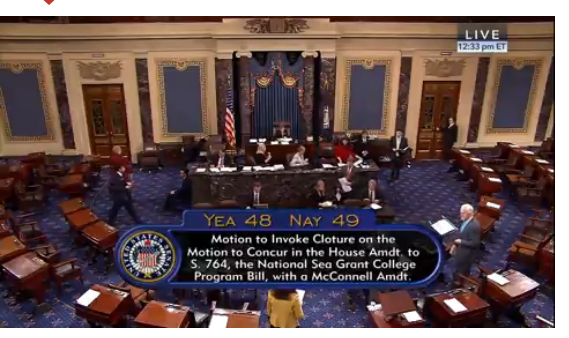
On March 16, the Kansas Republican was unable to invoke cloture and limit debate on an amendment to block states from writing mandatory labeling laws and instead create a federal voluntary labeling process overseen by the Agriculture Department. The amendment was attached to an unrelated bill (S 764).
Roberts needed 60 votes for cloture, but got a 48-49 vote. McConnell changed his vote to have the right to bring the proposal back to the floor at a later date. Shortly after the vote, Roberts indicated that he was open to further talks with Democrats dissatisfied with his amendment language. Democrats were cool to the option of the Agriculture Department creating a mandatory labeling regime if companies had not sufficiently complied under voluntary disclosure after final regulations establish the labeling process.
“Democrats blocked this compromise solution and now we see the result: big companies are making labeling decisions, but they are also making decisions to reformulate their products and avoid biotech ingredients altogether,” Roberts said in a statement. “The unwillingness to compromise by Senate opponents to my bill is about to hit both farmers and consumers directly in the pocketbook,” he added.
Roberts predicted a ripple effect. Companies, he said, would replace GMO ingredients because the labeling stigmatizes them. That would dent sales for farmers who grow major crops from GMO seeds such as corn and soybeans.
Faber and Colin O’Neil, at the Environmental Working Group, disputed Roberts’ argument that consumers would pay higher food costs. O’Neil said Mars is incorporating the Vermont requirements into planned label changes to mark its 75th anniversary this year.
Now that companies have demonstrated that they can label food packages, Faber said, it's less likely that senators would vote for Roberts’ labeling legislation, which would allow companies to direct consumers to websites or toll-free numbers for information on GMO products.
“We remain hopeful Congress will craft a national solution so consumers have information and companies have certainty,” Faber said, adding that he planned to collect and feature GMO labels on his Twitter feed.
Roger Lowe, spokesman for the Grocery Manufacturers Association, argues that the companies' decisions strengthen the argument that Vermont’s law will encourage other states to adopt mandatory labeling with different requirements. That, he said, would drive up food companies’ business costs that would be passed along to consumers. Just two other states, Connecticut and Maine, have mandatory GMO labeling laws. However, those laws cannot take effect until four neighboring states enact similar laws.
“If everyone labels for Vermont and then another state passes its own law that has a different standard we’re back in the same mess again. There’s still an imperative for a national labeling standard and a federal law,” Lowe said.
Lowe said the grocery group does not think the companies’ decisions will lead the Senate to back mandatory labeling of GMO food products and beverages, which is supported by many Senate and House Democrats. A final bill must have Republican support in the House, which passed a voluntary labeling bill (HR 1599) with state pre-emption language in July 2015. 
***
Michael Hansen, Ph.D.
Senior Scientist
Consumers Union

Sunday, March 27, 2016

DARK ACT - BACK ON DECK TO FIGHT GMO LABELS IN APRIL 2016


More to the Story?

More to the Story?
The world’s largest food corporations have spent hundreds of millions of dollars (some of it illegally) to avoid being required to label the genetically engineered ingredients in their products.
But with the July 1 deadline for complying with Vermont’s GMO labeling law on the horizon, a handful of the largest multinational food corporations have announced they will now label GMOs—not solely because they will be forced to, but because as General Mills claims, they believe “you should know what’s in your food and how we make ours.”
Have consumers won the GMO labeling battle? Have these food companies that so fiercely fought to keep labels off their products really split with the Grocery Manufacturers Association (GMA), the multi-billion-dollar lobbying group that is still trying to overturn Vermont’s law in the courts, and preempt it in Congress?
Or is there something more to these recent announcements than just the need to comply with Vermont’s law? As in, a strategy to lull consumers into complacency, while at the same time forcing Congress to give food companies what they’ve wanted all along—a free pass on labeling?
Read the essay

Share on Facebook Share on Twitter Email the OCA
ACTION ALERT

April Fools?

April Fools?
Last week, the Senate defeated S. 2609—or what we call the DARK Act, the bill that would Deny Americans our Right to Know about GMOs.
We hope you celebrated last week. Because this week, we have to get back to work. With a vengeance.
Sen. Pat Roberts (R-Kan.) didn’t have thevotes on March 16 to pass a bill to preempt Vermont’s labeling law. But that doesn’t mean we’ve seen the last of Roberts, Monsanto and the Grocery Manufacturers Association.
Here’s why. After the vote on the DARK Act failed last week, Senate Majority Leader Mitch McConnell (R-Ky.) flipped his vote from yes to no. It’s not that McConnell had a sudden change of heart. Hardly. He just used a procedural maneuver in order to allow the Senate to bring back an amended version of the DARK Act for another vote.
So what’s next? When Congress returns on April 4, after a two-week recess, we expect the pro-GMO, Monsanto-funded Democrats in the Senate, led by Sen. Debbie Stabenow (D-Mich.), to keep working on a compromise bill. Stabenow has said all along that she wants a federal labeling bill that preempts Vermont. Can she come up with a compromise bill that accomplishes preemption, but is acceptable enough to win over a few more Senators? Enough to get the bill passed in the Senate? And turn consumers into April Fools?
TAKE ACTION: Call Sen. Debbie Stabenow and ask her to protect Vermont’s GMO Labeling Law
Dial 888-897-0174 to tell your Senators to vote against any compromise that would block or delay Vermont's bill from taking effect.
Help or organize an April Fool’s Day action at the home office of your Senator. Email campaigns (at) organicconsumers.org if you can help!

Thursday, March 24, 2016

TO (MANDATORILY) LABEL OR NOT TO LABEL GMOs - THAT IS THE QUESTION

Published on
by

Food Companies Plan to Label GMOs—but Is There More to the Story?

"Is there something more to these recent announcements than just the need to comply with Vermont’s law?" ask Paul and Cummins. Could it be a "strategy to lull consumers into complacency, while at the same time forcing Congress to give food companies what they’ve wanted all along—a free pass on labeling?" (Photo: via OCA)
The world’s largest food corporations have spent hundreds of millions of dollars(some of it illegally) to avoid being required to label the genetically engineered ingredients in their products.

But with the July 1 deadline for complying with Vermont’s GMO labeling law on the horizon, a handful of the largest multinational food corporations have announced they will now label GMOs—not solely because they will be forced to, but because as General Mills claims, they believe “you should know what’s in your food and how we make ours.”

Have consumers won the GMO labeling battle? Have these food companies that so fiercely fought to keep labels off their products really split with the Grocery Manufacturers Association (GMA), the multi-billion-dollar lobbying group that is still trying to overturn Vermont’s law in the courts, and preempt it in Congress?

To be sure, consumer pressure has had an impact on brands’ decisions to label. We should celebrate that. But before we break out the champagne, it’s worth noting that not all of the food companies that announced plans to label have taken a strong position on labeling. Equally important, four out of the five companies announced plans to label after a Senate bill to preempt Vermont’s labeling law failed, but before the Senate has a chance to come backwith an amended version of the bill after Congress returns on April 4 from Easter recess.

Is there something more to these recent announcements than just the need to comply with Vermont’s law? As in, a strategy to lull consumers into complacency, while at the same time forcing Congress to give food companies what they’ve wanted all along—a free pass on labeling?

It’s also worth noting that all of the companies that have revealed plans to label adamantly defend the “safety” of GMOs—without once mentioning the fact that the vast majority of GMO crops, from which GMO food ingredients are derived, are sprayed with glyphosate, classified last year by the World Health Organization as “a probable human carcinogen.” Clearly, we have a long way to go before food corporations acknowledge the devastating consequences of the GMO monoculture model on the environment, human health and global warming.

Who’s labeling, and why?
Campbell’s Soup Co. CPB (NYSE), General Mills (NYSE:GIS), Mars and Kellogg’s(NYSE: K) and ConAgra Foods (NYSE CAG) have all declared they will label GMOs in time to comply with Vermont’s July 1 deadline, and in accordance with the Vermont law’s standards. The companies say that any costs associated with labeling won’t be passed on to consumers—a claim that deflates one of the industry’s long-standing, albeit routinely debunked, arguments that GMO labeling will lead to higher food prices for consumers.

Campbell’s was first out of the gate, and the first to break with the GMA on the lobbying group’s non-negotiable stance against mandatory labeling. After spending a half a million dollars to help defeat California’s Proposition 37 ballot initiative that would have mandated labels, Campbell’s now says the company supports a mandatory federal labeling solution. Following Campbell’s January 1announcement, we reached out to clarify what the soup company would do if Vermont’s law were preempted at the federal level. A Campbell’s spokesperson responded by saying that regardless of what happens in Congress, Campbell’s products will be labeled, with the words “partially produced with genetic engineering,” in all 50 states. On the surface, that's good news. But let's not forget that a federal labeling bill could forbid companies from printing those, or similar words on a label, to prevent food producers from "stigmatizing" biotechnology.

Similarly, we reached out to General Mills, Mars and Kellogg’s this week asking for clarification on their positions. Kellogg’s responded, but wouldn't provide answers to our direct questions, referring us instead to the official statement(which doesn't answer our questions). We haven't yet heard back from ConAgra, but we did receive responses from General Mills and Mars.

When asked if General Mills now supports a mandatory federal labeling solution, Mike Siemienas, manager of brand media relations, told us in an email that the cereal giant is “supportive of a model similar to what is used for organic products.”  In other words, voluntary, not mandatory. Asked if General Mills would label its GMO products according to Vermont standards even if Congress were to preempt Vermont, Siemienas wrote: “ . . . we would comply with any law that Congress passes.” We took that as a no.
But General Mills appears (so far) to be alone in continuing to side with the GMA on opposing mandatory labeling laws. Jonathan Mudd, Mars’ global director of media relations, told us by email that Mars, like Campbell’s, supports “the establishment of a mandatory national labeling system.” Mudd also confirmed that Mars will label its products “consistent with Vermont” regardless of whether or not Vermont is preempted “because we believe in consumer transparency.” (Mars pitched in $376,000 to defeat California’s Proposition 37. But after anti-labeling food corporations became boycott targets following the defeat of Prop 37, Mars sat out similar battles in Washington State (2013) and Oregon (2014).

Campbell’s and Mars both cited the “need to avoid a 50-state patchwork” of labeling laws as their reason for supporting a mandatory federal solution, as opposed to supporting states’ rights to pass GMO labeling laws. On the surface, the patchwork argument might sound rational—until you consider the fact that there are more than 100 state laws, governing food labeling, including a Vermont maple syrup labeling law, and a Minnesota law governing the labeling of wild rice. None of these laws ever created “chaos” in the marketplace, as U.S. Department of Agriculture Secretary Tom Vilsack has warned about Vermont’s GMO labeling law. And none were ever opposed with the same relentless determination, much less lavish spending, as GMO labeling laws. Maybe because none of them affected Monsanto’s bottom line?

Timing is everything

General Mills, Mars and Kellogg’s all revealed their labeling plans after the Senate failed to pass S. 2609, a bill intended to preempt Vermont. It’s possible that their announcements signal that these food giants have conceded defeat, especially as they all noted the need to comply with the Vermont July 1 deadline.

That’s the optimistic view. But the timing of these announcements, made before the Senate returns to try again to try to pass a preemption bill, could also be part of a calculated strategy to win over more Senators to a compromise bill, one that will delay or outright preempt enactment of Vermont’s Act 120.

Sen. Pat Roberts (R-Kan.), sponsor of the Monsanto- and GMA-funded S. 2609 (dubbed by opponents as the DARK—Deny Americans the Right to Know Act) is unwavering in his rejection of any legislation that requires labels on GMO ingredients. Though he is adamant about a “federal solution,” Roberts outright, and illogically, rejects the idea of a uniform mandatory federal solution.
Roberts’ rigid position on mandatory vs. voluntary cost him the support of Sen. Debbie Stabenow (D-Mich.), Ranking Member of the Senate Agriculture Committee and a key player in the GMO labeling drama. Stabenow says she would support a mandatory federal labeling law, though whether that support would include on-package labels, or some sort of QR barcode scheme or toll-free phone numbers, both of which have been floated as alternatives to on-package labels, remains unclear.

Still, Stabenow and other Senators representing Big Ag states are under tremendous pressure (by corporations, not voters) to keep Vermont’s law from taking effect. The Big Food corporations know this. So is it possible that companies, by announcing, in quick succession that they will label voluntarily, hope to send the message that there’s no need to pass a mandatory labeling law, because they’ve already volunteered? And could those big companies, or at least some of them, pull the plug on their labeling plans if federal legislation preempts Vermont? (Again, Campbell’s and Mars have said they will proceed regardless of what happens in Congress—we know that's not the case for General Mills; Kellogg's and ConAgra haven't confirmed one way or the other). 

That’s one possibility. Here’s another. General Mills told Politco’s Jenny Hopkinson that while the company won’t pass on the cost of labeling to consumers, the Minnesota-based cereal giant will have to spend “millions of dollars” to comply with Vermont’s law. Could this “woe is me” message win enough sympathy votes from Senators who may still be on the fence (and who are being hounded by their corporate donors), that they’ll be persuaded to betray consumers in order to stave off what General Mills or other companies allege is a “huge” financial burden?

It’s also possible that this is just a public relations ploy by corporations that are banking on the fact that a federal law will pass before they have to label, and that that law will include restrictions that prohibit them from printing “produced with genetic engineering,” or similar wording, on their packages. That scenario would allow them to say, gee, we tried to give consumers what they want, but Congress wouldn’t allow it.
Whatever the new-and-improved version of the Senate bill morphs into, assuming the Senate passes a bill, it will have to go back to the U.S. House. There, members of a Republican-controlled Joint Standing Conference Committee will try to “reconcile” the Senate bill with the House version, H.R. 1599, which passed the House in July by a vote of 275 – 150. Guaranteed, the House won’t sign off on anything with the words “mandatory” or “on-package.” In fact, House Agriculture Committee Chairman Mike Conaway (R-Texas), according to Politico, “declared just this week that he won't support on-package labeling, which he has said stigmatizes the technology.” Whatever ends up coming out of the committee will have to go back to the House and Senate for a full vote.
That leaves consumers no choice but to continue to hammer our Senators with this message: No compromise. Let Vermont’s law take effect. And if you really can’t tolerate supporting states’ rights to pass labeling laws, then pass a federal labeling law that meets, or preferably exceeds, the standards set by Vermont’s law.
Katherine Paul is associate director of the Organic Consumers Association.
Ronnie Cummins is a veteran activist, author, and organizer. He is the International Director of the Organic Consumers Association and its Mexico affiliate, Via Organica.

SEPT 2016 GMO CONFERENCE VIDEO: GLOBAL GMO CHARADE

GMOs: Unmasking the Global CharadeWith Jeffrey M. Smith, Claire Hope Cummings M.A., J.D., Steven Drucker J.D.
The Health Team at The Real Truth About Health.com
website: http://www.therealtruthabouthealth.com/2015-conference-replays

Special 10 Day Conference coming September 9-18, 2016

According to this panel, knowing what’s in your food is a luxury many of us take for granted. What trip to the grocery store does not involve an examination of the ingredients in the food we feed our families?

We look at such things because we care about our health and the health of our loved ones. So why are so many multinational companies seeking to prevent our government from enforcing laws that require that we are informed about what’s in our food where it comes from?

The sad fact is that GMO foods is big business and for some increasing profits trump what is best for the health of our families. But the good news is that the more people learn about the dangers of GMO foods, the greater the market response for non-GMO foods becomes.

Don’t leave yourself uninformed; learn the dangers of GMO foods and don’t fall prey to the misinformation campaigns of giant conglomerates. GMOs are made by chemical companies whose goal is to profit from the use of herbicides and pesticides.

The health of your family ought to be a top priority, don’t leave the purity of your food in the hands chemical companies.

Take advantage of this free video and arm yourself with the facts you need to help keep our food supply safe and healthy.

Watch this video now. Click here.

About This Panel:


C:\Users\Chris Goegan\Desktop\Chris Web Pics\Dr Brian Clement\2015 Conf May Orlando\2015 Conf Replays\Jeffrey_Smith_GMOs_Genetic_Roulette.pngJeffrey Smith is the leading consumer advocate promoting healthier non-GMO choices. Jeffrey’s meticulous research documents how biotech companies continue to mislead legislators and safety officials to put the health of society at risk and the environment in peril. His work expertly summarizes why the safety assessments conducted by the FDA and regulators worldwide teeter on a foundation of outdated science and false assumptions, and why genetically engineered foods must urgently become our nation’s top food safety priority.  


Claire Hope Cummings Uncertain PerilClaire Hope Cummings M.A., J.D., is an environmental lawyer, journalist, and the award winning author of Uncertain Peril: Genetic Engineering and the Future of Seeds (Beacon Press) which won the American Book Award and the book of the year award from the Society for Economic Botany. Claire’s stories focus on the environmental and political implications of how we eat and how food and farming reconnects us to each other, to the places where we live, and the extraordinary knowledge of land based peoples. Claire brings over three decades of broad experience in agriculture to her work.
  
Steven Druker Altered Genes Twisted TruthSteven Druker J.D., is a public interest attorney who founded the Alliance for Bio-Integrity, and as its executive director, organized a lawsuit against the U.S. Food and Drug Administration (FDA) that forced it to divulge its files on genetically engineered (GE) foods. This revealed that politically appointed administrators had covered up the extensive warnings of their own scientists about the unusual risks of these foods, lied about the facts, and then ushered these novel products onto the market in violation of explicit mandates of federal food safety law.   

 Please forward this email to those you know that might be interested in this topic. Let them learn first-hand what the experts have to sy.

The link for the video is here: http://www.therealtruthabouthealth.com/2015-conference-replays/watch/68/claire-hope-cummings-ma-jd-steven-drucker-and-jeffrey-m-smith-gmos-unmasking-the-global-charade

The Real Truth About Health Conference: September 9-18, 2016 in Orlando Florida

Attend Live in Orlando OR from a Computer Anywhere in the World!

Join our pre-registration interest list to stay informed of important updates and be the first to know about the conference.


You will also get FREE access to the educational videos from the 2015 Conference by the 29 world renowned authorities!!

GMO LABELING: THOSE SPENDING MILLION$ TO FIGHT IT - STEP UP TO MARKET PRESSURE AND LAW


This is a big week for everyone who eats!

Some of the very same companies that have spent millions of dollars fighting your right to know how your food is produced are now finally changing their tune.

In fact, just this week four major food companies have accepted the inevitable, and announced that they will now be labeling GMOs.

This is a huge victory for transparency and consumer empowerment.

Find out who’s come on board, and what it means, here.

Yours for the right to know,

Ocean Robbins

P.S. You made this possible. By being part of the food revolution, you’re helping to shift the course of history. We still have a ways to go before safe and accurate labeling becomes a reality - but we’re making huge progress. And I want to thank you for all that you do. Click here to check out the article now.

Tuesday, March 22, 2016

GMO LABELS A GO-GO CONAGRA & KELLOGG JOIN IN NATIONWIDE


ConAgra Going Nationwide With GMO Labeling update daily

ConAgra Going Nationwide With GMO Labeling

ConAgra Foods Inc. is going nationwide with labels that will say a food product is made with genetically modified organisms, finding it to be the easiest way to comply with a Vermont law on GMO labeling.
Other food giants including Kellogg Co., General Mills Inc., Mars Inc. and Campbell Soup Co. have all said they are changing their food packaging across the country in response to that state's law requiring disclosure of GMOs as of July 1.
These companies say it would be too complex and expensive to create a separate distribution network for the 626,000 residents of Vermont. Last week, an effort by some members of Congress to block Vermont's law stalled, pushing packaged food makers to start preparing for it now. 
ConAgra's products include Snack Pack pudding and Peter Pan peanut butter. It said it stands behind the health and safety of all of its products, including those with GMOs, but that it also believes consumers should know what's in their food. It is to reveal its stance via social media outlets Tuesdayevening.
Like other companies, ConAgra is hoping for a national law that addresses GMO labeling to avoid having to complying with multiple state laws, should others follow Vermont. But the big debate in Congress that's holding up a national standard is whether it should mandate GMO labeling on the food packages, allow it to be on company websites instead, or make it entirely voluntary.
ConAgra said it "supports using a variety of options for disclosure of GMOs."
Kellogg said its products with GMOs will have labels nationwide, beginning sometime in April, to comply with the Vermont law, but that's only "until a federal solution is reached."
So far, Campbell Soup is the only big company to break from the pack and endorse mandated GMO labeling on packages, while cutting funding to lobbying efforts that oppose it. Campbell said it will keep GMO labels on applicable food nationally, regardless of what happens on Capital Hill.