Saturday, June 2, 2012

REP. DENNY REHBERG (R-MT) to 117 MILLION IN USA: YOU HAVE NO RIGHT TO CLEAN WATER! PROFIT IS AT STAKE


FOR IMMEDIATE RELEASE
June 1, 2012
3:38 PM
CONTACT: Earthjustice
Liz Judge, Earthjustice, (202) 797-5237, cell (970) 710-9002

America’s Clean Water Under Siege by U.S. House of Representatives

WASHINGTON - June 1 - Today the U.S. House of Representatives voted against Clean Water Act protections for streams, lakes, and rivers across the United States. The House majority voted to keep a Dirty Water Rider in the House’s Energy and Water Appropriations bill, which would expose 60 percent of our country’s streams and at least 20 million acres of wetlands to toxic pollution and threaten the drinking water of 117 million Americans. The Dirty Water Rider was introduced by Rep. Denny Rehberg (R-MT) in an effort to block the Obama administration from protecting waters of the United States, making it easier for polluters to dump their waste into our waters.

The following is a statement from Earthjustice Senior Legislative Counsel Joan Mulhern:
“We have never seen a House of Representatives so woefully at odds with the wants and needs of the American people whom they represent. Americans want and depend on clean water; they say this overwhelmingly in poll after poll. Americans cherish and rely on their lakes, rivers, and streams, but they are also deeply concerned about so many of our waters that are dangerously polluted and unsafe. It’s critical that we continue to clean up our waterways to protect our communities, but instead, the House majority is using a spending bill to pay favors to their polluter friends, putting 117 million Americans in harm’s way.
“It’s dumbfounding to try to understand why, when Americans want and need clean water, their representatives are voting for dirty water, pollution, contamination, and sickness.

“Americans cannot be clearer about it: They want to fill their glass with water that won’t give them cancer; they want their children to be able to swim in lakes and rivers; they want to be able to fish in America’s waters; and they want to run their businesses in places that don’t sicken their families. Our elected leaders in the House are putting American families and communities in danger just so that they can promote their political careers; this is just plain wrong.

“We need the Senate to stop this Dirty Water Rider and protect the people and waters of this country. We’re relieved to hear that the White House won’t stand for this kind of polluter attack on clean water, and we urge the president to veto any and all legislative attempts to block protections for our nation’s waters and communities.”
###
Earthjustice is a non-profit public interest law firm dedicated to protecting the magnificent places, natural resources, and wildlife of this earth, and to defending the right of all people to a healthy environment. We bring about far-reaching change by enforcing and strengthening environmental laws on behalf of hundreds of organizations, coalitions and communities.

IS WATER A BASIC HUMAN RIGHT? USA DOES NOT THINK SO

Canada, Last Holdout, Drops Opposition to Water as Human Right

by Thalif Deen 
UNITED NATIONS - Canada, in a dramatic political turnaround, has signaled its willingness to recognise water and sanitation as a basic human right.
Some 3.4 million people die each year from water, sanitation and hygiene-related causes. (Credit:Eva Bartlett/IPS) As negotiations continue over the Rio+20 plan of action on sustainable development to be adopted in Brazil next month, Canada became one of the last Western nations to drop its opposition to a reference to water as a human right in the document titled "The Future We Want."
Maude Barlow, national chairperson of the Council of Canadians, one of Canada's largest social justice advocacy organisations, said it took "unprecedented pressure" to get the government in Ottawa to change its position.
"The shift is a good thing, but words are not enough. We need actions, and the government's actions directly contradict respect for the human right to water," said Barlowe, a former U.N. senior advisor on water to the president of the General Assembly.
Asked what next, she told IPS: "That's a very good question." She said the government is supposed to prepare a report on its plan of action and submit it to the United Nations.
"You can be sure we will be sitting on them," she added.
When the U.N. General Assembly adopted a resolution in July 2010 recognising water and sanitation as a basic human right, 122 countries voted for it, with 41 abstentions, but with no negative votes.
The United States, along with Canada, abstained - and so did some of the European, as well as industrialised countries, including Britain, Australia, Austria, Greece, Sweden, Japan, Israel, South Korea, Luxembourg, the Netherlands, Denmark, and Ireland.
But several developing nations, mostly from Africa, also abstained on the vote, siding with rich industrial countries. These included: Botswana, Ethiopia, Kenya, Lesotho, Zambia, Guyana and Trinidad and Tobago.
At the initial Rio+20 negotiations last year, several human rights and non-governmental organisations (NGOs) warned that the human right to water and sanitation was under threat.
Anil Naidoo, of the Canada-based Blue Planet Project, said that as recently as last month, Canada was isolated in the Rio+20 negotiations as the only country to publicly claim there is no legal basis for the right and call for its deletion.
"This position was untenable, however, almost two years after the General Assembly passed a resolution recognizing the right, followed by three subsequent confirming Human Rights Council resolutions', he added.
The U.N. Conference on Sustainable Development (UNCSD), also known as Rio+20, will be a summit meeting of world leaders, scheduled to take place in Brazil Jun. 20-22.
A Preparatory Committee (PrepCom), comprising all 193 members states, is currently conducting another round of weeklong negotiations, beginning last Tuesday, aimed at finalising the plan of action, informally called the zero draft.
Naidoo said the first indication that states would try to undermine the human right to water and sanitation was when the UK, working inside the European Union (EU), proposed deleting paragraph 67 of the zero draft, which explicitly recognised the human right to water and sanitation.
After pressure from several international NGOs, and a rare explicit sanction from the Special Rapporteur on Water Catarina de Albuquerque, the EU backed down and other governments pushed back against the UK, notably Spain, said Naidoo.
But still, Canada, the other main longstanding opponent of the human right to water and sanitation, continued to call for deletion of paragraph 67 and in the next round was joined by the United States and Israel.
"Working with allies inside the negotiations, we increased the pressure and with staff from the Office of the High Commissioner for Human Rights, were able to get the High Commissioner to call for human rights to be protected in the Rio negotiations." he added.
Naidoo said "this has been a long struggle for those of us in Canada."
"We are aware that recognition is only the first step towards our real goals of implementation and realisation," he added.
"We also know those governments and corporations who are against the human right will continue to try ever means to limit the scope and impact of this victory; still, (but) we are making progress," he said.

GET UP, STAND UP! SHIVA: Nagoya Protocol on Access and Benefit Sharing - LEGALIZED BIOPIRACY

A Global Call: Eco Warriors, Arise!

Ahead of the Rio+20 Earth Summit, a call for a paradigm shift

In June 2012, movements and leaders will meet in Rio for Rio+20, two decades after the Earth Summit was organised in 1992 to address urgent ecological challenges such as species extinction, biodiversity erosion and climate change. The Earth Summit gave us two very significant international environmental laws: the United Nations Convention on Biological Diversity and the United Nations framework Convention on Climate Change. It also gave us the Rio principles, including the Precautionary Principle and the Polluter Pays Principle.
The world has changed radically since 1992, and sadly, not for the better. Ecological sustainability has been systematically sacrificed for a particular model of the economy, which is itself in crisis. 1995 created a tectonic shift in what values guide our decisions, and who makes the decisions. Rio was based on values of ecological sustainability, social justice and economic equity - across countries and within countries. It was shaped by ecological movements, ecological science and sovereign governments. The establishment of WTO, and the paradigm of global corporate rule, inaccurately called "free trade" (more accurately described as corporate globalisation) changed the values and the structures of governance and decision making.
Conservation of the Earth's resources, and equitable sharing was replaced by greed and the grabbing and privatisation of resources. Sustainable economies and societies were replaced by non-sustainable production systems, and a relentless drive to spread the virus of consumerism. Decision making moved into the hands of global corporations, both directly and indirectly. It is therefore not surprising that when we meet at Rio+ 20, the ecological crisis is deeper than what it was at the time of the Earth Summit, and the will and capacity of governments is weaker.
"Instead of polluters paying and being regulated at the national and international level to stop pollution, the biggest atmospheric polluters who have contributed most to climate change are now laying the rules on how to deal with climate change."
While the corporations wrote the rules of WTO and global free trade, they have also subverted the environmental rules which were supposed to regulate their commercial activities to ensure sustainability. They have mutated environmental laws which are supposed to regulate commerce into laws for commercialising and commodifying the earth's resources and ecological functions.
Profiting from pollution
They have subverted the Climate Treaty and the Biodiversity Convention. Instead of polluters paying and being regulated at the national and international level to stop pollution, the biggest atmospheric polluters who have contributed most to climate change are now laying the rules on how to deal with climate change. The biotechnology industry which has caused genetic pollution by releasing genetically engineered organisms into the environment is making the rules on how to manage biodiversity and how to govern Biosafety. The attempt to introduce BRAI, the Biotechnology Regulatory Authority of India, is one example.
The original objective of the Climate Treaty was to put in place legally binding emission reduction targets for the historic polluters, who in the pre-globalisation period were concentrated in the rich industrial North. The treaty was destroyed at the Climate summit in Copenhagen, by an attempt to replace it with a non binding Copenhagen Accord. The Kyoto Protocol introduced emissions trading, which in effect meant the polluter got paid, not punished. The big industrial polluters were first paid by allowing them to get private rights to our atmospheric commons. They then got paid by profiting from carbon trading.
Profits increased and emissions increased. Climate chaos is worse today than it was in 1992. And the polluters look for new avenues to make money and grab resources. Now they want to commodify the ecological functions and services that nature provides. This will be the big Climate debate in Rio+20.
"None of us are immune to the crisis, or the response to it. None of us are bystanders. we are all immersed in the processes that are either threatening the planet and our own future or finding creative ways to shape a sustainable and just future."
The original objective of the Convention on Biological Diversity was the conservation of biodiversity and its sustainable and equitable use. This objective has been subverted and is being increasingly replaced by objectives of trade in genetic resources, profits and privatisation. The Nagoya Protocol on Access and Benefit Sharing restricts access only to global players, ignoring the access of local communities. It treats as utilisation only utilisation for research and commerce - ignoring the survival needs of local communities. It is in fact legalised Biopiracy, because it enables the transfer of genetic wealth from local communities to global corporations, it undermines the biodiversity economies and cultures which have conserved biodiversity, and are necessary for conserving it for the future.
'We know we can change it'
In both the Climate Treaty and the Biodiversity convention, trade and commerce is replacing conservation and the commons. Rights of Corporations is replacing the Rights of Nature and People.
And this change in values, from conserving and sharing to exploiting and privatising, is justified in the name of economic progress and economic growth. Yet the economic paradigm for which the Earth and Society are being pillaged and destroyed, is itself in deep crisis. Look at the farmers suicides and hunger and malnutrition crisis in India. Look at the protests in Greece, Spain or the Occupy movement of the 99% in the US.
As the Spanish indignados said:
"We fail to understand why we should have to pay the costs of the crisis, while its instigators continue to post record profits. We're sick and tired of one injustice after another. We want human dignity back again.

This isn't the kind of world we want to live in, and it's we who have to decide what world we do want. We know we can change it, and we're having a great time going about it."
A paradigm shift is desperately needed. And it will not come those who have created the crisis, and who are looking for new ways to extend the life of the Greed economy by commodifying and privatising all life on earth. They will come to Rio+20 to paint the Greed Economy Green, and call it the Green Economy. And they will have powerful governments on their side.
Movements for ecological sustainability, social justice and deep democracy will come to Rio+20 with another paradigm, one centred on the Rights of Mother Earth, the rights of future generations, of women, indigenous communities and farmers.
It is this epic contest between a destructive and dying outmoded paradigm and a life enhancing emergent paradigm that will be the most significant aspect of Rio+20. The outcome of this contest will determine the future of humanity. It will not enter the negotiations, which can only be the lowest common denominator in the current context of corporate influence. But it will provide the energy for the People's Summit, and many government initiatives at Rio Centro. This contest will continue beyond Rio, in every country, in every village and town, every farm and workplace, every home and street.
None of us are immune to the crisis, or the response to it. None of us are bystanders. We are all immersed in processes that are either threatening the planet and our own future, or finding creative ways to shape a sustainable and just future. Every day is an earth summit in our lives. And each of us is negotiating our collective fate on the earth.
Vandana Shiva
Dr. Vandana Shiva is a philosopher, environmental activist and eco feminist. She is the founder/director of Navdanya Research Foundation for Science, Technology, and Ecology. She is author of numerous books including, Soil Not Oil: Environmental Justice in an Age of Climate Crisis; Stolen Harvest: The Hijacking of the Global Food Supply; Earth Democracy: Justice, Sustainability, and Peace; and Staying Alive: Women, Ecology, and Development. Shiva has also served as an adviser to governments in India and abroad as well as NGOs, including the International Forum on Globalization, the Women’s Environment and Development Organization and the Third World Network. She has received numerous awards, including 1993 Right Livelihood Award (Alternative Nobel Prize) and the 2010 Sydney Peace Prize.
Source:   http://www.commondreams.org/view/2012/06/01-4

Friday, June 1, 2012

FAT, SICK AMERICANS = HUGE CORPORATE $$$$

Why Are Twinkies Cheaper Than Carrots?

John RobbinsPosted: 06/01/2012 8:26 am
Why is Coca-Cola often more affordable than clean water? Why are candy bars and cigarettes often more readily available than fresh fruits and vegetables?
If you want to eat healthfully, you have to fight an uphill battle. Why are government subsidies pushing in the wrong direction?
Who would it hurt if we enacted policies that actually encouraged the foods that are healthiest for people and for our world? Who opposes the efforts to make it easier, rather than harder, for people to make healthy food choices?
Government Policy Consistently Favors Big Agribusiness
As I describe in my new book No Happy Cows, agrichemical companies, factory farms and junk food manufacturers are quite happy with things the way they are. Thanks to their lobbying clout, government policies consistently favor the financial interests of these special interests over public health, even though the result is trillions of dollars in additional health care expenses.
Here's an example: In just the last two years, 24 states have considered legislation that would place a tax on soft drinks. These "soda taxes" would discourage consumption of drinks high in sugar, thus reducing obesity and health care costs. And they would also raise money that could be used to subsidize healthier foods. But in every single state, the legislation has been defeated. PepsiCo Inc., the Coca-Cola Company, and the American Beverage Association have spent hundreds of millions of dollars to determine the outcome.
"In the political arena, one side is winning the war on child obesity," a new Reuters report on the food lobby begins. "The side with the fattest wallets."
The Center for Science in the Public Interest, perhaps the best-financed lobbying force for healthier food, spent about $70,000 lobbying last year -- roughly what those opposing stricter guidelines on sugary sodas in the U.S. spent every 13 hours.
Spending $1 Trillion on the Wrong Things
Next week, the U.S. Senate will begin floor debate on the 2012 Farm Bill, which lays the groundwork for nearly $1 trillion in U.S. government spending over the next decade. Most of that spending goes to the Supplemental Nutrition Assistance Program (SNAP -- still sometimes referred to as food stamps), and to subsidies and incentives for farmers.
Efforts to restrict SNAP spending to healthier foods have been fought bitterly, and successfully, by the junk food lobbies.
Meanwhile, the current Senate proposal would give tens of billions of dollars in subsidies to Big Agribusiness, but would give next to nothing to programs benefiting the environment, organic food, nutrition, or small farmers. The food blog Civil Eats calls the proposal an "all-you-can-eat-buffet for the subsidy lobby."
In a national poll last year, 78 percent said making nutritious and healthy foods more affordable and accessible should be a top priority in the farm bill. But that's not what's on the table in this year's "agri-business as usual" farm bill.
Kari Hamerschlag, Senior Food and Agriculture Analyst for the Environmental Working Group, explains that the current proposal would actually "slash programs for conservation, nutrition, rural development and beginning and socially disadvantaged farmers."
For example, funding for research in organic farming would be cut to almost nothing, while corn growers, who have received $73.8 billion in subsidies in the last 15 years, would get even more now. Subsidized GMO corn is used to produce cheap high-fructose corn syrup, a substance that even Vice President Joe Biden says is more likely to kill an American than terrorism.
This heavily subsidized genetically modified corn is also fed to livestock in factory farms and feedlots -- at unfairly reduced prices.
"Factory farms pose a serious public health hazard, so why are they subsidized by public money?" asks Food Revolution Summit speaker Dr. Neal Barnard. "These facilities pump out high-fat, high-cholesterol meat products and often pollute waterways -- yet they also receive generous subsidies under the Farm Bill. We want Congress to stop rewarding facilities that endanger public health."
These subsidies aren't just costing U.S. taxpayers and enriching big agribusiness. They are also having a devastating impact on the health of tens of millions of people.
With all that we now know about nutrition, what kind of sense do these government policies make?
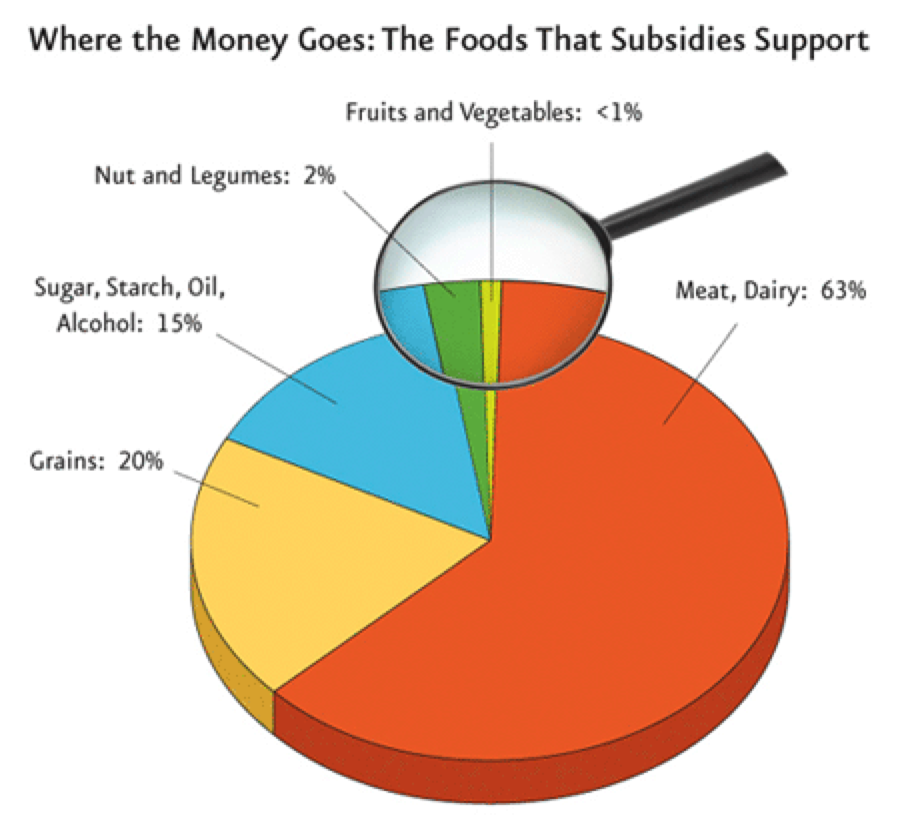
2012-05-29-JRchart.png
Chart courtesy of Physicians Committee for Responsible Medicine

The USDA's Dietary Guidelines say eating more healthful plant-based foods and less saturated fat and cholesterol helps prevent heart problems and other life-threatening medical conditions.
But 63 percent of the government's agricultural subsidies for domestic food products in recent history have supported meat and dairy production -- the very foods highest in saturated fat and cholesterol. Less than 1 percent of these subsidies have gone to fruits and vegetables.
Food Revolution, Anyone?
The good news is that people are waking up, and you can join in the movement! Increasing numbers of people across partisan lines are calling for government policy to stop supporting the loudest lobbyists, and to start supporting the health of the population. And with the Farm Bill coming up for vote soon, this is a great time to get involved.
  1. Call the U.S. Capitol Switchboard at (202) 224-3121 and ask for your senators' and/or representative's office. Tell them the Farm Bill should invest in food that is healthy for people and the earth. Tell them that instead of cutting support for nutrition, conservation and anti-hunger programs, they should cut crop insurance programs that only benefit the largest and wealthiest agribusiness operations.
  2. Physicians Committee for Responsible Medicine is one of many organizations doing brilliant work on this issue in the U.S. Find out more and sign up to take action here.
  3. Educate yourself by reading books like No Happy Cows. You'll learn how to protect yourself in an age of predatory marketing. And your body will thank you for the rest of your life.
John Robbins is the author of many bestsellers including No Happy Cows: Dispatches From The Frontlines of The Food Revolution and Diet For A New America. He and his son, Ocean Robbins, are co-hosts of the 32,000 member Food Revolution Network. He is the recipient of the Rachel Carson Award, the Albert Schweitzer Humanitarian Award, the Peace Abbey's Courage of Conscience Award, and Green America's Lifetime Achievement Award. 
Source:   http://www.huffingtonpost.com/john-robbins/farm-bill_b_1553955.html

UPDATES ON GMO EVERYTHING.....

From Institute For Responsible Technology 6-1-2012
Millions in Monsanto Money Wields Influence on Capitol Hill and Beyond
With an election looming this November and the Farm Bill set to expire in 2013, Monsanto has poured $1.4 million into its lobbying efforts targeting the U.S. Department of Agriculture, the Food and Drug Administration and the Environmental Protection Agency among others.
They even seek to extend their influence into public universities across the country in a funding fueled, pro-GMO public relations push. The University of Illinois has accepted $250,000 to create an "Agricultural Communications Program"; Iowa State undergraduates enjoy their Monsanto Student Services Wing; and professors of ag-science at the University of Missouri deliver their lectures in the Monsanto Auditorium. All that money comes with serious strings and an implied quid pro quo.
Read more about Monsanto's attempts to purchase legislators [Read the Article]
Read more on which collegiate programs accept funding from Monsanto [Read the Article]
Monsanto Staffer Turned Regulator Revolving Door Plagues Europe Along With U.S.
The hijacking of regulatory agencies is not limited to Monsanto's control of the FDA. In Europe, their FDA equivalent - EFSA - just ousted Diana Banati due to her participation in the biotech lobbying group International Life Sciences Institute Europe (ILSI). Naturally, upon submitting her resignation she became ILSI's executive and scientific director.
In the U.S., President Obama's appointment of Michael Taylor is receiving similar scrutiny. Taylor - the former vice president for public policy at Monsanto - is currently deputy commissioner for foods at the FDA where he oversees food safety.
Read more on Banati's resignation [Read the Article]
Read more about the revolving door in Europe
[Read the Article]
Read more on Taylor and the FDA [Read the Article]

Bt Cotton Leads to Cycle of Debt and Increased Suicide Rate in India
As increasing rates of suicide and farm distress in India are tied to Bt cotton by the agriculture ministry, the call for alternatives has grown louder. Bt propaganda relies on shaky data while sustainable, safer and affordable alternatives are available. Monsanto seed has produced a lower than promised yield, resulting in farmers taking on debts they are often unable to repay.
Read more on the Bt suicide crisis from [Read the Article]
Read how one town is dealing with the increasing suicide rate [Read the Article]

Monsanto-Backed Seed Monopolizing Bill Defeated in Mexico
A group of farmer organizations in Mexico succeeded in blocking a bill to modify "Plant Breeders' Rights" which would effectively limit family farms from developing their own seed. The bill as written would have worsened the state of poverty and food dependency in Mexico and significantly reduced agricultural biodiversity by creating seed monopolies for transnational corporations such as Monsanto.
Read more about the victory of small famer organizations [Read the Article]

on Alerts
Stop Feeding our Babies Genetically Engineered Infant Formula and Baby Food!
Gerber, Abbott Nutrition Labs, Mead Johnson, Walmart, Kellogg's and the Federal Government are force-feeding genetically modified organisms (GMOs) to the most vulnerable among us: our children.
Nearly all of our infant formula, including every one of the millions of bottles distributed free by the government, contains genetically engineered corn or soy, as well as milk from cows injected by bovine growth hormone.
[Sign the Petition]

Support our new film on GMOs!
Jeffrey Smith is working with a team to create a powerful new film with shocking evidence, showing how GMOs are wreaking havoc with our health. Please help us fund this important project! [Donate Today!]

Thursday, May 31, 2012

FRANKENPHONY RENT-A-PROTESTS - NOT FROM OUR GOOD FRIENDS AT...YOU GUESSED IT!

gmoprotests 210x131 Monsanto Admittedly Influences Colorado GMO Ban, Launches Phony GMO Co Existence ProtestsMonsanto Admittedly Influences Colorado GMO Ban, Launches Phony ‘GMO Co-Existence’ Protests

Anthony Gucciardi
NaturalSociety
December 21, 2011
Bloated biotech giant Monsanto has admitted to using their influence to block an initiative introduced by Boulder, Colorado to ban the growing of genetically modified crops on county soil. While county officials and farmers claimed that Monsanto influence had nothing to do with the blocking of the health conscious legislation, the company itself has admitted to being involved.  Furthermore, Monsanto may have actually setup phony ‘GMO co-existence’ protests in order to voice phony public support against the bill. After the admitted involvement of Monsanto and the curious protests, the county commissioners changed their formerly anti-GMO tune.
Instead of banning GMO crops, the Boulder County commissioners voted unanimously on Tuesday to allow for the growing of some GMO crops on county-owned open land.

Pro-Monsanto Farmers Deny Admitted Monsanto Involvement, Pushed for GMO Crops

Paul Schlagel was one of the farmers who originally pushed for GMO sugar beets in Boulder, Colorado. That year Schlagel wrote a letter to the Parks and Open Space Department, asking for permission to plant crops resistant to Monsanto’s Roundup herbicide that has been known to cause cancer and pollute local water supplies. Citing claims fabricated by Monsanto that have proven to be false in the past such as a decrease in pesticide use, Schlagel urged country officials to allow for the planting of GMO crops.
Around this time, Monsanto was launching a major initiative to capture the sugar beet market, with 95% of sugar beets ultimately becoming Roundup Ready by the year 2009. Monsanto got their wish, thanks to pro-Monsanto farmers like Schlagel, and now Schlagel is denying any involvement with Monsanto or other biotech corporations in regards to the blocked GMO ban despite Monsanto actually admitting to influencing the decision.
Schlagel even responds to the accusations that Monsanto voiced by not only denying the claims, but also by issuing a strong response that would seem quite anti-Monsanto if you did not know the full story. ”Monsanto doesn’t own me,” Schlagel said in a statement to the press. Meanwhile, Thomas Helscher, the company’s director of corporate affairs, has stated their direct involvement through e-mail reported on by the Boulder, Colorado press.
“Monsanto is a stakeholder in these proceedings as our company name and our innovations have been repeatedly named in the public discussions, and the safety and benefits of those innovations has been questioned,” wrote Helscher. Therefore, we submitted official comments to the Commissioners and also testified at the Dec. 8 hearing. We also have answered questions asked of us by our Boulder County farmer customers during this public and open process.”

Is Monsanto Funding Phony ‘GMO Co-Existence Protests’?

As anti-GMO activists rage over the event, many informed Colorado individuals are questioning the peculiar ‘GMO co-existence’ protests that sprung up in Boulder, Colorado. Wearing hats with the slogan FAIR and parading around support for Monsanto, the group was well-organized and seemed to appear out of thin air. Even more telling is the fact that these individuals were not a result of a grassroots movement that any of the citizens were aware of, and seemed to have their agenda organized before hitting the streets in an orderly fashion.
Legitimate anti-GMO grassroots protests have also been ongoing in Boulder, voicing opposition against food tyrant Monsanto and Boulder officials. It is only a matter of time until revealing information regarding Monsanto’s full involvement is leaked to the media. Whether or not they will cover it is in question, but we sure will.

Read more: http://naturalsociety.com/monsanto-admittedly-influences-colorado-gmo-ban-phony-co-existence-protests/#ixzz1wVOGQXQn

CAN THE DOCTOR BE ORDERING GMO LABELS???

labelgmo 235x147 Even the American Medical Association (AMA) May Back Labeling of GMOsEven the American Medical Association (AMA) May Back Labeling of GMOs

Anthony Gucciardi
NaturalSociety
May 31, 2012
Despite the facade put in place by Monsanto that virtually all mainstream medical organizations believe there is no difference between traditional and genetically modified organisms, even the American Medical Association (AMA) may soon support the labeling of GMOs through federal legislation or regulation. In an attempt to accelerate the process towards the direct labeling of GMOs, the Indiana State Medical Association and Illinois State Medical Society have both introduced resolutions to the AMA on the subject. The resolutions, which stem from these prominent mainstream entities, urge the AMA to back labeling initiatives.

The AMA will reportedly be considering the proposals on June 17th, during its annual meeting. What’s more, the long list of individuals and organizations behind the push for labeling does not stop there. The resolutions submitted to the AMA are backed by a multitude of researchers and physicians, including Dr. Martha Herbert, a pediatric neurologist and past vice-chair of the Council on Responsible Genetics. In response to the secretive nature of GMOs and the subsequent lack of real knowledge on their wide scale effects, Dr. Herbert stated:
 “Tracking the millions of people with vulnerable immune systems and their reaction to novel proteins and virus fragments in genetically engineered food is impossible without food labeling.”

Labeling of GMOs Gains Momentum

In other words, since GMOs are currently incognito in the food supply and unsuspecting consumers are constantly consuming them, it can be very difficult to tie them directly to a condition. For example, a large incidence of cancer may have erupted as a result of GMO consumption, and it may be nearly impossible to isolate the incidents and conclusively link GMOs to the onset of the disease. This is one reason why it is extremely challenging to bring down Monsanto with a lawsuit, as the company could say — due to the mislabeling and allowance of GMOs into the food supply — that it is impossible to prove GMOs were directly responsible.

What we do know, however, is that GMOs have been linked to a number of problems for both humans and the environment. Insects like rootworms are continually becoming more and more resistant to heavy pesticide usage on GMO crops, prompting farmers to douse the crops in even more brain damage-linked pesticides. Not only does this pose a serious threat to human health, but the environment as well. Through the creation of ‘mutated’ bugs that threaten farmland, Monsanto’s creations are changing the very way that the insects respond to chemical pesticides. As a result, warnings by the EPA and scientific groups have begun surfacing.

Even mainstream medical groups are coming out of the woodwork to lend support to the labeling of GMOs. It’s time that the government began responding appropriately to the overwhelming amount of support towards the many labeling campaigns and initiatives currently being launched around the globe.
Additional sources:
American Medical Association
Truth In Labeling Coalition
Explore More:
  1. Genetically Modified Food Labeling Initiative Gains Momentum
  2. Stealth GMOs Rapidly Consuming Global Food Supply
  3. Vermont Introduces Monumental GMO Labeling Legislation
  4. FDA Deletes 1 Million Signatures for GMO Labeling Campaign
  5. Obama Promised GMO Labeling in 2007
  6. Congressman, Senators Join Massive Grassroots Initiative to Label GMOs