Sunday, September 11, 2011

CHILD LABOR IN BIG AG

girl in fiels

Field of broken dreams

Photo: U. Roberto Romano
Since the 1970s, there have been two very different sets of rules for young workers in this country: one that applies to teenage agricultural workers, and one for everyone else.
"Most teenagers in America can't get a job until they turn 16," says Norma Flores López, director of the Children in the Fields Campaign at the Association of Farmworker Opportunity Programs. But when it comes to farm work, kids as young as 12 who are not in school can start working for an unlimited number of hours alongside adults -- as long as they have parental permission.
"During the summer we talk to kids who are out there working 12-hour days, seven days a week," says Lopez. "And we've seen the effects it has. Many farmworker kids are unable to finish high school (they have four times the national dropout rate), let alone go to college -- so they're continuing the cycle of poverty."
Most teen employers (think movie theaters, grocery stores, the Gap) must follow an array of federal and state rules limiting the hours and types of jobs teens can work. But within the notoriously dangerous agriculture industry, scant protections exist for young farmworkers.
They often work with livestock, handle toxic pesticides, and run heavy machinery; the results are frequently catastrophic. In 2010 alone, five kids under 16 died in grain silo accidents where the corn acted like quicksand, sucking them down and suffocating them within minutes. In July, two 14-year-old girls were electrocuted by an irrigation system. According to Human Rights Watch, the Bureau of Labor Statistics reports that out of the 35 children who died of work-related injuries in 2010, 19 had been working in crop production.
None of this surprises Flores, who started working on farms at an early age. But she says she's seen the industry grow more and more dangerous as time passes. "We hear about deaths and injuries like this every summer, among teenagers who are just getting started in life," she says.
Changes ahead
There is some hope on the horizon. Last week, the Department of Labor (DOL) proposed changes to the existing rules governing youth who work in agriculture; if they pass, underage workers would no longer be allowed to herd cattle or work in grain elevators. Those under 16 would be prohibited from dangerous tasks like driving farm equipment and harvesting tobacco.
These proposed changes have been a long time coming: It's been 40 years since the Fair Labor Standards Act was amended to address child labor. And despite recent hold-ups (In These Times "Working" blog reports that the proposal was held up at the DOL for a full nine months), the changes will likely pass in one form or another.
The intention, says the DOL, is to "bring parity" between the two sets of rules (those for farm workers and those for youth working in "nonagricultural workplaces").
Flores is cautious when speaking about the issue. "We do recognize it as a historic step forward," she says, but making the workplace less hazardous isn't the only step necessary to move toward what she sees as true parity.
Flores believes the new tobacco rules, for instance, won't go far enough. She points to the fact that workers who participate in the harvest absorb as much nicotine as one would get smoking 36 cigarettes a day. Younger workers are especially vulnerable to nicotine, and often fall ill with something called "green tobacco sickness." (a non-lethal but harmful form of nicotine overdose). And because the harvest takes place in southern states like North Carolina during the hottest time of year, wearing protective clothing puts workers at risk for dehydration.
"If you think about the way our federal laws are set," she adds, "kids aren't allow to buy cigarettes until they're 18. And even if these new rules pass, we'll still be allowing 16-year-olds to work in that environment."
The tobacco rule highlights a unique problem: Even if the law passes, the two-year gap means kids 16-18 could still work in these same hazardous conditions. But the DOL can only impact child labor through "hazardous work orders," which apply to those 16 and under. Changing the conditions for those in the 16- to 18-year-old age range would take an act of Congress.
Critics of the bill worry that it will impact some farmers who rely on their own children for support. But it's not yet clear whether the rule would actually make employing family members any more difficult on genuine family farms.
There is currently an exemption in the rules for family farmers, and Flores believes it should continue. Children who work with relatives on genuine family farms are far less likely to engage in hazardous tasks without close supervision. "If your child is working alongside you, chances are he or she will be protected in a different way than a 12-year-old child working out in the fields of a huge agribusiness."
A ways to go
Ironically, the U.S. has been a key voice in fighting child labor elsewhere through the International Labor Organization's Convention 182 on child labor.
According to Zama Coursen-Neff of Human Rights Watch, international child labor laws specify that work should not be "damaging to the health morals or safety of a child" and set the cut-off age at 15-years-old in most of the world (for some developing nations it's 14).
"These rules will help the U.S. follow international law, but they won't fix the whole problem," says Coursen-Neff. "Ultimately it's up to Congress to do that."
Reid Maki, coordinator of the Child Labor Coalition at the National Consumers League, agrees. "These proposed regulations must be implemented as soon as possible to protect teen workers in agriculture," he says.
More importantly, though, Maki hopes to see laws that go further by blocking very young teens from working in what are otherwise considered "normal" conditions for many farm workers -- namely very long days in relentless, 100-degree heat with few breaks and little protection from the elements.
"A child cannot work in an air-conditioned office making copies at age 12. Why should they be allowed to perform back-breaking labor under harsh and dangerous conditions in the fields?"

The proposed changes to the rules will be up for public comment until Nov. 1.
Twilight is the food editor at Grist. In her previous life, she wrote about sustainable food systems for the San Francisco-based Center for Urban Education about Sustainable Agriculture (CUESA). Her writing has also appeared in the New York Times, the Bay Citizen, Culinate, GOOD, and Civil Eats.

Source:
http://www.grist.org/food/2011-09-07-field-of-broken-dreams

ATTACK OF THE ROUND-UP RESISTANT PIGWEED ...A REAL GAME CHANGER?

ragweed

Superweeds go mainstream

Photo: Lost in Fog
I don't expect that Monsanto takes much notice when articles about superweeds -- plants that have developed resistance to its flagship RoundUp herbicide and its active ingredient glyphosate -- appear in Grist, Scientific American, Mother Jones or even The New York Times. That's nothing but typical "fearmongering" from the "liberal media" and the biotech behemoth can laugh it off all the way to the bank.
But when the mainstream business press writes lead paragraphs like this:
Justin Cariker grabs a 7-foot-tall Palmer pigweed at his farm, bending the wrist-thick stem to reveal how it has overwhelmed the cotton plant beneath it. This is no ordinary weed: Over time it has developed resistance to Monsanto's best-selling herbicide, Roundup. Hundreds of such "superweeds" are rising defiantly across this corner of the Mississippi Delta. "We're not winning the battle," Cariker, owner of Maud Farms in Dundee, Miss., says as he looks at weeds that tower over his infested cotton field like spindly green scarecrows.
...as Bloomberg BusinessWeek did under the headline "Attack of the Superweeds," I have to believe that Monsanto's top brass starts to worry.
The language in the article is striking. Reporter Jack Kaskey tells how "unrelenting" use of glyphosate has led to an "invasion" of resistant weeds across the country. Of course, Monsanto has a plan -- and it involves engineering resistance to older (more dangerous pesticides) into its seeds.
The article even quotes Chuck Benbrook, director of the Organic Center and the type of sustainable agriculture spokesperson who doesn't often get quoted in magazines like BusinessWeek. Benbrook says Monsanto's strategy is "akin to putting gasoline on a fire to put it out... It's a very high-risk gamble for the U.S. biotechnology and pesticide industry to go down this road."
And missing in this account is the inevitable declaration that the solution to the problem lies "just around the corner" in the form of new technology and advanced seeds. In fact, one scientist in the article points out that many of the herbicides biotech companies are turning to in their search for a solution already have huge resistant weed problems of their own. The bulk of these herbicides pre-date glyphosate, so weeds have had decades to develop resistance. No easy techno-fixes there!
Of course, it will take more than a good article in the business press for sustainable ag to stake a real claim on our nation's future. But I was struck by Kaskey's choice of a kicker. After describing his efforts to battle superweeds the old-fashioned way (by industrial ag standards, that is), with lots of tilling, dangerous chemicals and manual labor, farmer Cariker declares:
"This can change the whole farming industry if we can't get a handle on it."
It says a lot about these anthropomorphic superweeds that even the business press has begun warning of their real and present danger. Next thing you know, BusinessWeek might just tell us that the best solution to this problem is agro-ecological farming. A guy can hope, can't he?
A 17-year veteran of both traditional and online media, Tom is a Contributing Writer at Grist covering food and agricultural policy. Tom's long and winding road to food politics writing passed through New York, Boston, the San Francisco Bay Area, Florence, Italy and Philadelphia (which has a vibrant progressive food politics and sustainable agriculture scene, thank you very much). In addition to Grist, his writing has appeared online in the American Prospect, Slate, the New York Times and The New Republic. He is on record as believing that wrecking the planet is a bad idea.
Source:  http://www.grist.org/industrial-agriculture/2011-09-09-superweeds-go-mainstream

Effect of Contaminated Soil on Food Chain Sparks Fears

Cesium absorption through roots may have long-term effect on farming

by Mizuho Aoki
Six months after the nuclear meltdowns in Fukushima Prefecture, the public's awareness of the threat posed by radiation is entering a new phase: the realization that the biggest danger now and in the future is from contaminated soil.
The iodine-131 ejected into the sky by the Fukushima No. 1 power station disaster was quickly detected in vegetables and tap water — even as far away as Tokyo, 220 km south of the plant.
But contamination levels are now so low they are virtually undetectable, thanks to the short half-life of iodine-131 — eight days — and stepped up filtering by water companies.
But cesium is proving to be a tougher foe. The element's various isotopes have half-lives ranging from two to 30 years, generating concern about the food chain in Fukushima Prefecture, a predominantly agricultural region, as the elements wash fallout into the ground.
The root of the problem is, well — roots.
Cesium-134 and cesium-137 are viewed as potential health threats because vegetables can absorb the isotopes from the soil they're planted in.
"Until early spring, produce was contaminated (on the surface with radioactive materials) that the No. 1 plant discharged into the atmosphere. But now, the major route of contamination is through plant roots," said Kunikazu Noguchi, a radiation protection expert at Nihon University.
Whether absorption by plant roots can affect human health remains to be seen. Experts are warning that the region's soil and agricultural products will require close monitoring for many years.
At the moment, sampling data collected by the various prefectural governments indicate that no vegetables, except for those grown in Fukushima Prefecture, have been found to contain more than the government's provisional limit of 500 becquerels per kilogram since June.
Likewise, as of Sept. 7, samples of pork, chicken, milk and fruit had also tested within the provisional radiation limit, apart from Fukushima products and tea from Chiba, Kanagawa, Gunma, Tochigi, Saitama and Ibaraki prefectures.
In fact, the amount of radioactive materials in most of the food sampled has been steadily declining over the past few months, except for produce from Fukushima.
"The results of Fukushima's sampling tests show the amountof radioactive material contained in vegetables has dropped sharply in recent months, including those grown in areas with high radiation levels," Noguchi said.
"People shouldn't worry about it much (for the time being)," he said. "But mushrooms and other vegetables grown in contaminated forests are likely tocontain high levels of radioactive materials."
Now that soil in a wide area of eastern Japan has been contaminated with cesium, experts are calling for close monitoring of soil and produce.
The education ministry conducted soil surveys in June and July at 2,200 locations within 100 km of the crippled plant. At 34 locations in six municipalities in Fukushima Prefecture, including Minamisoma, Namie and Iitate, the data said cesium levels had exceeded 1.48 million becquerels per sq. meter — the same level that was used to define the exclusion zone around Chernobyl in 1986.
Yasuyuki Muramatsu, a radiochemistry professor at Gakushuin University, said that agricultural contamination will likely peak this year because cesium binds more strongly with minerals in soil as time passes, making it more difficult to be absorbed by plant roots.
"Data from the Chernobyl disaster show that radioactive cesium in soil tends to become fixed more strongly to clay minerals as time passes. So agricultural contamination will lessen next year," he said.
Muramatsu urged that special caution should be taken over products grown in soil rich in organic matter, such as in forested areas.
"If the soil is rich in organic matter, it makes (cesium) more easily transferable to plants. . . . Forest soil is rich in organic matter, so people should be careful," he said.
"This year, it's very important to conduct thorough surveys. The contamination will continue for a long time, so data collection is essential," Muramatsu said.
"We need to be prepared for the following years by recording data this year and studying the rate at which cesium in the soil is absorbed by each kind of produce," Muramatsu said.
In the meantime, the radioactivity itself will continue to weaken over the years. Cesium-134 has a half-life of 2 years and cesium-137 a half-life of 30 years, meaning the radiation they emit will drop by half in 2 years and 30 years.
The ratio of cesium-134 to cesium-137 in the Fukushima accident is estimated as 1-to-1, while the ratio during the 1986 Chernobyl disaster was 1-to-2. This indicates the radiation in Fukushima will weaken at a faster rate than at Chernobyl.
Between April and early August, the farm ministry tested soil at some 580 locations in six prefectures, including Fukushima, Tochigi and Gunma, to get a better picture of the full extent of contamination.
According to the results, 40 locations in Fukushima Prefecture had an intensity exceeding 5,000 becquerels per kilogram — the government's maximum limit for growing rice. Many municipalities within 30 km of the Fukushima No. 1 plant were banned from planting rice based on similar tests conducted in April.
In addition, the ministry has asked 17 prefectures in eastern Japan to conduct two-phase radiation tests on harvested rice.
So far, none of the tests performed on unmilled rice — including from Fukushima — exceeded the government's limit of 500 becquerels per kilogram.
Masanori Nonaka, an agriculture professor at Niigata University who specializes in soil science, said rice grown in contaminated areas is likely to be tainted, but to what extent is anyone's guess. White rice, however, may prove to be safe, Nonaka said. Because most of the radioactive material will adhere to the bran — the part of the husk left behind after hulling — about 60 percent of the cesium can be removed just by polishing it, he explained.
Other foods, such as marine produce, won't be as easy to handle, experts say. After the Chernobyl accident, for example, the radioactive contamination of fish peaked between 6 to 12 months after the disaster.
The Fisheries Agency, meanwhile, has asked nine prefectures on the Pacific coast to increase their sampling rates to prevent contaminated fish from landing in supermarkets.

Saturday, September 10, 2011

Damian Carrington

Food is the ultimate security need, new map shows

It is a graphic demonstration of the sickening, symbiotic relationship between hunger and conflict and highlights food supply problems from Somalia to India to Spain
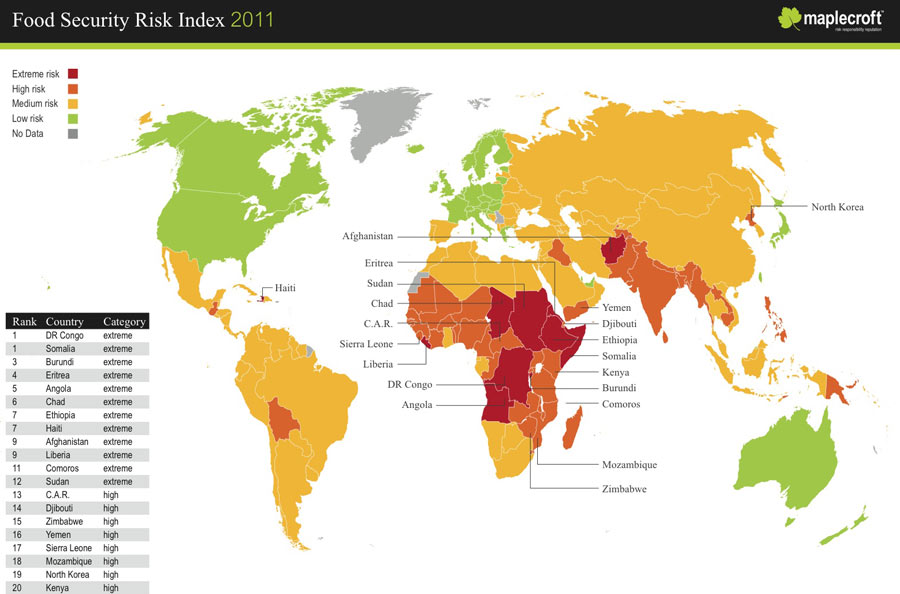
Food Security : A 2011 map of Maplecroft food security risk index View larger picture
Sub-saharan Africa dominates a new food security risk map, while the Indian sub-continent and Iberian peninsula also stand out Map: Maplecroft
A new map of food security risk around the world is, in some ways, depressingly familiar. Sub-saharan Africa leaps out as the place where the most people fear for their next meal, while the rich world has more to fear from obesity. But there's plenty of salutary reminders and fascinating detail, like India's food problems and the vulnerability of Spain.
And it demonstrates the sickening, symbiotic relationship between lack of food and conflict: where one leads, the other follows.
We must start with the worst, in the horn of Africa. In Somalia, Ethiopia and Eritrea, human failings mean a severe drought has tipped millions into famine. It's a textbook case of why things go wrong. War begets poverty, leaving food unaffordable. Devastated infrastructure destroys both food production and the ability to truck in emergency food. The collapse of society means the effects of extreme weather such as drought cannot be dealt with. And the fear of violence turns people into refugees, leaving their livelihoods and social networks behind.
Famine in Horn of Africa : Food distribution centre at Badbaado settlement camp, Mogadishu, Somalia Refugees wait for food aid in Somalia's capital Mogadishu on August 18, 2011. Photograph: Ismail Taxta/Reuters
The recent spike in food prices, linked by some to the uprisings across north Africa and the Middle East, had also hit hard in Somalia. Maize prices in Mogadishu were 100% higher in June 2011 than in June 2010, and the price of sorghum in Somalia rose by 180% compared with 2010 prices.
Sharing Somalia's unhappy ranking as having the greatest risk of food crisis is the Democratic Republic of Congo, where all the factors above apply, plus the impact of as much as half its rich arable land being land grabbed by foreigners. The situation in DRC is simply scary: it is on track to be one of the most populous nations on Earth in coming years.
Turning to India, the new map, produced by risk analysts Maplecroft, reminds us that behind the booming economy of that vast nation, hundreds of millions of poor people remain hungry. Almost half of India's children are malnourished and one in four of the world's hungry poor live there.
"Despite the enormous economic growth India has and is experiencing, it still has very stark income inequality, which is reflected in the malnourishment and infant mortality data," says Helen Hodge, head of maps and indices at Maplecroft. The Maplecroft index, reviewed last year by the World Food Programme, uses 12 types of data to derive a measure of food risk that is based on the UN FAO's concept. That covers the availability, access and stability of food supplies, as well as the nutritional and health status of populations.
Spain and Portugal stand out as very rare examples of rich nations with a medium risk of food security problems. Hodge explains, that while water problems are an issue there, the major reason is heavy reliance on grain imports. Spain buys in 11bn kilograms of grain more than it exports every year at a cost of $2.6bn, while Portugal pays $890m for 3.3bn kilograms.
"Spain and Portugal have made the decision that olive oil and wine exports are more profitable than grain," she says, along with salad crops. So they sell lettuce and Rioja and buy wheat and corn with the profits.
That calculation may change if global food prices continue on their current upwards trend. In other parts of the world, soaring food costs may well ignite further conflict. "It is striking is how much food security plays into the wider picture of unrest," says Hodge.
Source:   http://www.guardian.co.uk/environment/damian-carrington-blog/2011/aug/31/food-security-prices-conflict

DAIRIES TOO BIG TO FAIL? THEY MAY BE CRYING OVER SPILT MILK

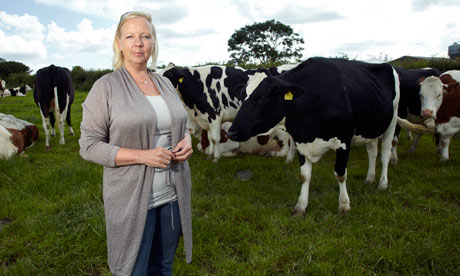
Deborah Meaden on mega-dairy factory farm

Mega-dairy factory farms are economically unsustainable

There is no denying our dairy industry is in desperate need of economic turnaround, but we must support small-scale farms
  • guardian.co.uk,
  • Article history
  • Mega-dairy factory farms are too high risk and not a sound long-term option. Photograph: WSPA
    There is a sector of Britain's business that is in serious crisis. Companies are going bankrupt or simply shutting down as they find themselves unable to profit.The sector in question trades on a basic staple: a raw product that isn't in short supply. If we don't act now to preserve it, then this relatively quiet crisis will be over before most of us realise it is happening.
    One day we will look out of the window and ask what happened to our countryside, where our cows went and why we only have a few hundred massive factory dairies instead of thousands of dairy farms, shaping our landscape and rural life.
    Ten years ago there were around 30,000 dairy farms in the UK.
    Now, every day across Britain one of our 11,000 remaining dairy farmers is turning their back on dairy farming and selling off their herds. There is no denying that our dairy industry is in desperate need of an economic turnaround.
    The farming industry is looking to the mega-dairies of the US and likes what it sees.
    The grass may well seem greener, but look into the actual economics behind the large-scale, intensive, indoor system and the picture is far from rosy.
    Farmers are too often told to expand their herd size and with it change the way they farm, under the belief that a greater economy of scale will solve all the problems.
    But as we learned the hard way with the global banking crisis, the notion of "too big to fail" is a myth.
    The basic requirement of a good business model is insulation from as much unnecessary risk as possible, while still making a profit. If you have a choice of high-risk for an average position in the marketplace, would you pick that over low risk for long-term gain?
    Perhaps yes if you were opening a pop-up shop, or capitalising on a commodity that will only be around for a short period of time.
    But when you apply those options to the British dairy industry, the high-risk option surely loses its appeal. In the dairy economics report published on Friday by the World Society for the Protection of Animals (WSPA), the mega-dairy is found to be a high-risk option, and I agree with them.
    The potential for financial ruin is enormous when a good farmer (who may not be a good businessman) switches production methods to that of a massive US-style dairy farm.
    When things go wrong it affects not just the business but the animals , and too much can go wrong with a mega-dairy for me to be comfortable with it as the future of UK dairy farming. Yes, farming is ultimately a business, but it is an emotive one that doesn't pay enough for those in the industry to be in it solely for the money, so we know they care about their animals.
    We must lose the idea that mega-dairies mean more milk and therefore more profit. Consider instead the profit lines from animals that live longer, with fewer health issues.
    Consider that this means avoiding early culling, so maintaining longer-term profit margins becomes a sustainable reality and, above all, a more palatable approach to dairy farming.
    Because what are we faced with instead if we go down the mega-dairy route?
    Two years ago I invested in a woollen mill in Somerset. The textiles industry was suffering as many people had shifted production to China, but I believed in their specialist knowledge. Now, demand has shifted back to products which need those dedicated skills to produce them, but sadly most of those skills were lost when the production was exported.
    This is worth remembering as our dairy farmers and herdsman face being replaced with cheap labour and machinery.
    Britain – like many countries – has tried liberal economics and deregulation of the markets. It allows for an incredible financial boom, but the following bust in the 1980s and 1990s and our current situation has become more devastating each time, with today's levels of unemployment at a record high.
    Perhaps it is time for a more socially responsible approach?
    Economists say that the most robust marketplace is one of many small-scale buyers and sellers, none of which can individually influence price. Reducing the number of dairy farms can only take us farther from the robust marketplace.
    I suggest that our dairy industry deserves the chance to try something truly economically sustainable rather than going through a financial groundhog day and wondering where all the dairy farms went, 10 years from now. Let's change this quiet crisis into a loud revolution.
    We all have a part to play in this – if we don't support our small-scale dairy farmers now, tomorrow will be too late.
    • Deborah Meaden is an entrepreneur and an investor on the BBC programme Dragons' Den
    Source: http://www.guardian.co.uk/environment/2011/sep/09/mega-dairy-farms-unsustainable

E.U. FORCES LABELING OF GMO CONTAMINATED HONEY!

Honey bees sit on a honeycomb at Bad Segeberg, northern Germany

EU bans GM-contaminated honey from general sale

Bavarian beekeepers forced to declare their honey as genetically modified because of contamination from nearby Monsanto crops
  • guardian.co.uk,
  • Honey bees on a honeycomb in Germany. A European court has ruled that honey which contains traces of pollen from genetically modified crops needs special authorisation before it can be sold. Photograph: Heribert Proepper/AP
    The European Union's highest court on Tuesday ruled that honey which contains trace amounts of pollen from genetically modified (GM) corn must be labelled as GM produce and undergo full safety authorisation before it can be sold as food. In what green groups are calling a "groundbreaking" ruling, the decision could force the EU to strengthen its already near-zero tolerance policy on genetically modified organisms (GMOs). Bavarian beekeepers, some 500m from a test field for a modified maize crop developed by Monsanto - one of only two GM crops authorised as safe to be cultivated in Europe - claimed their honey had been "contaminated" by pollen from the plant. The European court of justice found in their favour, a ruling that should offer grounds for the beekeepers to claim compensation in a German court. But the court's finding also potentially threatens recent EU legislation, introduced in July this year, that permits traces of GMOs in animal feed without a safety review. Mute Schimpf, food campaigner for Friends of the Earth Europe, said that the ruling "would confirm that existing laws allowing traces of unauthorised GM contamination are insufficient and would need revising." French Green MEP José Bové, an ex-farmer well-known for his destruction of a McDonald's franchise in the south of France and the uprooting of GM crops in Brazil, said that the only protection farmers can have is for a complete ban on GMOs in Europe. "Beekeepers are powerless to prevent the contamination of their honey by GM pollen, as farmers are for their crops, and thus powerless to prevent the tainting of the foodstuffs they produce and the integrity of their product. "The only sure way to prevent this is by precluding the cultivation of GMOs." Greenpeace, describing the traces of pollen in the honey as "genetic pollution" said that Monsanto and the Bavarian state should be held liable for the beekeepers' losses as a result of their product having to be labelled as containing GMOs. However, agricultural specialists criticised the ruling, saying that the decision has no grounding in science. Guy Poppy, the director of the centre for biological sciences at the University of Southampton, told the Guardian: "There is no safety issue. This honey is as safe as any other." The corn in question is genetically engineered to produce an insecticide that naturally occurs in the soil bacterium Bacillus thuringiensis (BT). The production of this toxin protects the maize plants from European corn borer larvae. "The Monsanto maize is genetically modified to produce the BT protein. But this same protein actually has been regularly used for years as a spray even by organic farmers," he added. "The consequences of these sorts of ruling is that new methods of plant breeding, whether GM or other forms that are developed, could be thrown out of potential use, making it impossible to innovate." Vivian Moses, professor of biotechnology at the University of London and the chairwoman of Cropgen, an advisory group on GM foods, said: "These beekeepers believe that there is a sensitivity among consumers of the presence of GM material, that the honey containing GM loses quality. They are just protecting their economic interest. "But scientifically this doesn't add up to anything, as the crop has been judged as safe for human consumption." In response to the ruling, the European commission will in two weeks discuss the issue of GMOs and honey with EU member states. According to Brussels, it is likely that the decision will have an impact on the honey into the EU as Europe does not itself produce sufficient quantities for the size of the market. The bloc produces 200,000 tonnes per year and must import an additional 140,000 tonnes. Argentina and China, both GM-friendly countries and the two biggest importers of honey into the EU, are likely to be affected in particular, the commission warned. "The honey is not dangerous. There is no health risk from honey in the EU," insisted EU consumer protection spokesman, Frédéric Vincent, worried that shoppers might stop buying honey as a result of the news. "It's an important ruling from the court. I can't say at this point whether we need to change any laws," he added. "The contamination is done by the bees themselves. We can't put GPS tracking on the bees." Source: http://www.guardian.co.uk/environment/2011/sep/07/europe-honey-gm

Friday, September 9, 2011

MONSANTO BUYS INTO ALOHA LAND EDUCATION SYSTEMS


MEDIA RELEASE   Posted on 4:54 pm, Wednesday, September 7, 201
The College of Tropical Agriculture and Human Resources (CTAHR), at the University of Hawaii at Manoa has received $500,000 from Monsanto Company to establish the Monsanto Research Fellows Fund.
The fund will assist graduate students pursuing a Masters or Ph.D. degree and post doctoral researchers at the College related to the study of plant science and protection.
“We are very grateful to Monsanto Company for its generous financial support of CTAHR students engaged in agricultural research – Hawaii’s future leaders of sustainable industries and a strong, diversified economy,” said UH Manoa Chancellor Virginia S. Hinshaw.
The goal of the new fund is to enable eligible students to enhance their educational and professional development through fellowship programs, including financial support for student research and participation in national professional conferences.
“We are deeply appreciative of Monsanto’s investment in our college and students,” said Dr. Sylvia Yuen, CTAHR’s interim dean. “Because of workforce shortages, there is a critical need to educate the next generation of researchers preparing to tackle the difficult problem of producing more food on less land in a sustainable way, using less water and energy, to feed a growing population. This gift will allow CTAHR to attract the best and brightest young people to engage in this important work.”
This gift is part of the Monsanto Fellows in Plant Breeding Program, designed to prepare students for successful careers in plant breeding and encourage the development of future leaders in the agricultural industry.
Monsanto additionally supports higher education in Hawaii through internships, scholarships, facility tours and contributions toward various educational programs.
“Many leaders and agricultural experts – including Governor Abercrombie, Chair Kokubun of the Hawaii Department of Agriculture, and the Hawaii Farm Bureau – have expressed how vital it is for Hawaii’s agricultural industry to be strong and vibrant, not just today, but tomorrow and beyond as well,” said Fred Perlak, Ph.D., vice president of research and business operations for Monsanto in Hawaii. “This gift to CTAHR is an effort to do our part toward contributing to this greater goal.”
The College of Tropical Agriculture and Human Resources (CTAHR) is committed to the preparation of students and all citizens of Hawaii for life in the global community through research and educational programs supporting tropical agricultural systems that foster viable communities, a diversified economy, and a healthy environment. CTAHR actively helps Hawaii diversify its economy, ensure a sustainable environment, and strengthen its communities, and serves as the premier resource for tropical agricultural systems and natural resource management in the Asia-Pacific region.
The University of Hawaii at Manoa serves approximately 20,000 students pursuing more than 225 different degrees. Coming from every Hawaiian island, every state in the nation, and more than 100 countries, UH Manoa students matriculate in an enriching environment for the global exchange of ideas.
The University of Hawaii Foundation, a nonprofit organization, raises private funds to support the University of Hawaii System. Our mission is to unite our donors’ passions with the University of Hawaii’s aspirations to benefit the people of Hawaii and beyond. We do this by raising private philanthropic support, managing private investments and nurturing donor and alumni relationships.
Monsanto Company is a leading global provider of technology-based solutions and agricultural products that improve farm productivity and food quality. Monsanto remains focused on enabling both small-holder and large-scale farmers to produce more from their land while conserving more of our world’s natural resources such as water and energy. 
Source:  http://www.hawaii247.com/2011/09/07/monsanto-funds-education-research-at-uh/