Monday, August 16, 2010

Mmmmm, Mmmmm, what???


Artificial meat? Food for thought by 2050
Leading scientists say meat grown in vats may be necessary to feed 9 billion people expected to be alive by middle of century

John Vidal, environment editor
* The Guardian, Monday 16 August 2010
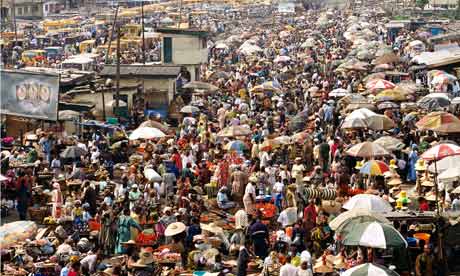
Food and overpopulation : Crowded Oshodi Market in Nigeria A sea of shoppers and vendors in Lagos, Nigeria. With the world population forecast to hit 9 billion people by 2050 novel ways to increase food production will be needed, say scientists. Photograph: James Marshall/Corbis

Artificial meat grown in vats may be needed if the 9 billion people expected to be alive in 2050 are to be adequately fed without destroying the earth, some of the world's leading scientists report today.

But a major academic assessment of future global food supplies, led by John Beddington, the UK government chief scientist, suggests that even with new technologies such as genetic modification and nanotechnology, hundreds of millions of people may still go hungry owing to a combination of climate change, water shortages and increasing food consumption.

In a set of 21 papers published by the Royal Society, the scientists from many disciplines and countries say that little more land is available for food production, but add that the challenge of increasing global food supplies by as much as 70% in the next 40 years is not insurmountable.

Although more than one in seven people do not have enough protein and energy in their diet today, many of the papers are optimistic.

A team of scientists at Rothamsted, the UK's largest agricultural research centre, suggests that extra carbon dioxide in the air from global warming, along with better fertilisers and chemicals to protect arable crops, could hugely increase yields and reduce water consumption.

"Plant breeders will probably be able to increase yields considerably in the CO2 enriched environments of the future … There is a large gap between achievable yields and those delivered ... but if this is closed then there is good prospect that crop production will increase by about 50% or more by 2050 without extra land", says the paper by Dr Keith Jaggard et al.

Several studies suggest farmers will be up against environmental limits by 2050, as industry and consumers compete for water. One group of US scientists suggests that feeding the 3 billion extra people could require twice as much water by then. This, says Professor Kenneth Strzepek of the University of Colorado, could mean an 18% reduction in worldwide water availability for food growing by 2050.

"The combined effect of these increasing demands can be dramatic in key hotspots [like] northern Africa, India, China and parts of Europe and the western US," he says.

Many low-tech ways are considered to effectively increase yields, such as reducing the 30-40% food waste that occurs both in rich and poor countries. If developing countries had better storage facilities and supermarkets and consumers in rich countries bought only what they needed, there would be far more food available.

But novel ways to increase food production will also be needed, say the scientists. Conventional animal breeding should be able to meet much of the anticipated doubling of demand for dairy and meat products in Asia and sub-Saharan Africa, but this may not be enough.

Instead, says Dr Philip Thornton, a scientist with the International Livestock Research Institute in Nairobi, two "wild cards" could transform global meat and milk production. "One is artificial meat, which is made in a giant vat, and the other is nanotechnology, which is expected to become more important as a vehicle for delivering medication to livestock."

Others identify unexpected hindrances to producing more food. One of the gloomiest assessments comes from a team of British and South African economists who say that a vast effort must be made in agricultural research to create a new green revolution, but that seven multinational corporations, led by Monsanto, now dominate the global technology field.

"These companies are accumulating intellectual property to an extent that the public and international institutions are disadvantaged. This represents a threat to the global commons in agricultural technology on which the green revolution has depended," says the paper by Professor Jenifer Piesse at King's College, London.

"It is probably not possible to generate sufficient food output or incomes in much of sub-Saharan Africa to feed the population at all adequately … For least developed countries there are prospects of productivity growth but those with very little capacity will be disadvantaged."

Other papers suggest a radical rethink of global food production is needed to reduce its dependence on oil. Up to 70% of the energy needed to grow and supply food at present is fossil-fuel based which in turn contributes to climate change.

"The need for action is urgent given the time required for investment in research to deliver new technologies to those that need them and for political and social change to take place," says the paper by Beddington.

"Major advances can be achieved with the concerted application of current technologies and the importance of investing in research sooner rather than later to enable the food system to cope with challenges in the coming decades," says the paper led by the population biologist Charles Godfray of Oxford University.

The 21 papers published today in a special open access edition of the philosophical transactions of the royalsociety.org are part of a UK government Foresight study on the future of the global food industry. The final report will be published later this year in advance of the UN climate talks in Cancun, Mexico.
http://www.guardian.co.uk/environment/2010/aug/16/artificial-meat-food-royal-society

Sunday, August 15, 2010

NO TO SENATE BILL S510!!

Senate Bill S510 Makes it illegal to Grow, Share, Trade or Sell Homegrown Food
Written on August 13, 2010 at 7:29 pm by Andrew McCleese
S 510, the Food Safety Modernization Act of 2010, may be the most dangerous bill in the history of the US. It is to our food what the bailout was to our economy, only we can live without money.

“If accepted [S 510] would preclude the public’s right to grow, own, trade, transport, share, feed and eat each and every food that nature makes. It will become the most offensive authority against the cultivation, trade and consumption of food and agricultural products of one’s choice. It will be unconstitutional and contrary to natural law or, if you like, the will of God.” ~Dr. Shiv Chopra, Canada Health whistleblower

It is similar to what India faced with imposition of the salt tax during British rule, only S 510 extends control over all food in the US, violating the fundamental human right to food.

Monsanto says it has no interest in the bill and would not benefit from it, but Monsanto’s Michael Taylor who gave us rBGH and unregulated genetically modified (GM) organisms, appears to have designed it and is waiting as an appointed Food Czar to the FDA (a position unapproved by Congress) to administer the agency it would create — without judicial review — if it passes. S 510 would give Monsanto unlimited power over all US seed, food supplements, food and farming.

History

In the 1990s, Bill Clinton introduced HACCP (Hazardous Analysis Critical Control Points) purportedly to deal with contamination in the meat industry. Clinton’s HACCP delighted the offending corporate (World Trade Organization “WTO”) meat packers since it allowed them to inspect themselves, eliminated thousands of local food processors (with no history of contamination), and centralized meat into their control. Monsanto promoted HACCP.

In 2008, Hillary Clinton, urged a powerful centralized food safety agency as part of her campaign for president. Her advisor was Mark Penn, CEO of Burson Marsteller*, a giant PR firm representing Monsanto. Clinton lost, but Clinton friends such as Rosa DeLauro, whose husband’s firm lists Monsanto as a progressive client and globalization as an area of expertise, introduced early versions of S 510.

S 510 fails on moral, social, economic, political, constitutional, and human survival grounds.

1. It puts all US food and all US farms under Homeland Security and the Department of Defense, in the event of contamination or an ill-defined emergency. It resembles the Kissinger Plan.

2. It would end US sovereignty over its own food supply by insisting on compliance with the WTO, thus threatening national security. It would end the Uruguay Round Agreement Act of 1994, which put US sovereignty and US law under perfect protection. Instead, S 510 says:

COMPLIANCE WITH INTERNATIONAL AGREEMENTS.

Nothing in this Act (or an amendment made by this Act) shall be construed in a manner inconsistent with the agreement establishing the World Trade Organization or any other treaty or international agreement to which the United States is a party.

3. It would allow the government, under Maritime Law, to define the introduction of any food into commerce (even direct sales between individuals) as smuggling into “the United States.” Since under that law, the US is a corporate entity and not a location, “entry of food into the US” covers food produced anywhere within the land mass of this country and “entering into” it by virtue of being produced.

4. It imposes Codex Alimentarius on the US, a global system of control over food. It allows the United Nations (UN), World Health Organization (WHO), UN Food and Agriculture Organization (FAO), and the WTO to take control of every food on earth and remove access to natural food supplements. Its bizarre history and its expected impact in limiting access to adequate nutrition (while mandating GM food, GM animals, pesticides, hormones, irradiation of food, etc.) threatens all safe and organic food and health itself, since the world knows now it needs vitamins to survive, not just to treat illnesses.

5. It would remove the right to clean, store and thus own seed in the US, putting control of seeds in the hands of Monsanto and other multinationals, threatening US security. See Seeds – How to criminalize them, for more details.

6. It includes NAIS, an animal traceability program that threatens all small farmers and ranchers raising animals. The UN is participating through the WHO, FAO, WTO, and World Organisation for Animal Health (OIE) in allowing mass slaughter of even heritage breeds of animals and without proof of disease. Biodiversity in farm animals is being wiped out to substitute genetically engineered animals on which corporations hold patents. Animal diseases can be falsely declared. S 510 includes the Centers for Disease Control (CDC), despite its corrupt involvement in the H1N1 scandal, which is now said to have been concocted by the corporations.

7. It extends a failed and destructive HACCP to all food, thus threatening to do to all local food production and farming what HACCP did to meat production – put it in corporate hands and worsen food safety.

8. It deconstructs what is left of the American economy. It takes agriculture and food, which are the cornerstone of all economies, out of the hands of the citizenry, and puts them under the total control of multinational corporations influencing the UN, WHO, FAO and WTO, with HHS, and CDC, acting as agents, with Homeland Security as the enforcer. The chance to rebuild the economy based on farming, ranching, gardens, food production, natural health, and all the jobs, tools and connected occupations would be eliminated.

9. It would allow the government to mandate antibiotics, hormones, slaughterhouse waste, pesticides and GMOs. This would industrialize every farm in the US, eliminate local organic farming, greatly increase global warming from increased use of oil-based products and long-distance delivery of foods, and make food even more unsafe. The five items listed — the Five Pillars of Food Safety — are precisely the items in the food supply which are the primary source of its danger.

10. It uses food crimes as the entry into police state power and control. The bill postpones defining all the regulations to be imposed; postpones defining crimes to be punished, postpones defining penalties to be applied. It removes fundamental constitutional protections from all citizens in the country, making them subject to a corporate tribunal with unlimited power and penalties, and without judicial review. It is (similar to C-6 in Canada) the end of Rule of Law in the US.

http://www.thelibertyvoice.com/senate-bill-s510-makes-it-illegal-to-grow-share-trade-or-sell-homegrown-food

U.S. District Judge Jeffrey S. White says NO TO GMO SUGAR BEET SEEDS!!!!!!


Judge Revokes USDA Approval Of Monsanto's Genetically Modified Sugar Beets, Orders Review
MICHAEL LIEDTKE | 08/14/10 10:41 PM

SAN FRANCISCO — A federal judge has revoked the government's approval of genetically altered sugar beets until regulators complete a more thorough review of how the scientifically engineered crops affect other food.

The ruling by U.S. District Judge Jeffrey S. White Friday means sugar beet growers won't be able to use the modified seeds after harvesting the biotechnology beets already planted on more than 1 million acres spanning 10 states from Michigan to Oregon. All the seed comes from Oregon's Willamette Valley.

Additional planting won't be allowed until the U.S. Department of Agriculture submits an environmental impact statement. That sort of extensive examination can take two or three years.

White declined a request to issue an injunction that would have imposed a permanent ban on the biotech beets, which Monsanto Co. developed to resist its popular weed killer, Roundup. Farmers have embraced the technology as a way to lower their costs on labor, fuel and equipment.

The Center for Food Safety, Organic Seed Alliance and Sierra Club have been trying to uproot the biotech beets since filing a 2008 lawsuit.

Andrew Kimbrell, the Center for Food Safety's executive director, hailed Friday's decision as a major victory in the fight against genetically engineered crops and chided the Agriculture Department for approving the genetically engineered seeds without a full environmental review.

"Hopefully, the agency will learn that their mandate is to protect farmers, consumers and the environment and not the bottom line of corporations such as Monsanto," Kimbrell said in a statement.

Attempts to reach the Agriculture Department for comment Saturday were unsuccessful. Monsanto, based in St. Louis, referred requests for comment to the America Sugarbeet Growers Association, which pointed to a Saturday statement from the Sugar Industry Biotech Council.

In the statement, the sugar beet council said it intends to help the Agriculture Department come up with "interim measures" that would allow continued production of the genetically altered seeds while regulators conduct their environmental review.

If a temporary solution isn't found, the planting restrictions are likely to cause major headaches for sugar beet growers and food processors.

The genetically altered sugar beets provide about one-half of the U.S. sugar supply and some farmers have warned there aren't enough conventional seeds and herbicide to fill the void. The scientific seeds account for about 95 percent of the current sugar beet crop in the U.S.

"The value of sugar beet crops is critically important to rural communities and their economies," the Sugar Industry Biotech Council said Saturday.

White expressed little sympathy for any disruption his decision might cause. He noted in his 10-page ruling that regulators had time to prepare for the disruption because he had already overturned the deregulation of the genetically altered beets in a decision issued last September.

The Agriculture Department "has already had more than sufficient time to take interim measures, but failed to act expediently," White wrote.

Organic farmers, food safety advocates and conservation groups contend genetically altered crops such as the sugar beets could share their genes with conventionally grown food, such as chard and table beets.

Those arguments helped persuade another federal judge in San Francisco to stop the planting of genetically altered alfalfa seeds in 2007 pending a full environmental review that still hasn't been completed.

Monsanto took that case all the way to the U.S. Supreme Court, which in June overturned an injunction against the company's sale of the modified seeds.

Sunday, August 8, 2010

TO BE OR NOT TO BE: PATENTS ON PLANTS, SEEDS, ANIMALS???


Published on Friday, August 6, 2010 by Inter Press Service
When Agrochemical Corporations Invented Nature

by Julio Godoy

BERLIN - A civil society protest against a British agrochemical company that claims it has invented a particular sort of broccoli has again focused attention on the question who owns natural biodiversity, especially vegetables, seeds, and many forms of meat and animal food products.

[A sign reading "patent" is placed on a basket of peppers during a protest staged by Greenpeace in front of the patent office in Munich, Germany. The European Patent Office recently began reviewing patents given to two methods of growing broccoli and tomatoes. Two firms filed motions against the patents, awarded in 2000 and 2002 respectively, claiming that they constituted what the plaintiffs said were natural or "essentially biological" processes.]A sign reading "patent" is placed on a basket of peppers during a protest staged by Greenpeace in front of the patent office in Munich, Germany. The European Patent Office recently began reviewing patents given to two methods of growing broccoli and tomatoes. Two firms filed motions against the patents, awarded in 2000 and 2002 respectively, claiming that they constituted what the plaintiffs said were natural or "essentially biological" processes.
Delegates from some 300 environmental and consumer organizations from all over the world gathered last month in Bavarian capital Munich, some 500 kilometers south of Berlin last month to demonstrate outside the headquarters of the European Patent Office (EPO) against the patent the agency accorded on broccoli seeds, plants and breeding methods to the British agrochemical company Plant Bioscience.

EPO granted the patent in 2002, on a method claimed by Plant Bioscience for increasing a specific compound in broccoli through conventional breeding methods. The patent, which also faces opposition by two other agrochemical multinationals, includes the breeding methods, and the broccoli seeds and edible broccoli plants obtained through these procedures.

The demonstration in Munich took place as the EPO opened its litigation procedure on the legitimacy of its own patent agreement. A decision on the issue is expected in October.

Plant Bioscience claims that its breeding methods increase the anti- carcinogenic glucosinolates in the species. This is one of hundreds of similar claims presented by numerous agrochemical multinational companies, such as Monsanto and Syngenta.

For environmental and consumer activists and independent farmers, such patents amount to an attempt to expropriate natural biodiversity for the benefit of a handful of corporations, which would rule as a cartel upon agriculture, especially in developing countries.

Christoph Then, expert on intellectual property rights for the environmental organization Greenpeace, told IPS that what a handful of biochemical multinational companies are doing is to "misappropriate biodiversity."

Then is co-author of a study on the 'The Future of Seeds and Food', in which he warns of the "monsantosizing of biodiversity." Earlier this year he led a successful European campaign against a patent filed by Monsanto, in which the company claimed it had invented a particular sort of ham.

Last April, EPO revoked this patent given to Monsanto in 2005. Then told IPS that the "revocation of the patent is a major success for consumers and farmers in Europe. The EPO's decision shows that even the most powerful transnational companies must give in to public pressure."

According to Greenpeace and other environmental organizations researching patent claims by agrochemical corporations, the EPO has to decide on more than 1,000 other property rights filed on vegetables, seeds and animal products presented by the firms Monsanto, Syngenta, DuPont-Pioneer, Bayer Cropscience, BASF and Dow Agrosciences, and others.

The broccoli case is typical of this battle among multinationals over conventional breeding methods. The agrochemical companies Limagrain and Syngenta, which have filed opposition against the Plant Bioscience patent, argue that the patent has to be revoked as its claims refer to an essentially biological process, and so to conventional methods.

According to the European Patent Convention, essentially biological processes are not patentable.

Despite this, most patents filed today by agrochemical multinationals concern conventional breeding methods. In a study for the Gen-Ethical Foundation, German biologist Ruth Tippe showed that the number of patents filed by agrochemical multinationals on conventional breeding methods has grown more than 20 percent since 2000.

"Nowadays, 30 percent of all patent applications on plant breeding filed by Monsanto involve conventional breeding methods," Tippe told IPS. "Before 2005, such patent applications did not reach five percent of the total."

"The patent on broccoli has become a test case for the patentability of conventional seeds and breeding methods," Franz Schaettle, director of the international campaign No Patent on Seeds, told IPS.

No Patent on Seeds represents hundreds of environmental, consumer, and farmer organizations across the world, to fight the "monsantosizing of biodiversity", and has formulated a global appeal against patents on conventional seeds and farm animals addressed to the Enlarged Board of Appeal of the European Patent Office, governments, and the executive boards of agro-business companies.

"The continuing patenting of seeds, conventional plant varieties and animal species leads to far reaching expropriations of farmers and breeders," Schaettle told IPS. "Farmers, especially in developing countries, are deprived of their rights to save their harvested seeds, and breeders are under strong limitations to use the patented seeds freely for further breeding."

Numerous examples of patent applications by agrochemicals confirm the warnings of Tippe, Schaettle, and Then. In Monsanto's patent application WO2008021413 on maize and soy, methods are claimed that are widely used in conventional breeding.

"On more than 1,000 pages and in 175 claims Monsanto apply for patents on various gene sequences and genetic variations, especially in soy and maize," Schaettle said. "Monsanto even goes as far as explicitly claiming all relevant maize and soy plants, inheriting those genetic elements. Furthermore, all uses in food, feed and biomass are listed."

By filing specific regional applications Monsanto shows especial interest in applying for this patent in Europe, Argentina and Canada.

By the same token, in patent application WO 2009011847, on meat and milk, Monsanto broadly claims methods for cattle breeding, the animals, as well as "milk, cheese, butter and meat." Other companies have also filed patents on genetic resources needed for feed and food production.

"All these patents are the backbone of a strategy for taking over global control on all levels of food production, "Schaettle said. "The patents do not stifle research and innovation; they are simply meant to block access to genetic resources and technology and to establish new dependencies for farmers, breeders and food producers."

This is particularly the case in developing countries, especially in Africa and Latin America. In such regions, in contrast to Europe, small farmers and consumer organizations do not have legal or financial resources to fight unfair patents. Under such circumstances, the likes of Monsanto can claim they have actually invented natural diversity.
© 2010 Inter Press Service
http://www.commondreams.org/headline/2010/08/06

Friday, August 6, 2010

VEGGIES TOUR U.S. COLLEGES TO DEBATE MEAT EATING


Published on Friday, August 6, 2010 by The Huffington Post
Resolved: Eating Animals Is Indefensible

by Bruce Friedrich

For the past few years, I've been spending a lot of time on college campuses, discussing the ethics of eating animals with college debate teams; I argue that vegetarianism is an ethical imperative for all members of the student body, and my adversaries (two members of the school's debate team) argue that it's not.

Last year, I visited Harvard, Yale, BYU, the Universities of Texas, Georgia, and Florida -- and dozens of other schools, coast to coast. This fall, I'm slated to visit Cornell, Princeton, Boston College, the University of Minnesota, and half a dozen additional schools.

The topic is a hot one on college campuses, and the teams that have accepted have been rewarded by what they have consistently told us to be their largest event audiences ever. You can watch many of the debates online, if you're so inclined, but here is the crux of my argument:

First, eating meat wastes and pollutes our land, water and air-- as I discuss more thoroughly here. Second, eating meat drives up the price of cereals, which leads to starvation and food riots -- as I discuss here. Finally, eating meat supports cruelty to animals so severe that it would warrant felony cruelty charges were dogs or cats so horribly abused -- and that's true even of so-called "humane" farms (video).

Cruelty to animals is where I focus in these debates, because it's the issue that is most obvious: We are a nation of animal lovers -- according to a Gallup Poll last May, fully 97 percent of us support laws to protect animals from abuse -- and yet the animals with whom we come into contact most frequently are the animals we pay other people to abuse and kill for us.

The arguments that seem to resonate with students most deeply are:

First, other animals are made of flesh, blood, and bone -- just like humans. They have the same five physiological senses (i.e., they see, hear, smell, taste, and touch) that we do. And they feel pain -- again, just like we do. At most colleges and universities, students are unanimously opposed to eating dogs or cats; the idea revolts them. Yet there is no ethical difference between eating a dog, cat, chicken, pig or fish. If anything, eating your dogs or cats would be morally preferable, since they would have led a good life until you killed them.

In fact, both pigs and chickens do better on cognition tests than dogs or cats. Chickens can navigate mazes, learn from television and have both a capacity for forethought and meta-cognition. Pigs dream, recognize their names, play video games far more effectively than even some primates, and lead social lives of a complexity previously observed exclusively among primates.

Dr. Richard Dawkins, the foremost living evolutionary biologist, calls other species our evolutionary "cousins" and denounces what he calls "speciesist arrogance" -- the idea that we are better than, and can do whatever we want to other species. Darwin taught us that other species are more like us than they're unlike us. Eating meat entails eating "someone," not "something." Eating meat entails eating bits from an animal's corpse. That's not hyperbole; it's reality. That's not sentimental; it's a fact. Don't want to eat corpses? Don't eat meat.

Second, if we're eating meat, we are paying people to abuse animals in myriad ways that would violate anti-cruelty laws if these were dogs or cats rather than chickens and pigs. Animals are deprived of everything that is natural and important to them; they never breathe fresh air, raise their young, develop normal relationships with other animals, explore their surroundings, or do anything else they would do in nature. Artificial breeding practices are used so that animals will grow far more quickly than they would naturally, and their organs and limbs simply can't keep up. For example, chickens' upper bodies grow seven times as quickly as they did just 30 years ago, so these factory-farmed animals who live for fewer than two months (they're still chirping like infants when they're sent to slaughter) suffer from lung collapse, heart failure, and crippling leg deformities.

Michael Specter, a longtime staff writer for the New Yorker , visited a chicken farm and wrote, "I was almost knocked to the ground by the overpowering smell of feces and ammonia. My eyes burned and so did my lungs, and I could neither see nor breathe... There must have been 30,000 chickens sitting silently on the floor in front of me. They didn't move, didn't cluck. They were almost like statues of chickens, living in nearly total darkness, and they would spend every minute of their six-week lives that way."

Similarly hideous conditions exist for all animals raised for food; rather than further detailing the horrid details, I will ask that you if you eat meat, you watch "Meet Your Meat," which is narrated by Alec Baldwin, and "Glass Walls," which is narrated by Sir Paul McCartney -- I generally show the opening two minutes of Meet Your Meat as a part of my 10 minute opening statement in college debates. Both videos offer a gruesome window into what we're supporting if we choose to eat chickens, pigs and other farmed animals. If we eat meat, we should at least ensure that we know what we're paying for.

If you would not personally slice a chicken's beak off, or castrate a pig without pain relief or slice open an animal's throat, why pay someone else to do it for you? Where is the basic integrity in entering into this mercenary relationship? Is the person who hires someone to do something less culpable than the one who carries out the action? Of course not. Eating meat involves paying people to do things for us that most of us would not do ourselves. Where's the basic integrity -- the consistency -- in such a relationship?

Or, put in a more affirmative way: Vegetarianism allows me to live my values -- to "pray ceaselessly," as St. Paul puts it: Every time I sit down to eat, I cast my lot: for mercy, against misery; for the oppressed, against the oppressor; and for compassion, against cruelty. There is a lot of suffering in the world, but how much suffering can be addressed with literally no time or effort on our part? We can just stop supporting it, by making different choices.

So what's the trade-off: Why do people eat meat? And are the reasons we eat meat -- the benefits -- worth the costs?

Well, we get a few moments of pleasure -- most of us like the taste. We have more options at the grocery store and at restaurants. We can eat over at a friend's house without having to bring a dish. We never have to explain our dietary choices...

Is that really it? That it's convenient? That it's easier?

Although I don't discuss this on university campuses, where everyone knows plenty of healthy vegans and thus knows they don't need meat to survive, I should take a moment to point out that meat is absolutely not good for us. The American Dietetic Association -- the largest body of nutrition professionals on the planet -- conducted a meta-analysis of all the studies that have ever been done on diet and disease, and found that vegetarians have lower rates of heart disease, diabetes, high blood pressure, cancer and obesity than meat-eaters (they believe that the studies indicate causality, not just correlation). Their position paper on vegetarian and vegan diets concludes that vegetarian and vegan diets are appropriate for all people and during all stages of life, including infancy and pregnancy.

So add it all up: Eating meat wastes and pollutes our natural resources -- requiring many times the water, land and energy of eating plants (a moral imperative on its own). Eating meat requires about 1 billion metric tons of grain, corn, and soy -- fed to the animals, who burn most of that energy off, which drives up the price of food for people who are starving (another moral imperative, on its own). And eating meat involves paying other people to do a wide variety of things to animals in ways that most of us would never do ourselves.

Put another way: If we believe that people should try to protect the environment, OR we believe that we should try not to cause people to starve OR we oppose cruelty to animals, the only ethical diet is a vegetarian one.

Find recipes, shopping tips, and a lot more information at www.GoVeg.com.
Copyright © 2010 HuffingtonPost.com, Inc.
Bruce Friedrich is vice-president of policy and government affairs for People for the Ethical Treatment of Animals (PETA), the world's largest animal rights organization.

IS TOTAL CONTROL OF GLOBAL FOOD LEGAL thru PATENTS of CROPS & ANIMALS ??

When Agrochemical Corporations Invented Nature

Friday 06 August 2010

by: Julio Godoy | Inter Press Service | Report

Berlin - A civil society protest against a British agrochemical company that claims it has invented a particular sort of broccoli has again focused attention on the question who owns natural biodiversity, especially vegetables, seeds, and many forms of meat and animal food products.

Delegates from some 300 environmental and consumer organisations from all over the world gathered last month in Bavarian capital Munich, some 500 kilometres south of Berlin last month to demonstrate outside the headquarters of the European Patent Office (EPO) against the patent the agency accorded on broccoli seeds, plants and breeding methods to the British agrochemical company Plant Bioscience.

EPO granted the patent in 2002, on a method claimed by Plant Bioscience for increasing a specific compound in broccoli through conventional breeding methods. The patent, which also faces opposition by two other agrochemical multinationals, includes the breeding methods, and the broccoli seeds and edible broccoli plants obtained through these procedures.

The demonstration in Munich took place as the EPO opened its litigation procedure on the legitimacy of its own patent agreement. A decision on the issue is expected in October.

Plant Bioscience claims that its breeding methods increase the anti- carcinogenic glucosinolates in the species. This is one of hundreds of similar claims presented by numerous agrochemical multinational companies, such as Monsanto and Syngenta.

For environmental and consumer activists and independent farmers, such patents amount to an attempt to expropriate natural biodiversity for the benefit of a handful of corporations, which would rule as a cartel upon agriculture, especially in developing countries.

Christoph Then, expert on intellectual property rights for the environmental organisation Greenpeace, told IPS that what a handful of biochemical multinational companies are doing is to "misappropriate biodiversity."

Then is co-author of a study on the 'The future of seeds and food', in which he warns of the "monsantosizing of biodiversity." Earlier this year he led a successful European campaign against a patent filed by Monsanto, in which the company claimed it had invented a particular sort of ham.

Last April, EPO revoked this patent given to Monsanto in 2005. Then told IPS that the "revocation of the patent is a major success for consumers and farmers in Europe. The EPO's decision shows that even the most powerful transnational companies must give in to public pressure."

According to Greenpeace and other environmental organisations researching patent claims by agrochemical corporations, the EPO has to decide on more than 1,000 other property rights filed on vegetables, seeds and animal products presented by the firms Monsanto, Syngenta, DuPont-Pioneer, Bayer Cropscience, BASF and Dow Agrosciences, and others.

The broccoli case is typical of this battle among multinationals over conventional breeding methods. The agrochemical companies Limagrain and Syngenta, which have filed opposition against the Plant Bioscience patent, argue that the patent has to be revoked as its claims refer to an essentially biological process, and so to conventional methods.

According to the European Patent Convention, essentially biological processes are not patentable.

Despite this, most patents filed today by agrochemical multinationals concern conventional breeding methods. In a study for the Gen-Ethical Foundation, German biologist Ruth Tippe showed that the number of patents filed by agrochemical multinationals on conventional breeding methods has grown more than 20 percent since 2000.

"Nowadays, 30 percent of all patent applications on plant breeding filed by Monsanto involve conventional breeding methods," Tippe told IPS. "Before 2005, such patent applications did not reach five percent of the total."

"The patent on broccoli has become a test case for the patentability of conventional seeds and breeding methods," Franz Schaettle, director of the international campaign No Patent on Seeds, told IPS.

No Patent on Seeds
represents hundreds of environmental, consumer, and farmer organisations across the world, to fight the "monsantosizing of biodiversity", and has formulated a global appeal against patents on conventional seeds and farm animals addressed to the Enlarged Board of Appeal of the European Patent Office, governments, and the executive boards of agro-business companies.

"The continuing patenting of seeds, conventional plant varieties and animal species leads to far reaching expropriations of farmers and breeders," Schaettle told IPS. "Farmers, especially in developing countries, are deprived of their rights to save their harvested seeds, and breeders are under strong limitations to use the patented seeds freely for further breeding."

Numerous examples of patent applications by agrochemicals confirm the warnings of Tippe, Schaettle, and Then. In Monsanto's patent application WO2008021413 on maize and soy, methods are claimed that are widely used in conventional breeding.

"On more than 1,000 pages and in 175 claims Monsanto apply for patents on various gene sequences and genetic variations, especially in soy and maize," Schaettle said. "Monsanto even goes as far as explicitly claiming all relevant maize and soy plants, inheriting those genetic elements. Furthermore, all uses in food, feed and biomass are listed."

By filing specific regional applications Monsanto shows especial interest in applying for this patent in Europe, Argentina and Canada.

By the same token, in patent application WO 2009011847, on meat and milk, Monsanto broadly claims methods for cattle breeding, the animals, as well as "milk, cheese, butter and meat." Other companies have also filed patents on genetic resources needed for feed and food production.

"All these patents are the backbone of a strategy for taking over global control on all levels of food production, "Schaettle said. "The patents do not stifle research and innovation; they are simply meant to block access to genetic resources and technology and to establish new dependencies for farmers, breeders and food producers."

This is particularly the case in developing countries, especially in Africa and Latin America. In such regions, in contrast to Europe, small farmers and consumer organisations do not have legal or financial resources to fight unfair patents. Under such circumstances, the likes of Monsanto can claim they have actually invented natural diversity.

Tuesday, August 3, 2010

A SLAM DUNK!


Are vertical farms the future of urban food?
A conceptual illustration of a vertical farm A conceptual illustration of a vertical farm. Photograph: www.odesign.com.au /Oliver Foster
With more mouths to feed and increasing demands on land, Duncan Graham-Rowe looks to see if high rise city blocks will be the source of tomorrow's supper

Duncan Graham-Rowe for Green Futures, part of the Guardian Environment Network
guardian.co.uk, Thursday 29 July 2010 10.20 BST

The vaults rose up as high as the city walls, bearing reeds richly bedded in bitumen and gypsum. The layered galleries peered each beyond its neighbour to reach the sunlight, and water drawn from the river was pumped through conduits up to the highest level. The topsoil was thick enough to root even the largest trees...

These were the renowned Hanging Gardens of Babylon, as described by the Greek historians Diodorus and Callisthenes, and the earliest example of vertical farming – at least according to Dan Caiger-Smith. His company, Valcent, is taking the concept into the 21st century, recently launching the first farm of its kind at Paignton Zoo in Devon.

It's a beguilingly simple idea: make maximum use of a small amount of space by filling glass houses with plant beds stacked high one above the other.

Financial and environmental pressures on modern agriculture have sparked new interest in vertical farming. With global population expected to exceed 9 billion by 2050, competition for land to grow both food and energy crops will become increasingly fierce. Four-fifths of us will live in dense urban areas, and increasing awareness of the carbon and water footprints of well-travelled food will have pushed locally grown produce even further up the list of desirables.

So it's easy to see the appeal of a system which, its proponents insist, can surpass the productivity of existing agricultural spaces by up to 20 times, while using less water, cutting mileage and energy costs, and delivering food security.

"It answers so many of the big questions of the future", says Caiger-Smith.

Valcent's system requires about the same amount of energy as having a home computer on for ten hours a day. That's enough to produce half a million lettuces a year – and, the company claims, seven times less than is required to grow the same crop on a traditional farm.

The 100 square metre farm at Paignton Zoo grows leaf vegetables for animal feed. It applies a technique called hydroponics, where plants are grown in nutrient rich solutions instead of soil. Stacked in trays eight layers high, the crops are continually rotated to ensure that all have adequate access to air and sunlight. The system also allows nutrients that have not been directly taken up by the plants to be collected and recirculated, along with the water, reducing usage and minimising waste.

This is just the beginning, says Caiger-Smith. His company now has more than 150 clients around the world queuing up to see how hydroponics could meet the needs of human food production, too.

How indeed. Inspiring concepts and artists' impressions abound, but with none actually up and running yet, how can vertical farms meet the impressive efficiency and production claims being made for them?

By cutting lots of corners. For a start, they remove the need for tractors and other fuel-dependent equipment. Distances to ship the produce from grower to retailer to consumer are also slashed. As Jeanette Longfield, Co-ordinator of the food and farming non-profit group, Sustain, puts it: "Intensive agriculture is currently entirely dependent on fossil fuels, from its use of nitrogen-based fertilisers to mechanical equipment, transport and refrigeration – and so urban agriculture really makes a lot of sense". In particular, Longfield sees "great potential for perishables that don't travel well".

Moreover, the traditional dependence of yield on the weather is taken out of the equation, offering greater security to the full supply chain.

Proven business models are still a way off. "It takes a stock market to build a high-rise," says Natalie Jeremijenko, an aerospace engineer and environmental health professor at New York University. She doubts that the income from vertically farmed crops would be sufficient to recoup the rent. But this hasn't stemmed her interest. Instead, she's come up with two designs to sidestep the problem: one is a small hydroponic rooftop pod with a curved shape to maximise exposure to the sunlight. The other is a vertical farm designed around a fire escape on an occupied high rise.

Sustain has also set out to demonstrate that urban land doesn't always come at a premium. The organisation has launched the programme Capital Growth, which aims to create 2,012 new food growing spaces in London before the city hosts the Olympics that year. The search encompasses "all kinds of nooks and crannies" – from school grounds and the banks of canals to roof terraces.

The other option is to simply do things on an industrial scale. Dickson Despommier at Columbia University, author of The Vertical Farm: The World Grows Up, believes there is scope to take vertical farming to an entirely new level, quite literally. He wants to create a new type of skyscraper to pierce the Big Apple's skyline – vast multi-storey buildings dedicated to vertical farming. According to Despommier, a single 30-storey building could provide enough food for 10,000 people.

And he's not alone in thinking big. Belgian architect Vincent Callebaut has drawn up plans for a huge tower, also in New York, on the city's Roosevelt Island (see 'Weak signals: how to track a changing horzion'). Callebaut's vision, dubbed the Dragonfly, is to create buildings with lush, fertile interiors that function as self-contained, sustainable eco-systems, producing food for their residents.

It's not just a flight of fancy. Will Allen in Milwaukee has already demonstrated the concept with a community food aquaculture system he calls Growing Power. This symbiotic cultivation system relies on aquatic life, such as tilapia fish and yellow perch, to redistribute nutrients. Waste products from the fish fertilise plants, while vegetable waste and worms from the gardens feed the fish. Both the vegetables and the fish are sold to local businesses at a marked up price, so that local residents can buy the produce directly from the farm at a subsidised price.

If vertical food does prove cheaper to produce and consume, then it's unlikely to face much opposition. In years to come, "locally grown" may mean just a few blocks from home.

• Duncan Graham-Rowe is a former staff writer for the New Scientist and a regular contributor to The Economist and The Guardian.

• Additional material by Anna Simpson, Deputy Editor, Green Futures.
http://www.guardian.co.uk/environment/2010/jul/29/vertical-farms-urban-food