Thursday, December 5, 2013

NATIONAL STRIKES ON McSLAVE WAGE CORPORATIONS TODAY

Fast Food Strikes Hit 100 Cities Thursday

Demonstrators hold signs and chant slogans outside of a Wendy's fast food restaurant, April 4, 2013, in New York. (AP Photo/Mary Altaffer)Fast-food workers in New York City are expected to walk off their jobs Thursday, one year after their first strike, joining a 100-city strike wave. Organizers say actions will take place all across the country as part of the movement for $15 an hour and the right to form a union without retaliation.
In New York City, there are more than 57,000 fast-food workers, and the median wage is $8.89/hour, the lowest of any occupation in the city.
With support from union groups such as the Service Employees International Union, the fast-food protests have dramatically grown over the course of the last year. The early protests in New York City in November grew to thousands of protesters waging actions in seven other cities during the summer. An August strike spread to more than fifty cities, including areas in the South that have historically been hostile to union actions.
This Thursday, there will be more new strike locations in Charleston, South Carolina; Providence, Rhode Island; and Pittsburgh, Pennsylvania.
Mary Coleman, known to her co-workers as Ms. Mary, works at a Popeye’s in Milwaukee for $7.25 an hour. Coleman, 59, lives with her daughter, who has a heart condition, and her two grandchildren. She also relies on food stamps to make ends meet and says she would gladly trade in her Qwest card for higher wages. Thursday marks Mary’s fourth strike. Previously, she walked off the job on May 15, August 1 and August 29.
“I’m tired of working for $7.25,” Coleman says. “I can’t take care of my household, I can’t even take care of myself.”
Little amenities many individuals take for granted, such as deodorant, are unaffordable for Coleman on fast-food low wages.
“Every day struggles are being able to keep food on the table, being able to get the necessities that’s needed for every day living…. And then if you need to go to the doctor, you can’t afford that either.”
Coleman says she is inspired by the organizing of low-wage workers in other states.
“I’m very excited about it, and it lets me know people can come together and do what’s right,” she says.
Some workers Coleman’s age might consider protesting a job for younger people, but she felt compelled to join the strikes, if only to show apathetic youth that change is possible.
“If we sit back and leave everything to the younger generation, we’ll never get anywhere,” she says. “At this point, it seems like a majority of the younger generation thinks that their voices don’t matter. I want to let them know that their voice does matter.”
Danielle, 23, is a fast food worker at Bojangles’ Famous Chicken ’n Biscuits in Charleston who will be going on strike
Danielle has worked at Bojangles for four years, started as a cashier and is now a manager making $11 an hour, and though she makes more than entry-level position workers, she still can’t survive on her wages. Over the past year, Danielle’s mother, father, and grandmother have all passed away, so she is now struggling to support herself.
She walks five miles every day to work, and because she’s on her own, says she has trouble paying her bills on time. Sometimes she receives her paycheck and sees it isn’t even enough to cover rent.
“I’m tired of living paycheck to paycheck. I can’t live like that,” says Danielle.
Like many fast-food workers, Danielle says she isn’t scheduled for enough hours, but works hard while she’s at the restaurant, and yet she isn’t fairly compensated for her labor. However, she too draws inspiration from the wave of strikes and walkouts occurring at major big-box stores and fast-food chains all across the country.
“It makes me feel good because people are opening their mouths and going on strike, and saying we want a raise. We’ve been busting out butts and we finally want a raise. I’m glad to be one of the people going on strike because this is ridiculous,” she says.
Danielle adds she doesn’t fear retaliation from her employers for going on strike.
“I know my rights as a manager. They can’t fire me for opening my mouth. I earned [my paycheck], I’m a hard worker.”
Brooklyn KFC worker Naquasia LeGrand, 22, will be going on strike for the fifth time this week. While she doesn’t have children, LeGrand does have an extended family that she helps support, and even though at $7.70/hour she earns slightly above New York’s minimum wage ($7.25), LeGrand says the fifteen-hours-per-week cap at KFC makes it impossible to earn a living wage.
“I have to pay for my Metro card, I have to pay $100 for my phone bill, I do try to put food in the house…. Sometimes I can’t even feed myself,” says LeGrand, who has been working at KFC for two years.
The lack of resources finally drove LeGrand to participate in her first strike: “I realized that we needed a change. I thought about the future. Are we going to be living off $7.25 in twenty years?” she asks.
LeGrand says she feels under-appreciated by an industry that makes lavish profits off the hard labor of workers like herself. To the naysayers and critics, who say fast-food jobs are low skill, and therefore deserve low pay, LeGrand says these businesses could not profit without workers.
“Why do you think these corporations are an over $200 billion a year business? Off our hard work. [The CEOs] aren’t working. They’re just collecting all the money.”
LeGrand has participated in the fast-food strikes since they began in November, and hers is a unique perspective, since she’s witnessed the movement grow and flourish, an evolution that mirrors her own transition from skeptic to passionate activist.
“In the beginning, I was afraid. I was skeptical. I didn’t know what was going on. I didn’t even know what a union was. People say, ‘You’re not gonna get $15 [per hour].’ But I would tell people to look at what’s going on. Look at where we started in New York City. On November 29, 2012, it was 127 workers who decided to walk out on their jobs to make a statement and say we want $15 [per hour] and a union. Now, [this week] 200 cities are about to have actions. This is spreading around the whole country.”

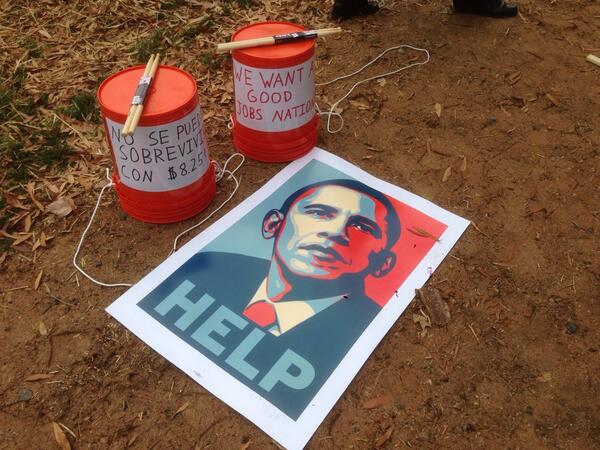
COULD YOU SURVIVE ON $7.25? McSUBSIDIES ON McSLAVE WAGES

'Low Pay Is Not OK': Fast Food Workers Rise Up with Nationwide Protests

Actions expected in over 100 cities demanding end to poverty wages

- Common Dreams staff
Fast food workers and their supporters protest outside a McDonald's before dawn in Chicago as a day of similar actions kicked off Thursday. "On strike. Shut it down! Chicago is a union town!" read the twitter message attached to this photo. (Credit: @fightfor15 / Twitpic)Worker strikes and public protests outside fast food restaurant chains are kicking off across the country on Thursday as low-wage employees in the industry are demanding a federal living wageof $15 an hour.

'Low Pay Is Not OK': Fast Food Workers Rise Up with Nationwide Protests

Actions expected in over 100 cities demanding end to poverty wages

- Common Dreams staff
Fast food workers and their supporters protest outside a McDonald's before dawn in Chicago as a day of similar actions kicked off Thursday. "On strike. Shut it down! Chicago is a union town!" read the twitter message attached to this photo. (Credit: @fightfor15 / Twitpic)Worker strikes and public protests outside fast food restaurant chains are kicking off across the country on Thursday as low-wage employees in the industry are demanding a federal living wageof $15 an hour.
Organizers for the day's events include the groups Low Pay Is Not OK, Fast Food Forward,Fight for 15:
. @RonaldMcGrinch bringing a McChristmas of low wages 2 Chicago but @fightfor15 workers fight back! pic.twitter.com/OYMyq75Osq
Organizers for the day's events include the groups Low Pay Is Not OK, Fast Food Forward,Fight for 15:
Those groups are being supported by various local, regional, and national workers rights groups and labor organizations who all agree that stagnant wages across all fifty states are keeping huge segments of the population trapped in poverty while the giant fast food corporations who make huge profits while dodging taxes and paying their executive exorbitant salaries can afford to pay more.
Organizers created this tool to help individuals locate protests that might be in their area and received support for their efforts from former U.S. Secretary of Labor and economist Robert Reich, who released this video to explain why workers are right to be making their demands for a $15 wage:
With actions expected in over 100 cities, the Twitter hashtag #FastFoodStrikes is being used to post updates and photos throughout the day:

DON'T DRINK THE WATER - 18 UNREGULATED CONTAMINANTS AROUND USA

New Report: Unregulated Contaminants Common in Drinking Water

Traces of 18 unregulated chemicals were found in drinking water from more than one-third of U.S. water utilities in a nationwide sampling, according to new, unpublished research by federal scientists. Included are 11 perfluorinated chemicals, an herbicide, two solvents, caffeine, an antibacterial compound, a metal and an antidepressant.

By Brian Bienkowski
Low concentrations of 18 unregulated contaminants were found in one-third of water tested from U.S. utilities. (Photo: Chris Austin/flickr)Traces of 18 unregulated chemicals were found in drinking water from more than one-third of U.S. water utilities in a nationwide sampling, according to new, unpublished research by federal scientists.
Included are 11 perfluorinated compounds, an herbicide, two solvents, caffeine, an antibacterial compound, a metal and an antidepressant.
Water contains traces of industrial chemicals and other unregulated contaminants. (Wisconsin Department of Natural Resources)Researchers from the U.S. Geological Survey and the Environmental Protection Agency analyzed single samples of untreated and treated water from 25 U.S. utilities that voluntarily participated in the project.
Twenty-one contaminants were detected – mostly in low concentrations of parts per trillion – in treated drinking water from at least nine of the utilities. Eighteen of the chemicals are not regulated under the federal Safe Drinking Water Act so utilities do not have to meet any limit or even monitor for them.
“The good news is the concentrations are generally pretty low,” said Dana Kolpin, a research hydrologist with the USGS who participated in the study.
“But,” he added, “there’s still the unknown. Are there long-term consequences of low-level exposure to these chemicals?”
For many of the contaminants, little is known about any potential human health effects of low doses. But one of the perfluorinated compounds, known as PFOA, has been linked to a variety of health problems, including cancer, among people in communities where water is contaminated by a chemical plant in West Virginia.
Of 251 chemicals, bacteria, viruses and microbes the scientists measured, 117 were not detected in any of the treated drinking water. Twenty-one were found in water from more than one-third of the 25 utilities (nine or more) and 113 were found in less than one-third (eight or fewer).
EPA research chemist Susan Glassmeyer, who led the project, said the utilities, which remain anonymous, represented a mix of large and small, and used different water treatment technologies.

Preliminary findings of the study, which is expected to be published next year, were presented by the scientists at a toxicology conference in Nashville last month.
While studies increasingly report newly emerging contaminants in wastewater, there has been little data on which ones are in drinking water.
Four of the chemicals found in the samples – the metal strontium, the herbicide metolachlor, PFOS and PFOA – are on the EPA’s list of chemicals under consideration for drinking water standards. The EPA plans to make decisions regarding at least five of the contaminants on its list next year.
“We’re hoping through this work the EPA will do a much more intensive contaminant candidate list and develop new methods and requirements for drinking water plants,” said Edward Furlong, a scientist with the USGS who participated in the study.

Perfluorinated chemicals, which were found most frequently, are widely used in a variety of industrial processes, including manufacture of some nonstick and stain-resistant food packaging, fabrics and cookware.
The two most common perfluorinated compounds, PFOS and PFOA, in the utilities’ water have been detected in the blood of nearly all people in the United States.
A panel of scientists has concluded that there is a “probable link” between PFOA in drinking water and high cholesterol, ulcerative colitis, thyroid disease, testicular cancer, kidney cancer and pregnancy-induced hypertension. The findings were based on people in Mid-Ohio Valley communities whose water was polluted with PFOA from a DuPont plant.
Some facilities, like this water recycling plant in Carson, Calif., use advanced treatment technologies. (EPA)PFOS, used in Scotchgard until 3M phased it out in 2002, has been linked to attention disorders in children and thyroid disease in men.
The EPA has classified metolachlor as a possible human carcinogen based onstudies of highly exposed rats. Strontium can affect bone growth, according to some animal studies that used doses much higher than those found in drinking water.
The perfluorinated compounds were at similar concentrations in the untreated and treated drinking water, suggesting that treatment techniques are largely unsuccessful. Only one plant was successful at removing them, and it used activated carbon treatment.
Activated carbon, ozone and UV treatments are generally better at removal than traditional chlorine treatment, but such techniques are often prohibitively expensive, Glassmeyer said.
“People resent having to pay anything for water,” she said. “There’s the thought that there’s a God-given right to have as much as we want but, if you want the cleanest water, these techniques take money.”
Treatment also can sometimes transform compounds into new ones, said Laurel Schaider, a research associate at the Harvard School of Public Health.
“Chlorination and other treatments technologies will remove some contaminants, but will react with others,” Schaider said. “Some compounds may appear to be removed but may be transformed to a chemical we know even less about.”
___________________

Tuesday, December 3, 2013

UNREPENTANT SERALINI.....


Seralini Refuses to Retract GM Maize Tumor Study

Posted on Nov 28 2013 - 6:01pm by Sustainable Pulse
The journal Food and Chemical Toxicology (FCT) wants to withdraw the article by Professor Seralini on rats fed GM maize NK603, which was published in September 2012. The researcher counters: why not retract the article by Monsanto in 2004 on the same subject?
Gilles-Eric Seralini
The Associate Editor of the FCT is now Richard E. Goodman, a former Monsanto scientist and an affiliate of the GMO industry-funded group, the International Life Sciences Institute.
ARM WRESTLING. He has mustered his scientific and political supporters … A symbol. Surrounded notably by Paul Deheuvels, statistician of the Academy of Sciences and Corinne Lepage, Member of the European Parliament on November 28, at a press conference in Brussels, Professor Gilles Eric Séralini of the University Caen will defend his sensational article on GMOs, released last year, which is now threatened with retraction.
Seralini asked to retract his article on a GMO maize. He refuses
Rachel Mulot
Le Nouvel Observateur (Science and the Future), 28 Nov 2013
GMWatch translation from French original at bit.ly/1jNbePu
He suggested that rats fed over a lifetime with GM maize NK603, tolerant to the herbicide Roundup and manufactured by the US company Monsanto, developed more tumors and diseases… The media coverage of the paper in September 2012 had caused turmoil amongst the public and politicians, a debate in the scientific community and a critical questioning of the safety evaluation procedures for genetically modified plants currently in force.
Bombard the Journal Editor – Support Seralini !!:
www.journals.elsevier.com/food-and-chemical-toxicology/editorial-board/a-wallace-hayes/#contact
No fraud or manipulation of data
Some days ago, the editor of the journal Food and Chemical Toxicology (Elsevier Group) which originally published the article, requested Professor Seralini to kindly retract it, that is to say to withdraw it himself.

The reason? “The results are inconclusive and therefore do not reach the threshold needed for publication” and “there is a legitimate reason for concern about both the number of animals tested in each group and the particular strain of rat selected,” he explains in a letter to the researcher at the University of Caen which Science and the Future has seen.

“MERIT”. The editor of FCT admits that “the problem of the low number of animals had been identified during the initial peer-review process” but it was finally decided to publish it because the work “still had merit despite its limitations”. It seems that the editorial policy of the magazine has changed (see here).

Praising the “goodwill and openness” of Gilles Eric Séralini, who provided the raw data to meet the criticisms raised by the article, the editor emphasises that finally, after having carefully and extensively studied it, the reviewers have detected “no fraud or manipulation of data”.

Refusal to comply and counter-attack
Professor Seralini now refuses to retract his article. He has argued for months that the offending strain of rat (the Sprague-Dawley) is used routinely in the United States – including sometimes by Monsanto to study the carcinogenicity and chronic toxicity of chemicals. He recalls that he has conducted a groundbreaking study on rats fed over a lifetime with this GM maize and even if he only used ten rats per group, he has nevertheless performed many more measurements on these animals.
“The disruption of sex hormones and other parameters are sufficient in this case to indicate a serious effect after a year,” he protested, demanding that we take into account “the timing and number of tumors per animal”.

DOUBLE STANDARD? There are many signs that should be considered in a real study of risk, he said. In addition, the researcher points to a paper by Monsanto, published in 2004 in the same journal FCT and never retracted, finding NK603 maize safe after measuring its effects on ten Sprague-Dawley rats for three months only, and asks: is there a double standard in force for assessment?

“Only studies pointing to adverse effects of GMOs are rigorously scrutinized on their experimental and statistical methods,” he said, “while those who say GMOs are safe are taken at face value.”

Latest bombshell: the biologist is preparing to challenge the way statistical analyses are performed on tested rats because they are distorted by historical data. According to a study that he aims to carry out with his team, all experimental animals have always been exposed in their cages and via their food to pollutants (pesticides, mercury, cadmium, endocrine disrupting chemicals) and possibly GMOs … so that it was impossible to distinguish spontaneous, natural, tumors from tumours induced by these substances, regardless of the number of rats tested …

Fan the flames: To conduct tests on large cohorts of 50 rats per group, for example, would therefore be pointless. In short, the ultimate defence [of Seralini’s 2012 GM maize study] is to cast doubt on the relevance of the studies done so far. This statement – which would need to be seriously supported – will undoubtedly cause a wave of protest. The editors of the journal Food and Chemical Toxicology were perhaps hoping to extinguish the controversy, but instead they may have fanned the flames.

Source:  http://sustainablepulse.com/2013/11/28/seralini-refuses-retract-gm-maize-tumor-study/

Monday, December 2, 2013

ACTION ITEM: SPEAK OUT TO STOP THE TPP

Help Stop Secret Trade Deal,  the TPP: the global Monsanto Protection Act on Steroids!


Earlier this year, Monsanto lobbyists successfully snuck the Monsanto Protection Act into a must pass spending bill in Congress, but because of you, Congress was forced to repeal it. This pissed off Monsanto big time! And right now, Monsanto’s lobbyists are working harder to pass a secret trade agreement that will be a Global Monsanto Protection Act that will allow them to undermine nation’s laws in favor of GMO labeling and bans on their toxic products. The TPP is so bad that it would even allow Monsanto to sue a country if they felt it’s nation’s laws harmed Monsanto’s profits.

This is as serious as it gets. Send President Obama and Congress a message – tell them it’s time to stop working behind closed doors. Don’t let our democratic rights be stolen by secret trade agreements. Every voice counts!
http://action.fooddemocracynow.org/go/1095?t=7&akid=1067.160877.7FoM5z

Two weeks ago, representatives pushing for a secret trade deal known as the Trans-Pacific Partnership (TPP) met behind closed doors in Salt Lake City, Utah to hammer out the final details of an agreement that will mean the end of democracy as we know it.
For the past 3 years, more than 600 unelected corporate lobbyists and “trade advisors” have held more than a dozen meetings to craft a secret trade agreement that ignores and overwrites laws written by federal, state and local elected officials in favor of new unilateral “agreements” crafted by the likes of Walmart, DuPont, Halliburton and Monsanto.

Fortunately for us, on November 13th Wikileaks went public with a secret draft chapter on “intellectual property”, confirming the worst fears about this secret trade agreement.
The recent leaks prove that the Obama administration is pushing hard for Fast Track approval of the TPP without proper oversight by Congress while trying to keep the American public in the dark. The powers the TPP would grant corporations would allow them to undermine food safety laws, trample workers’ rights and environmental protections, limit access to vital medicine, restrict access to an open Internet and limit a country’s abilities to pass laws to protect themselves against Monsanto’s predatory practices and toxic chemicals and GMOs.

Send President Obama and Congress a message – tell them it’s time to stop working behind closed doors. Don’t let our democratic rights be stolen by secret trade agreements. Every voice counts!

According to the Washington Post, George Washington University professor and trade expert Susan Sell: “the U.S. administration is negotiating for intellectual property provisions that it knows it could not achieve through an open democratic process….The United States appears to be using the non-transparent Trans-Pacific Partnership negotiations as a deliberate end run around Congress on intellectual property, to achieve a presumably unpopular set of policy goals.”

These trade deals are so secretive that even Congress has been shut out of the process, despite the fact that under the Constitution, Congress writes the laws and sets trade policy. Even now the majority of Congress has never see the draft text of the trade agreement, even after repeated requests for the language.

Unfortunately, due to a little-known provision called “investor-state dispute settlement,” “corporations could rise to the level of nations and be empowered to sue governments directly over environmental protections that they claim might hurt their profits.”
This makes the TPP essentially a Get Out of Jail Free card for Monsanto and other corporate polluters and we need your help to stop it from overriding America’s laws.

Independent analysis of the TPP has confirmed that this secret trade agreement would be like the Monsanto Protection Act on steroids, but for multiple industries, basically giving free reign for corporations to overwrite democratically written laws in independent nation's and allowing giant corporations to sue country’s if they believe a law passed by their elected officials potentially harms or limits corporate profits on highly dubious products like GMOs and pesticides and harmful practices like fracking.

Make no doubt about it; this is the greatest assault on democratic freedom that we have witnessed by out of control corporate lobbyists and their front groups.
Already ExxonMobil and Chevron have used similar rules in other trade deals to initiate more than 500 lawsuits against 95 governments.

Monsanto and the U.S.’s Real Plan Behind TPP and Secret Trade Negotiations
Even worse, a biotech and pesticide industry lobbyist that once represented Monsanto, DuPont, Syngenta and the biotech giants is working as the Chief Agricultural Negotiator for the U.S. government!

That’s right, Islam Siddiqui, former lobbyist for CropLife, a biotech and pesticide front group, who was appointed by President Obama as the Chief Agricultural Negotiator for the Office of the U.S. Trade Representative in 2010, now bargains on behalf of agribusiness and the biotech industry.

If you think GMO labeling in the U.S. or Europe is going to survive under Islam Siddiqui’s leadership, consider the fact that in 2003 he likened Europe’s policy of invoking the precautionary principle on new GMO crops to “denying food to starving people”.

He also claimed “mandatory labeling [of GMOs] could mislead consumers about the safety of these products.” Another Monsanto talking point!

Tell Congress and President Obama that it's outrageous to negotiate secret trade agreements behind closed doors. Stop the TPP - the global Monsanto Protection Act on steroids! Every voice counts!

After you sign this petition, feel free to join a Global Day of Action organized by Flush the TPP. http://action.fooddemocracynow.org/go/1015?t=11&akid=1067.160877.7FoM5z
The World Trade Organization begins its next meeting tomorrow, December 3 and more than 90 organizations and social movements in Indonesia have called for a global day of action that day. http://action.fooddemocracynow.org/go/1096?t=13&akid=1067.160877.7FoM5z
Many have already stepped up to plan events in your communities. You can find them on the Flush the TPP Action Map here.
Here are some of the current events listed:
Baltimore, MD - TPP Global Day of Action Baltimore Style! Penn Station at 5 pm, see for details: http://action.fooddemocracynow.org/go/1099?t=16&akid=1067.160877.7FoM5z
Washington, DC - Rally and Petition Delivery at the Office of the US Trade Representative at noon, See details here: http://action.fooddemocracynow.org/go/1101?t=18&akid=1067.160877.7FoM5z
New York, NY - See details here: http://action.fooddemocracynow.org/go/1103?t=20&akid=1067.160877.7FoM5z
St. Louis, MO - Rep. Ann Wagner's Office, 301 Sovereign Court, Suite 201, Ballwin, MO 63011 at 11 am. See http://action.fooddemocracynow.org/go/1117?t=22&akid=1067.160877.7FoM5z
Chicago, IL - Details to come, see here: http://action.fooddemocracynow.org/go/1119?t=24&akid=1067.160877.7FoM5z
Honolulu, HI - TPP Awareness Campaign, Federal Building at 6 pm. See http://action.fooddemocracynow.org/go/1127?t=26&akid=1067.160877.7FoM5z
Olympia, WA - Tivoli Fountain at Washington State Capital Grounds at noon. See http://action.fooddemocracynow.org/go/1129?t=28&akid=1067.160877.7FoM5z
Portland, OR - At Reed College, more details to come. See http://action.fooddemocracynow.org/go/1131?t=30&akid=1067.160877.7FoM5z
Orange, CA - At 5 pm, The Orange Circle, Glassell Street and Chapman Ave, Event website: http://action.fooddemocracynow.org/go/1133?t=32&akid=1067.160877.7FoM5z and see http://action.fooddemocracynow.org/go/1135?t=34&akid=1067.160877.7FoM5z
Sacramento, CA - At the state capital building, raise your voices against the TPP, at 11 am. See http://action.fooddemocracynow.org/go/1139?t=36&akid=1067.160877.7FoM5z
Thanks again for participating in food democracy! By standing together we can make the difference to take our democracy and our planet back from corporate control!
Dave, Lisa and the Food Democracy Now! team
Sources:
1. “Beware of secrecy surrounding TPP talks”, The Salt Lake Tribune, November 26, 2013
http://action.fooddemocracynow.org/go/1140?t=38&akid=1067.160877.7FoM5z
2. “Secret Trans-Pacific Partnership Agreement (TPP)”, Wikileaks, November 13, 2013
http://action.fooddemocracynow.org/go/1141?t=40&akid=1067.160877.7FoM5z
3. “Five Key Questions – and Answers – About the Leaked TPP Text”, Washington Post, November 15, 2013,
http://action.fooddemocracynow.org/go/1142?t=42&akid=1067.160877.7FoM5z
4. “How a Trade Pact Could Harm the Environment”, The New York Times, Letter to the Editor, Michael Brune, Executive Director, Sierra Club, Nov. 14, 2013
http://action.fooddemocracynow.org/go/1143?t=44&akid=1067.160877.7FoM5z
5. Flush the TPP Global Day of Action, http://action.fooddemocracynow.org/go/1015?t=46&akid=1067.160877.7FoM5z
6.  “Will European Requirements for Labeling GMO Foods Survive New Trade Negotiations?”, Huffington Post, July 3, 2013.
http://action.fooddemocracynow.org/go/1010?t=48&akid=1067.160877.7FoM5z
7. “At Trade Talks, U.S., E.U. Ready for Fight on Genetically Modified Crops”, The Washington Post, May 17, 2013.
http://action.fooddemocracynow.org/go/1011?t=50&akid=1067.160877.7FoM5z
8. “Stopping the Trans-Pacific Partnership: Global Revolt Against Corporate Domination”, Truth Out, July 10, 2013
www.truth-out.org/news/item/17472-stopping-the-tpp-a-victory-in-the-global-revolt-against-corporate-domination
9. “Obama’s Covert Trade Deal”, The New York Times, June 2, 2013
www.nytimes.com/2013/06/03/opinion/obamas-covert-trade-deal.html
10. "Flush the TPP: Stop the Global Corporate Coup!", www.flushthetpp.org/

L.A. TIMES SHOULD "DISSEMINATE ITS OWN (REDUCTIONIST) FACTS" ON GMOs

latimes.com

GMO protest Editorial

L.A.'s bid to target genetically engineered crops isn't productive

Council members Paul Koretz and Mitch O'Farrell want to ban bioengineered crops and seeds in L.A. The effort is pointless.

Hundreds of protesters took to the streets in downtown Los Angeles last May to demonstrate against genetically modified foods. Two city councilman want to ban bioengineered crops and seeds in L.A. (Los Angeles Times) December 1, 2013
We're not exactly sure why two Los Angeles councilmen are proposing a ban on growing genetically engineered crops or selling the seeds in the city. Maybe that's because they don't seem all that clear on the matter themselves.

So far as anyone knows, there are no plants grown in the city whose DNA was tinkered with in a laboratory, according to spokesmen for the two council members, Paul Koretz and Mitch O'Farrell. Nor does anyone have plans to grow them. Bioengineered seeds are generally sold to large agricultural operations, the type that an urban center doesn't have. So what's the concern?

One spokesman said that small urban farmers have asked for the measure out of fear of lawsuits by the likes of Monsanto if there is seed drift — if engineered genes accidentally make their way into organic or conventional fields. But California passed a law in 2008 that protects farmers from precisely these kinds of lawsuits.

Another explanation given for the ban: Genetically engineered crops are making honeybees disappear in America. This might be a valid argument if there were solid evidence for it (and if there were actually any such crops in Los Angeles). But the reasons for beehive collapse are not fully understood. According to the most recent, far-reaching research, pesticides appear to be one culprit, along with parasites, lack of genetic diversity, even bad nutrition among the bees. It is true that many genetically engineered crops either contain pesticides or are designed to withstand them. But in that case, the problem is the pesticides, not the plants. And some genetically engineered crops have nothing to do with pesticides.A form of rice is under development for people with allergies. Scientists are trying to figure out how to use genetic engineering to save the nation's citrus crops from a ravaging bacterial disease, perhaps by injecting genes from other organisms that have natural immunity.

There are some rational concerns about engineered food. Overuse of pesticides on engineered crops in the Midwest has created resistant weeds and killed much of the milkweed, the host plant for monarch butterflies. Maintaining a variety of seeds is important to our agricultural future. But neither of these is helped by a local ban on crops that don't exist in Los Angeles anyway.

If only the overuse of antibiotics in livestock, which promotes the development of resistant infections, prompted this kind of consumer pushback. Such infections are a more serious threat to public health than genetic modification. Farmers have been modifying crops through cross-breeding for centuries. We look to elected leaders to disseminate facts, set priorities and make evidence-based policy, not add to uninformed public panic.