Friday, April 8, 2016

GMO MONEY LAUNDERING CASE: FAILURE TO DISCLOSE: WA STATE I-522 CASE BEGINS

      
State seeks millions in damages from Grocery Manufacturers at upcoming trial
BY JOEL CONNELLY, SEATTLEPI.COM
Published 4:15 pm, Friday, April 8, 2016

·        
Photo: Mihajlo Maricic
Washington voters in 2013 narrowly rejected an initiative to require labeling of genetically modified foods.  The Grocery Manufacturers Association collected $14 million from the food industry to beat back the initiative, but concealed who gave how much.  It now faces a trial to determine damages for violating the state's Public Disclosure Act.

The state Attorney General's office is taking a powerful Washington, D.C., lobby, the Grocery Manufacturers Association, to court seeking damages over money laundering in a 2013 initiative campaign.

Attorney General Bob Ferguson has reportedly opted not to settle, but will seek damages running in the millions of dollars from the food industry lobby group.

The trial begins Monday in Thurston County Superior Court.

Thurston County Superior Court Judge Anne Hirsch awarded summary judgment last month, ruling that the GMA violated state public disclosure laws.

Judge Hirsch cited internal association memos on how the GMA concealed identities of big corporate donors who put up millions to defeat a food labeling initiative.

The purpose, wrote one association executive, was to "shield individual companies from public disclosure and possible criticism."

The Grocery Manufacturers Association created a "Defense of Brands" account, collected $14 million in contributions, and donated $11 million to the "No on 522" campaign.  Initiative 522 would have required labeling of genetically modified foods.

Under state law, penalties for campaign finance disclosure violations can rise to an amount equal to the sum of money not reported as required.

And more. The statute reads:  "If the violation is found to have been intentional, the amount of the judgment, which shall for this purpose include the costs, may be trebled as punitive damages."

Triple damages?  The upcoming trial will decide.

Judge Hirsch determined that there is still factual dispute over whether the Grocery Manufacturers Association circumvention of Washington law was intentional.

The judge did not determine a penalty, ruling that the case will continue to trial on disputed facts.

In a statement last month, the GMA defended its conduct and said:  "In the upcoming trial we believe the facts will show that GMA always intended to comply with the law."
Attorney General Bob Ferguson, by contrast, has said:  "We look forward to making our case on intentionality and penalties."

Donations to the "Defense of Brands" account included $2.69 million from Pepsico; $1.75 million from Nestle USA; $1.74 million from Coca-Cola; $996,000 from General Mills; $949,000 from ConAgra; $441,000 from Campbell Soup; $413,000 from the Hershey Co., $401,000 from J.M. Smucker and $369,000 from Kellogg.

The Grocery Manufacturers Association is being defended by the influential K & L Gates law firm.

AG Ferguson has been pursuing the legal challenge to GMA for 30 months. Before he went into politics, Ferguson was a lawyer at K & L Gates.

The AG has seemed to relish the upcoming legal showdown.


Saturday, April 2, 2016

VERMONT ALONE STANDS FOR THE 92% OF US DEMANDING GMO LABELS

Enclosed is my response to the OpEd against mandatory GE labeling that ran in the Boston Globe on Tuesday, March 29, 2016.  Unfortunately, they didn't include all the hyperlinks I included; only a few of them.

Michael Hansen


OPINION | MICHAEL HANSEN

Consumers deserve to know what’s in their food

SHUTTERSTOCK  
By Michael Hansen   APRIL 02, 2016


TIME AND again, national surveys indicate that upwards of 90 percent of
consumers want foods produced using genetically modified organisms
(GMOs) to be labeled as such — in fact, a recent Consumer Reports survey
placed the number at 92 percent. 

Of course, the right of everyone to know what they are eating is largely
self-evident. But, from a scientific standpoint, is genetically engineered
food really different enough to warrant a special label?

First developed in the 1970s, genetic engineering techniques allow genetic
material to be moved between living things in ways that can never occur in
nature. As an extreme example, human genes have been moved into rice
plants to make the plants produce certain proteins normally found in breast
milk. More routinely, most genetically engineered crops on the market
contain genes introduced from bacteria and viruses. 

A gene introduced into salmon from an eel-like fish called an ocean pout enables
engineered salmon to reach market size significantly faster than
nonengineered salmon.

Consumers have come to expect that their food will be labeled if it is frozen, 
made from concentrate, irradiated, or homogenized — and the law has
delivered on that expectation. All labeling, including required printing of
ingredients, additives, and nutritional content, exists to give consumers the
power to make free and informed choices about what they are putting in their
bodies. Consumers have long prized the transparency that allows them to
make a clear choice between, say, frozen and unfrozen corn. Is it too much
to ask that they are provided with the same level of transparency when
choosing between traditional corn and corn that has been genetically engineered to
express a toxin normally found in bacteria — a much more significant 
distinction?


Transparency is a value unto itself, but there are other reasons why consumers
might want to know if their food has been genetically engineered. The vast
majorityof soybean, corn, canola, and sugar beets have been engineered to
tolerate being sprayed with the weed killer glyphosate. Between 1996, when
GMO food crops were first allowed in USagriculture, and 2012,
 glyphosate use increased from roughly 20 million pounds to 280 million 
pounds, making it byfar the most widely-used pesticide 

in US agriculture. Last year, the World Health Organization’s 
International Agency for Research on Cancer unanimously
concluded that glyphosate, previously thought by pesticide
regulators to be largely benign,
Widespread herbicide use on genetically engineered crops throughout
the Corn Belt also appears primarily responsible fora large decline in
monarch butterfly populations, due to wiping out most of the 
milkweed on which they depend. These potentially severe health and
environmental impacts are reasons why consumers want to know whether
their food has been genetically engineered. Despite the touted potential for
GMO crops to produce more nutritious foods or to feed the world, little has
materialized so far. Genetically engineered crops have not significantly
increased yields beyond what conventional breeding or improvement in
other agricultural practices have attained, and there are far more cost-effective
and productive ways to address world hunger.

The US Senate acted in the clear interest of consumers when it voted not to
consider a bill that would have preempted Vermont’s mandatory GMO labeling
law — a decision that honored Justice Louis Brandeis’s 1932 observation that
“a single courageous state may . . . serve as a laboratory” of democracy. We at
Consumer Reports urge Massachusetts to meet the needs of its citizens by
requiring labels on genetically engineered food in the Commonwealth.


Michael Hansen is a senior scientist at Consumers Reports.

HALF OF US KIDS AUTISTIC BY TODAY'S ROUNDUP POISON USE TRACKING

MIT scientist links autism to Monsanto’s Roundup and predicts HALF of U.S. children will be autistic by 2025

Evidence just keeps pilling up against the herbicide Roundup manufactured by Monsanto and they can not be denied much longer. Even California has jumped the wagon and has called for it to be labeled as cancer causing. We must be very vigilant to what we put in our bodies may that be through our food but also beauty products and others. More and more our food crops and fruit trees are being sprayed with this and other similar chemicals and our food supply is being poisoned. Keep your family safe, buy locally, visit your farmer's markets and if you can grow your own vegetables organically, do so. You will never regret investing in producing your own food supply.
MIT research scientist and author Stephanie Seneff has studied autism for almost a decade, and her recent presentation regarding rising autism rates included a dramatic and controversial prediction. Seneff believes that if current rates continue, by 2025 one out of every two children born in the United States will be diagnosed with autism —  and she links the rise with the increased use of Monsanto’s weed killer Roundup and its active ingredient glyphosate. Additionally, she notes that exposure to heavy metals (such as mercury and aluminum, found in vaccines) are also a likely factor, especially in conjunction with glyphosate. Heavy use of Roundup began in 1990 and has increased ever since. Autism has seen a similar rise in that time period.

Although there are numerous genetic and environmental factors that are believed to contribute to the development of autism, Seneff believes the use of Roundup is a crucial link (especially considering how many children with autism have biomarkers indicating excessive glyphosate in their bodies), and other concerned environmental and parent groups are agreeing with her. Glyphosate has been found in dramatically high levels in breast milk in the United States (up to 1000 times higher than what is allowed in drinking water in Europe), people in 18 different countries have been found to have glyphosate in their blood, and urine testing has also shown that glyphosate levels are 10 times higher in the U.S. than in Europe.

Thursday, March 31, 2016

#RevokeGlyphosate Action


Tune into RT.com for a LIVE interview regarding the glyphosate in even organic wine report.
https://youtu.be/MBCyl1W-mq0

Above You Tube Zen Honeycutt discusses Glyphosate and RoundUp chemical cocktail, "pesticide foods" and GMO-glyphosate foods with Dr. Giles Eric Seralini


https://youtu.be/jthp2HNnriI  Dr. Stephanie Senneff What Glyphosate is and how it is killing us.


Please continue to call the EPA to revoke the license of glyphosate at 703-308-8187and share with any farmers you know, the benefits of eco agriculture. Check outwww.advancingecoag.com.

News!

Widespread contamination of glyphosate in wine, including organic.
Conventional wines tested show to have 28X higher levels of herbicide glyphosate!


vineyard.jpg

MAA article and report
http://www.momsacrossamerica.com/glyphosate_contamination_in_wine
This is not an attack on organic, organic is still the best option. We must fight for organic.
The only way to stop the contamination of organic is for farmers to stop using it.
Please call the EPA and ask for the cancellation of the license of glyphosate.
703-308-87187


Action Alert!

After the conference call with Alexis Baden Mayer of OCA, we are asking all our members to please call YOUR Senators this coming week,  202-224-3121, every day if you can.
Ask them to please honor state laws and allow Vermont's GMO labeling law to stand, and to NOT pass any other bills pertaining to GMO labeling before Vermont's law goes into effect.  The fact is that any bill, the DARK Act or the Merkley bill, would allow for a 2 year delay in GMO labeling per federal regulations.  We cannot wait that long.

Dark_act_cloture_stopped.png
The Pro GMO lobbyists continue to try to work a deal to stop federal, mandatory, clear GMO labeling!

Please visit our websiteHealth Solutions Store and Donate if you can support our work!
Thank you!

Moms Across America
http://www.momsacrossamerica.com/

Monday, March 28, 2016

VT STATE MARKET AND US PUBLIC DRIVING GMO LABELS NATIONWIDE


CQ NEWS
March 28, 2016 – 5:00 a.m.

GMO Legislation Could Fade as Companies Roll Out Labels
By Ellyn Ferguson, CQ Roll Call

The likelihood of action on a stalled Senate bill to block states from mandating the labeling of genetically modified food may be dimming now that leading food manufacturers have already started labeling to comply with Vermont's mandatory law due to take effect July 1.
Campbell’s Soup Co. and Mars are changing labeling nationwide on all their products with GMO [genetically modified organisms] ingredients to avoid violating the state of Vermont's requirements that has inadvertently become the national standard.  Even companies such as General Mills Inc., ConAgra Foods and the Kellogg Co. that back industry efforts in Congress to override state laws and create one national standard are jumping on board to avoid the $1,000 a day per product fine in Vermont, a state with 626,000 residents.
Story Photo
Mars Label on Peanut M&M's Candy  (CQ Roll Call)

​“We stand firmly with the coalition working on this issue in Washington. In order to comply with the VT law we had to label nationally because we have a national distribution system,” General Mills spokesman Mike Siemienas told CQ Roll Call via email.
But Scott Faber, of the Environmental Working Group, which has pushed for mandatory labeling, said the companies' actions lessen the chances of voting for labeling legislation. “We’d rebel if Congress said that consumers now have to wait on hold or fumble through websites now that companies have actually changed their packages and the democracy still stands,” Faber said.
By the time the Senate returns from its recess on April 4, at least a dozen companies are expected to have announced similar steps. This could make pending Senate legislation on the issue moot or could prod hold-out lawmakers to cross the aisle to reach an agreement. Presidential candidate Bernie Sanders and Democrat Patrick J. Leahyboth support their state's law.
Campbell’s broke with the industry in January and backs a national mandatory labeling requirement. Mars was not part of the food industry’s Safe Affordable Food Coalition, which has lobbied for pre-emption of state mandatory labeling laws and a voluntary labeling process. Mars has started labeling its candy products and will include its food and drink brands. All the companies stressed in statements that GMO products are safe for human consumption, but cited the impending Vermont law.
Vermont's 2014 law applies to raw vegetables and fruits as well as processed foods such as crackers, cereals and soft drinks sold at retail in stores. There are eight categories of exemptions, including for foods prepared in restaurant and take-out meals.
Senate Agriculture Chairman Pat Roberts, supported by Senate Majority Leader Mitch McConnell, R-Ky., has led the fight against mandatory labeling and his position appears to have hardened as companies announced they would meet Vermont’s requirements.
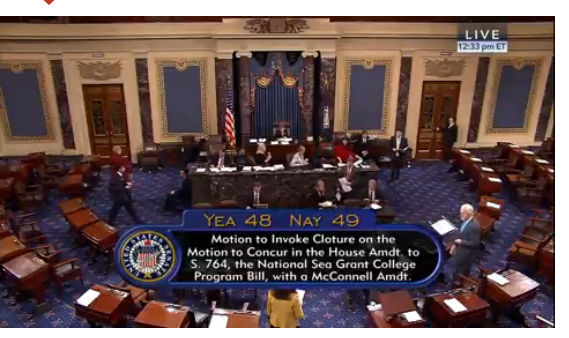
On March 16, the Kansas Republican was unable to invoke cloture and limit debate on an amendment to block states from writing mandatory labeling laws and instead create a federal voluntary labeling process overseen by the Agriculture Department. The amendment was attached to an unrelated bill (S 764).
Roberts needed 60 votes for cloture, but got a 48-49 vote. McConnell changed his vote to have the right to bring the proposal back to the floor at a later date. Shortly after the vote, Roberts indicated that he was open to further talks with Democrats dissatisfied with his amendment language. Democrats were cool to the option of the Agriculture Department creating a mandatory labeling regime if companies had not sufficiently complied under voluntary disclosure after final regulations establish the labeling process.
“Democrats blocked this compromise solution and now we see the result: big companies are making labeling decisions, but they are also making decisions to reformulate their products and avoid biotech ingredients altogether,” Roberts said in a statement. “The unwillingness to compromise by Senate opponents to my bill is about to hit both farmers and consumers directly in the pocketbook,” he added.
Roberts predicted a ripple effect. Companies, he said, would replace GMO ingredients because the labeling stigmatizes them. That would dent sales for farmers who grow major crops from GMO seeds such as corn and soybeans.
Faber and Colin O’Neil, at the Environmental Working Group, disputed Roberts’ argument that consumers would pay higher food costs. O’Neil said Mars is incorporating the Vermont requirements into planned label changes to mark its 75th anniversary this year.
Now that companies have demonstrated that they can label food packages, Faber said, it's less likely that senators would vote for Roberts’ labeling legislation, which would allow companies to direct consumers to websites or toll-free numbers for information on GMO products.
“We remain hopeful Congress will craft a national solution so consumers have information and companies have certainty,” Faber said, adding that he planned to collect and feature GMO labels on his Twitter feed.
Roger Lowe, spokesman for the Grocery Manufacturers Association, argues that the companies' decisions strengthen the argument that Vermont’s law will encourage other states to adopt mandatory labeling with different requirements. That, he said, would drive up food companies’ business costs that would be passed along to consumers. Just two other states, Connecticut and Maine, have mandatory GMO labeling laws. However, those laws cannot take effect until four neighboring states enact similar laws.
“If everyone labels for Vermont and then another state passes its own law that has a different standard we’re back in the same mess again. There’s still an imperative for a national labeling standard and a federal law,” Lowe said.
Lowe said the grocery group does not think the companies’ decisions will lead the Senate to back mandatory labeling of GMO food products and beverages, which is supported by many Senate and House Democrats. A final bill must have Republican support in the House, which passed a voluntary labeling bill (HR 1599) with state pre-emption language in July 2015. 
***
Michael Hansen, Ph.D.
Senior Scientist
Consumers Union

Sunday, March 27, 2016

DARK ACT - BACK ON DECK TO FIGHT GMO LABELS IN APRIL 2016


More to the Story?

More to the Story?
The world’s largest food corporations have spent hundreds of millions of dollars (some of it illegally) to avoid being required to label the genetically engineered ingredients in their products.
But with the July 1 deadline for complying with Vermont’s GMO labeling law on the horizon, a handful of the largest multinational food corporations have announced they will now label GMOs—not solely because they will be forced to, but because as General Mills claims, they believe “you should know what’s in your food and how we make ours.”
Have consumers won the GMO labeling battle? Have these food companies that so fiercely fought to keep labels off their products really split with the Grocery Manufacturers Association (GMA), the multi-billion-dollar lobbying group that is still trying to overturn Vermont’s law in the courts, and preempt it in Congress?
Or is there something more to these recent announcements than just the need to comply with Vermont’s law? As in, a strategy to lull consumers into complacency, while at the same time forcing Congress to give food companies what they’ve wanted all along—a free pass on labeling?
Read the essay

Share on Facebook Share on Twitter Email the OCA
ACTION ALERT

April Fools?

April Fools?
Last week, the Senate defeated S. 2609—or what we call the DARK Act, the bill that would Deny Americans our Right to Know about GMOs.
We hope you celebrated last week. Because this week, we have to get back to work. With a vengeance.
Sen. Pat Roberts (R-Kan.) didn’t have thevotes on March 16 to pass a bill to preempt Vermont’s labeling law. But that doesn’t mean we’ve seen the last of Roberts, Monsanto and the Grocery Manufacturers Association.
Here’s why. After the vote on the DARK Act failed last week, Senate Majority Leader Mitch McConnell (R-Ky.) flipped his vote from yes to no. It’s not that McConnell had a sudden change of heart. Hardly. He just used a procedural maneuver in order to allow the Senate to bring back an amended version of the DARK Act for another vote.
So what’s next? When Congress returns on April 4, after a two-week recess, we expect the pro-GMO, Monsanto-funded Democrats in the Senate, led by Sen. Debbie Stabenow (D-Mich.), to keep working on a compromise bill. Stabenow has said all along that she wants a federal labeling bill that preempts Vermont. Can she come up with a compromise bill that accomplishes preemption, but is acceptable enough to win over a few more Senators? Enough to get the bill passed in the Senate? And turn consumers into April Fools?
TAKE ACTION: Call Sen. Debbie Stabenow and ask her to protect Vermont’s GMO Labeling Law
Dial 888-897-0174 to tell your Senators to vote against any compromise that would block or delay Vermont's bill from taking effect.
Help or organize an April Fool’s Day action at the home office of your Senator. Email campaigns (at) organicconsumers.org if you can help!

Thursday, March 24, 2016

TO (MANDATORILY) LABEL OR NOT TO LABEL GMOs - THAT IS THE QUESTION

Published on
by

Food Companies Plan to Label GMOs—but Is There More to the Story?

"Is there something more to these recent announcements than just the need to comply with Vermont’s law?" ask Paul and Cummins. Could it be a "strategy to lull consumers into complacency, while at the same time forcing Congress to give food companies what they’ve wanted all along—a free pass on labeling?" (Photo: via OCA)
The world’s largest food corporations have spent hundreds of millions of dollars(some of it illegally) to avoid being required to label the genetically engineered ingredients in their products.

But with the July 1 deadline for complying with Vermont’s GMO labeling law on the horizon, a handful of the largest multinational food corporations have announced they will now label GMOs—not solely because they will be forced to, but because as General Mills claims, they believe “you should know what’s in your food and how we make ours.”

Have consumers won the GMO labeling battle? Have these food companies that so fiercely fought to keep labels off their products really split with the Grocery Manufacturers Association (GMA), the multi-billion-dollar lobbying group that is still trying to overturn Vermont’s law in the courts, and preempt it in Congress?

To be sure, consumer pressure has had an impact on brands’ decisions to label. We should celebrate that. But before we break out the champagne, it’s worth noting that not all of the food companies that announced plans to label have taken a strong position on labeling. Equally important, four out of the five companies announced plans to label after a Senate bill to preempt Vermont’s labeling law failed, but before the Senate has a chance to come backwith an amended version of the bill after Congress returns on April 4 from Easter recess.

Is there something more to these recent announcements than just the need to comply with Vermont’s law? As in, a strategy to lull consumers into complacency, while at the same time forcing Congress to give food companies what they’ve wanted all along—a free pass on labeling?

It’s also worth noting that all of the companies that have revealed plans to label adamantly defend the “safety” of GMOs—without once mentioning the fact that the vast majority of GMO crops, from which GMO food ingredients are derived, are sprayed with glyphosate, classified last year by the World Health Organization as “a probable human carcinogen.” Clearly, we have a long way to go before food corporations acknowledge the devastating consequences of the GMO monoculture model on the environment, human health and global warming.

Who’s labeling, and why?
Campbell’s Soup Co. CPB (NYSE), General Mills (NYSE:GIS), Mars and Kellogg’s(NYSE: K) and ConAgra Foods (NYSE CAG) have all declared they will label GMOs in time to comply with Vermont’s July 1 deadline, and in accordance with the Vermont law’s standards. The companies say that any costs associated with labeling won’t be passed on to consumers—a claim that deflates one of the industry’s long-standing, albeit routinely debunked, arguments that GMO labeling will lead to higher food prices for consumers.

Campbell’s was first out of the gate, and the first to break with the GMA on the lobbying group’s non-negotiable stance against mandatory labeling. After spending a half a million dollars to help defeat California’s Proposition 37 ballot initiative that would have mandated labels, Campbell’s now says the company supports a mandatory federal labeling solution. Following Campbell’s January 1announcement, we reached out to clarify what the soup company would do if Vermont’s law were preempted at the federal level. A Campbell’s spokesperson responded by saying that regardless of what happens in Congress, Campbell’s products will be labeled, with the words “partially produced with genetic engineering,” in all 50 states. On the surface, that's good news. But let's not forget that a federal labeling bill could forbid companies from printing those, or similar words on a label, to prevent food producers from "stigmatizing" biotechnology.

Similarly, we reached out to General Mills, Mars and Kellogg’s this week asking for clarification on their positions. Kellogg’s responded, but wouldn't provide answers to our direct questions, referring us instead to the official statement(which doesn't answer our questions). We haven't yet heard back from ConAgra, but we did receive responses from General Mills and Mars.

When asked if General Mills now supports a mandatory federal labeling solution, Mike Siemienas, manager of brand media relations, told us in an email that the cereal giant is “supportive of a model similar to what is used for organic products.”  In other words, voluntary, not mandatory. Asked if General Mills would label its GMO products according to Vermont standards even if Congress were to preempt Vermont, Siemienas wrote: “ . . . we would comply with any law that Congress passes.” We took that as a no.
But General Mills appears (so far) to be alone in continuing to side with the GMA on opposing mandatory labeling laws. Jonathan Mudd, Mars’ global director of media relations, told us by email that Mars, like Campbell’s, supports “the establishment of a mandatory national labeling system.” Mudd also confirmed that Mars will label its products “consistent with Vermont” regardless of whether or not Vermont is preempted “because we believe in consumer transparency.” (Mars pitched in $376,000 to defeat California’s Proposition 37. But after anti-labeling food corporations became boycott targets following the defeat of Prop 37, Mars sat out similar battles in Washington State (2013) and Oregon (2014).

Campbell’s and Mars both cited the “need to avoid a 50-state patchwork” of labeling laws as their reason for supporting a mandatory federal solution, as opposed to supporting states’ rights to pass GMO labeling laws. On the surface, the patchwork argument might sound rational—until you consider the fact that there are more than 100 state laws, governing food labeling, including a Vermont maple syrup labeling law, and a Minnesota law governing the labeling of wild rice. None of these laws ever created “chaos” in the marketplace, as U.S. Department of Agriculture Secretary Tom Vilsack has warned about Vermont’s GMO labeling law. And none were ever opposed with the same relentless determination, much less lavish spending, as GMO labeling laws. Maybe because none of them affected Monsanto’s bottom line?

Timing is everything

General Mills, Mars and Kellogg’s all revealed their labeling plans after the Senate failed to pass S. 2609, a bill intended to preempt Vermont. It’s possible that their announcements signal that these food giants have conceded defeat, especially as they all noted the need to comply with the Vermont July 1 deadline.

That’s the optimistic view. But the timing of these announcements, made before the Senate returns to try again to try to pass a preemption bill, could also be part of a calculated strategy to win over more Senators to a compromise bill, one that will delay or outright preempt enactment of Vermont’s Act 120.

Sen. Pat Roberts (R-Kan.), sponsor of the Monsanto- and GMA-funded S. 2609 (dubbed by opponents as the DARK—Deny Americans the Right to Know Act) is unwavering in his rejection of any legislation that requires labels on GMO ingredients. Though he is adamant about a “federal solution,” Roberts outright, and illogically, rejects the idea of a uniform mandatory federal solution.
Roberts’ rigid position on mandatory vs. voluntary cost him the support of Sen. Debbie Stabenow (D-Mich.), Ranking Member of the Senate Agriculture Committee and a key player in the GMO labeling drama. Stabenow says she would support a mandatory federal labeling law, though whether that support would include on-package labels, or some sort of QR barcode scheme or toll-free phone numbers, both of which have been floated as alternatives to on-package labels, remains unclear.

Still, Stabenow and other Senators representing Big Ag states are under tremendous pressure (by corporations, not voters) to keep Vermont’s law from taking effect. The Big Food corporations know this. So is it possible that companies, by announcing, in quick succession that they will label voluntarily, hope to send the message that there’s no need to pass a mandatory labeling law, because they’ve already volunteered? And could those big companies, or at least some of them, pull the plug on their labeling plans if federal legislation preempts Vermont? (Again, Campbell’s and Mars have said they will proceed regardless of what happens in Congress—we know that's not the case for General Mills; Kellogg's and ConAgra haven't confirmed one way or the other). 

That’s one possibility. Here’s another. General Mills told Politco’s Jenny Hopkinson that while the company won’t pass on the cost of labeling to consumers, the Minnesota-based cereal giant will have to spend “millions of dollars” to comply with Vermont’s law. Could this “woe is me” message win enough sympathy votes from Senators who may still be on the fence (and who are being hounded by their corporate donors), that they’ll be persuaded to betray consumers in order to stave off what General Mills or other companies allege is a “huge” financial burden?

It’s also possible that this is just a public relations ploy by corporations that are banking on the fact that a federal law will pass before they have to label, and that that law will include restrictions that prohibit them from printing “produced with genetic engineering,” or similar wording, on their packages. That scenario would allow them to say, gee, we tried to give consumers what they want, but Congress wouldn’t allow it.
Whatever the new-and-improved version of the Senate bill morphs into, assuming the Senate passes a bill, it will have to go back to the U.S. House. There, members of a Republican-controlled Joint Standing Conference Committee will try to “reconcile” the Senate bill with the House version, H.R. 1599, which passed the House in July by a vote of 275 – 150. Guaranteed, the House won’t sign off on anything with the words “mandatory” or “on-package.” In fact, House Agriculture Committee Chairman Mike Conaway (R-Texas), according to Politico, “declared just this week that he won't support on-package labeling, which he has said stigmatizes the technology.” Whatever ends up coming out of the committee will have to go back to the House and Senate for a full vote.
That leaves consumers no choice but to continue to hammer our Senators with this message: No compromise. Let Vermont’s law take effect. And if you really can’t tolerate supporting states’ rights to pass labeling laws, then pass a federal labeling law that meets, or preferably exceeds, the standards set by Vermont’s law.
Katherine Paul is associate director of the Organic Consumers Association.
Ronnie Cummins is a veteran activist, author, and organizer. He is the International Director of the Organic Consumers Association and its Mexico affiliate, Via Organica.