Tuesday, July 29, 2014

MASSIVE LOBBYING MONEY SELLS OUT AMERICANS' RIGHT TO LABEL GMO FOOD

The Anti-Label Lobby - Industry Lobbying boils over in bid to block Labels for Genetically Engineered Food

Industry lobbying to block labels for genetically engineered food boils over

Tuesday, July 29, 2014
by Libby Foley, Policy Analyst
Companies and organizations opposed to labeling foods that contain genetically engineered ingredients disclosed $9 million in lobbying expenditures that made reference to GE labeling in the first quarter of 2014 – nearly as much as they spent in all of 2013.
The burst of lobbying by food and biotechnology companies was partly designed to muster Congressional support for legislation that would block states from requiring GE labeling on food packages. That bill, dubbed the Deny Americans the Right to Know (DARK) Act by advocates of GE labeling, was introduced on April 9 by Rep. Mike Pompeo (R-Kan.).
In May, Vermont became the first state to enact legislation to require GE labeling, although industry has filed suit in an effort to block it. Connecticut and Maine have passed GE labeling laws that would go into effect if other northeastern states pass similar legislation.
Oregon and Colorado voters will consider GE labeling ballot initiatives this fall, and labeling bills have been introduced in 30 other states in 2013 and 2014.
Food and biotechnology companies and organizations disclosed $9.3 million in lobbying expenditures in 2013 that made reference to GE labeling and $9 million in the first quarter of 2014 alone. The forms cite lobbying on GE labeling as well as other policy issues.
In particular, the Grocery Manufacturers Association disclosed $1.2 million in lobbying expenditures that made reference to GE labeling in the first quarter of 2014. The Association’s member organizations separately disclosed another $4.3 million in lobbying expenditures that made reference to GE labeling in the first quarter, including $3.9 million by beverage giants Coca-Cola and Pepsi.

Food industry lobbying in Congress dwarfed that of supporters of GE labeling, who disclosed $1.6 million in lobbying expenditures that made reference to GE labeling in 2013 and just over $400,000 in the first quarter of this year – just one-eighth as much as the opponents. Advocates of GE labeling are supporting legislation introduced by Rep. Peter DeFazio (R-Ore.) and Sen. Barbara Boxer (D-Calif.) that would require GE labeling nationwide.
Several companies that produce genetically engineered seeds and herbicides – including Monsanto, Syngenta and Dow AgroSciences – did not report lobbying specifically on either piece of legislation on their 2013 disclosure forms or in the first quarter of 2014. Instead, their reports cited general advocacy on “biotechnology and biotech product issues,” “biotech innovation and regulation” and “biotechnology acceptance.” This language could easily include GE labeling, but that wouldn’t be obvious to the general public.
Lobbying expenditures for the second quarter of 2014 were due Monday (July 21), and the new data will be available by the end of July.

Food and biotechnology companies’ political action committees also reported giving $221,345 in campaign contributions to Pompeo and 22 of the 26 members of Congress who co-sponsored the DARK Act (as of July 9). Eight of them, including Pompeo, serve on the House Energy and Commerce Committee, which has jurisdiction over GE labeling.
Pompeo was the second-largest recipient of these campaign contributions, and Monsanto’s own PAC was the most generous PAC contributor.

In addition to disclosing $18.4 million in lobbying expenditures that made reference to GE labeling in 2013 and the first quarter of 2014, GE labeling opponents spent $67.9 million to defeat ballot initiatives in California and Washington. EWG did not tally funds expended to lobby state legislatures.

The DARK Act would block any state from requiring GE labels on packaged foods. In addition, it would also allow foods containing genetically engineered ingredients to be labeled as “natural” and limit the Food and Drug Administration’s ability to mandate GE labeling nationally.
Instead, the DARK Act would codify existing FDA rules that permit voluntary GE and non-GE labels. To date, no food manufacturer has voluntarily disclosed the presence of GE ingredients in its products.
Americans overwhelmingly support the right to know whether there are genetically engineered ingredients in their food, and recent polls in Oregon and Colorado found that more than three-quarters of voters in those states feel the same way. 

Key Issues: 


Monday, July 28, 2014

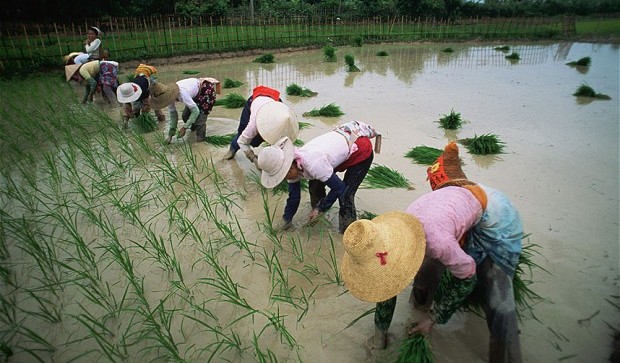
CHINA DEALING WITH MASSIVE ILLEGAL GMO RICE CONTAMINATION

Paddy-fields_china

China’s State Media Reveals Unapproved Genetically Modified Rice Is on the Market

Posted on Jul 29 2014 - 1:19am by Sustainable Pulse

CCTV, China’s state broadcaster, has discovered genetically modified rice being sold in two southern provinces, the second such allegation it has made in two years at a time when public opinion seems to have hardened against the technology.
Source: Global Voices
An investigative report aired last Saturday said GM rice was found in the market in southern Hubei and Hunan province, where rice remains the staple food. The allegation by the television network has been substantiated by the Beijing Entry-Exit Inspection and Quarantine Bureau after samples taken from the two provinces tested positive for GM traces.

Genetically modified organisms (GMOs) have stirred an ongoing global debate since their introduction two decades ago. As a deteriorating environment and decreasing arable land continue to threaten the country’s ability to feed the world’s biggest population, China is looking at various measures including GMO technology to cement its agricultural security.
In China, GM technology was named as one of the key projects part of the National Medium and Long-term Science and Technology Development Plan, which runs through 2020, and Beijing has vowed to invest altogether 20 billion Yuan in major GM research.

In a landmark decision to advance GM technology, the Chinese Ministry of Agriculture in 2009 granted safety certificates to two strains of GM rice and one GM maize — a move widely interpreted as a signal that the country might soon apply GM technology to its staple food.

But GM rice is an especially sensitive because it is widely consumed in much of southern China and by a vast majority of Han people in the north.

The Chinese Ministry of Agriculture maintains that GM rice is still at a research stage and said any commercialisation of it would be illegal. Despite that, CCTV’s report over the weekend, if proved to be true, would highlight the management hiccups behind a state-backed undertaking that might take years to get public on board.

“I think the [GM] technology has already spread out and once GM products are out, it’s hard to recall them [...] most of the rice in Hunan, Hubei, Anhui and Fujian have been contaminated,” the broadcaster quoted a Shanghai-based rice company executive as saying towards the end of the special report.

China is already the world’s largest importer of GMO soybean, with annual imports accounting for about 60 percent of global traded soybean.

 Source:  http://sustainablepulse.com/2014/07/29/chinas-state-media-reveals-unapproved-genetically-modified-rice-market/#.U9bR5UCwUXd

Friday, July 25, 2014

US-EU TRADE DEAL THROWS FOOD SAFTEY AND PUBLIC HEALTH UNDER BUS

For Immediate Release

Institute for Agriculture and Trade Policy
Contact: 
Andrew Ranallo
Communications Associate, IATP
(612) 870-3456

Leaked Document Reveals US-EU Trade Agreement Threatens Public Health, Food Safety

WASHINGTON - A draft chapter of the U.S-EU trade agreement leaked today by the Institute for Agriculture and Trade Policy (IATP) reveals public health and food safety could be at risk, according to an accompanying analysis. The leaked chapter concerns Sanitary and Phytosanitary (SPS) issues—those surrounding food safety and animal and plant health—in the Transatlantic Trade and Investment Partnership (TTIP) currently being negotiated. Only TTIP negotiators and security cleared advisors, mostly corporate representatives, can read and comment on draft negotiating texts.
According to the IATP analysis accompanying release of the leaked document, “This leaked draft TTIP chapter doesn’t tell us everything about where negotiations are headed on food safety, but it tells us enough to raise serious concerns.”
While key details have not been disclosed to the public or remain to be negotiated, the chapter clearly indicates negotiators continue to subordinate SPS regulations to the object of maximizing trade. The text, for example, supports the U.S. approach to not require port of entry food inspections and testing, meaning food contamination outbreaks will be harder to trace to their origin, and liability harder to assess—a win for U.S. meat and food companies that could jeopardize food safety for consumers. Further, the text indicates the trade agreement could make it more difficult to restrict imports from countries with animal or plant diseases, such as Mad Cow Disease or plant fungus outbreaks.
The leaked chapter does acknowledge animal welfare but lacks enforceable language, meaning a U.S. state or EU member state could pass mandatory laws or rules on agriculture animal welfare, but such mandatory measures could not be used to prevent import of products from abused animals. Alternatively, unenforceable trade policy could further the misguided “Right to Farm” legislation under consideration in several states.
“While many key details regarding things like GMOs are still hidden, it’s clear public health is losing out to corporate interests in a big way,” said IATP’s Dr. Steve Suppan, author of the analysis. “Moreover, it’s an affront to democracy that the public need rely on leaked documents to find out how these agreements could affect health and safety.”
The draft chapter would set up a Joint Management Committee to discuss concerns about U.S. and EU SPS regulations. But the draft provides very little information about how this committee or the yet to be negotiated TTIP Oversight Body, to which the Committee reports, would function if discussions did not resolve concerns about the effect of regulations on trade. It is not clear whether the Oversight Body would refer unresolved SPS concerns to the proposed and very controversial Investor State Dispute Settlement mechanism. The ISDS would have a private tribunal of trade lawyers, not a public court of law, decide whether U.S. or EU SPS rules, laws or enforcement measures violated TTIP. If the tribunal decided in favor of the complaining investor, the tribunal would determine the compensation that the EU member state or U.S. governments would have to pay investors for loss of anticipated benefits under TTIP.

Read the IATP analysis and the complete leaked chapter text for more information.

###
IATP works locally and globally at the intersection of policy and practice to ensure fair and sustainable food, farm and trade systems.
SOURCE:   http://www.commondreams.org/newswire/2014/07/24/leaked-document-reveals-us-eu-trade-agreement-threatens-public-health-food

MASSIVE PESTICIDE CONTAMINATION IN MIDWEST WATERWAYS

Published on
by

Notorious 'Neonics' Pervasive in Midwest Waters: Study

Researchers from the USGS found the insecticides in waterways of nation's corn, soy region.
A cornfield in Nebraska. (Photo:  Richard Hurd)
A new study has added to mounting evidence against a class of insecticides called neonicotinoids, or "neonics."
Linked in numerous studies to bee declines, the new research looks at neonics' impacts on surface water.
Researchers with the U.S. Geological Survey looked at 9 rivers and streams in the U.S. Midwest—home to vast plantings of corn and soybeans as well as widespread use of neonics—in the 2013 growing season.
The researchers detected neonics in all the waterways, which included the Mississippi and Missouri Rivers. One systemic pesticide, clothianidin, was found in 75 percent of the water samples.
“We noticed higher levels of these insecticides after rain storms during crop planting, which is similar to the spring flushing of herbicides that has been documented in Midwestern U.S. rivers and streams,” USGS scientist Michelle Hladick, the report’s lead author, said in a statement.
“In fact, the insecticides also were detected prior to their first use during the growing season, which indicates that they can persist from applications in prior years,” Hladick stated.
"Concentrations may frequently exceed chronic aquatic toxicity values during growing season," the study states.
"The fact that neonics are pervasively contaminating surface waters should be a wake-up call for state and federal regulators."
—Emily Marquez, Pesticide Action Network
Given the widespread use of neonicotinoid pesticides, their persistence in soil, and their high solubility in water, it's not surprising that neonics are ending up in Midwest waterways," said Emily Marquez, PhD, staff scientist at Pesticide Action Network.

"Researchers have recently documented the frequent detection of neonics at varying concentrations in surface waters in the U.S. and Canada," she continued. "The fact that neonics are pervasively contaminating surface waters should be a wake-up call for state and federal regulators, that must move more quickly to reduce and restrict use on farm fields."
The findings of the study, which the USGS touts as the first broad-scale investigation of neonics in the Midwest, were published in Environmental Pollution.
The USGS study comes on the heels of findings by researchers from the Netherlands who noted that concentrations of one neonic called imidacloprid were linked to declines in bird population, suggesting "the impact of neonicotinoids on the natural environment is even more substantial than has recently been reported."
And a global analysis out last month based on 800 peer-reviewed reports found "clear evidence" that neonics pose threats to bees, other pollinators and terrestrial invertebrates like earthworms, which are exposed to neonics through the soil, the treated plant itself and water.
"The global scientific community points to neonics as critical driver of bee declines. Officials should take water contamination as yet another sign that we must act now," Marquez stated.

Friday, July 18, 2014

GMO WHEAT TESTS FROM 1998-2005 IN16 STATES ENDED; 2012 GMO WHEAT DISCOVERED GROWING: STILL A "MYSTERY"

Vilsack: GMO wheat report due in ‘very near term’


By Eric Mortenson
Capital Press


Eric Mortenson/Capital Press U.S. Agriculture Secretary Tom Vilsack said a GMO wheat report is expected in the "very near term."

U.S. Agriculture Secretary Tom Vilsack acknowledges a GMO wheat investigation, now 15 months old, may not answer every question.

PORTLAND — Agriculture Secretary Tom Vilsack said he expects a report on the GMO wheat found in Eastern Oregon last year in the “very near term” but cautioned it may contain some question marks.
“I’m not sure we’re going to have every answer,” Vilsack said.
Vilsack, in Portland to discuss the USDA’s new Regional Conservation Partnership Program, said his department is working in the meantime to foster coexistence between growers of conventional and genetically engineered crops. Vilsack revived the department’s Advisory Committee on Biotechnology and 21st Century Agriculture for that purpose.
The discovery of GMO wheat last year temporarily disrupted the international export market crucial to Pacific Northwest growers. The USDA’s Animal and Plant Health Inspection Service has been working on the investigation for 15 months.

Producers have consistently said they don’t want markets threatened again by having a “bomb” dropped on them — a report that shows GMO contamination elsewhere, for example — during harvest this year.

The investigation began in April 2013 when an Eastern Oregon grower noticed that some volunteer wheat plants he sprayed with glyphosate did not die as expected. The 125-acre field had been planted with certified seed in October 2011 and harvested in the summer of 2012, and was lying fallow when they farmer sprayed it — a common practice to control weeds.
Tests at Oregon State University, confirmed by APHIS, showed the plants were a “Roundup Ready” variety developed by Monsanto Co. to withstand the key ingredient in its herbicide.
Monsanto field-tested the variety in 16 states, including Oregon, from 1998 to 2005, but withdrew its application to have it approved because farmers objected. The last testing in Oregon was in 2001, however, and the field where the plants were found was not a test site, which only deepened the mystery.
Buyers in Japan, South Korea and Taiwan, the chief markets for Pacific Northwest wheat, are strongly opposed to GMO food products.
Monsanto says its testing protocol was rigidly controlled and that genetically engineered crops pose no hazard to food or feed. APHIS says there’s been no more GMO wheat found and no evidence that it got into commerce. Beyond that, the agency has been silent.

SOURCE:   http://www.capitalpress.com/Nation_World/Nation/20140717/vilsack-gmo-wheat-report-due-in-very-near-term#.U8k0HED-XCI

GMO PUSH INTO TASMANIA LURKS

A worker stands next to a crushing machine in a warehouse at Tasmanian Alkaloids, a Johnson & Johnson subsidiary which processes around 80 percent of the world's thebaine poppies, the main ingredient in slow-release pain medication, located in Tasmania's northwest on the outskirts of Launceston June 4, 2014.   REUTERS-David GrayEven in isolated, pristine Tasmania, pressure to allow GMO farming

POWRANNA Australia Fri Jul 18, 2014 1:35am EDT


1 of 6. A worker stands next to a crushing machine in a warehouse at Tasmanian Alkaloids, a Johnson & Johnson subsidiary which processes around 80 percent of the world's thebaine poppies, the main ingredient in slow-release pain medication, located in Tasmania's northwest on the outskirts of Launceston June 4, 2014. Credit: Reuters/David Gray

Australia's Tasmania contemplates a less 'pure' future (Reuters) - Thousands of Black Angus bulls snort steam gently into the frigid early morning air at Tasmania's largest cattle feedlot as they jostle for space at a long grain trough. The pitch black cattle, blending into their muddy surroundings and stretching as far as the eye can see, are being fattened up for the Japanese market where marbled Angus beef is in high demand. These bulls at the feedlot owned by Japan's Aeon Co Ltd book an even higher premium, thanks to Tasmania's status as the only Australian state that bans genetically modified food crops and animal feed.  

That moratorium has made Tasmania - an island the size of Ireland separated from Australia's mainland by 250 km (150 miles) of Bass Strait waters - a model of high-end, value-added agriculture production.

Tasmania's isolation and wilderness once made it a dumping ground for the British Empire's convicts. But these same qualities, and a small population of just over half a million people, make the island one of the cleanest places on earth.
Now, with fewer and fewer places in the world free from genetically modified farming and the innovations it brings, the pristine environment is under threat.

The state government says it is planning legislation to extend the ban on genetically modified farming when it expires later this year. But Tasmania's powerful poppy industry, the world's largest supplier of pharmaceutical grade opiates for painkillers, is strongly lobbying for the moratorium on genetically modified organisms (GMO) to be lifted.

Johnson & Johnson subsidiary Tasmanian Alkaloids, GlaxoSmithKline and Australia's privately-held TPI Enterprises, who share a A$120 million ($113 million) oligopoly, see a major threat looming as Victoria state on the mainland recently indicated it wanted to allow production of genetically modified poppies.

That throws open the prospect of tough competition and Tasmanian poppy farms losing out on cost-savings just as global demand for painkillers surges.

"There is a threat," said Tasmanian Alkaloids field operator Rick Rockliff, whose factory in the state's northwest processes around 80 percent of the world's thebaine poppies, the main ingredient in slow-release pain medication. "I would hope our government wouldn't sit on their hands and let that happen."

ASIAN AMBITIONS
The road that Tasmania chooses will be critical as Australia seeks to fulfill lofty ambitions to become a "food bowl" for a rapidly growing middle-class in Asia. 

Already the world's third largest exporter of beef and the No.4 wheat exporter, Australia is eyeing agriculture as a key economic driver as a decade-long mining investment boom that brought the country riches wanes. 

But critics warn that it is in danger of failing at the farm gate due to the country's harsh, drought-prone climate and a lack of investment in agricultural innovation. 

In Tasmania, the accent is on high-value crops and cattle for export.

The state's niche producers are supplying everything from off-season wasabi and lavender teddy bears to fresh salmon and live abalone and see this as the future, rather than low value, bulk commodities. Its wine industry is thriving as climate change pressures major producers to move from traditional grape-growing regions on the mainland to Tasmania's cooler climes. 

These products attract a premium because of the GMO ban - the state's honey brings in prices of at least 40 percent more than mainland honey - according to the Safe Food Foundation. 

Tasmania Feedlot Pty Ltd in Powranna is home to between 6,000 and 11,000 Angus cattle all year round. The animals are beefed up over a period of five to six months before large cuts are shipped frozen to Japan. 

"They're looking for a very safe product, and a very consistent product," said the feedlot's Managing Director Andrew Thompson of the company's Japanese buyers.

"GM is one of the main factors, along with no use of hormone growth promotants," he added. "We've got this great reputation of being safe and clean and I think we've got to enhance that into the future."

CONTAMINATION FEARS
The use of GMOs was outlawed in Tasmania more than a decade ago, after genetically altered canola escaped from crops at secret trials around the state. 

The state government says it plans to introduce legislation later this year to extend the ban, which expires in November. But it has left the door open a crack, retaining exemptions for scientific trials of GM crops and refusing to rule out lifting the ban in the future.

That's left Tasmania's organic farmers nervously eyeing a recent landmark court case in Western Australia. Farmer Steve Marsh unsuccessfully sued his neighbor, blaming him for losing his licence as an organic grower after Monsanto GMO canola seed heads blew on to his property.

Marsh is appealing the ruling, a process that could take up to a year to be finalised. Tasmania's fear of contamination is reflected in its strict food importation rules. Visitors arriving from the mainland are required to dispose of any foodstuffs before leaving the airport.

The island's isolation and its small population were the main reasons the federal government granted an exclusive licence to Tasmania to grow opium poppies for legal commercial production half a century ago. 

The arrangement has proved a boon for growers, with U.N. figures showing demand for pain relief more than tripled between 1993 and 2012 to the equivalent of 14 billion doses. Demand is expected to rise further in coming decades as the middle-class, particularly in Asia, grows. 

POPPY DEMAND
But Tasmania's efforts to secure a further five-year ban on other states growing poppies for commercial production have fallen on deaf ears as the federal government considers Victoria's bid.

Tasmania's poppy farmers say expanding production across Australia will leave them at a handicap if the GMO ban in the state remains. 

"It will make it more attractive to grow in Victoria," said Tasmanian Alkaloids' Rockliff. His company developed a trial GMO poppy several years ago that was unaffected by a common herbicide used to kill weeds, a development that would cut growers' costs and time in the field if able to be used commercially. 

"From that perspective, GMO is really interesting and it will eventually happen in Tasmania," he said.

Many others are fervently hoping that Rockliff is wrong. 

"I think the key is that Tasmania will never have the scale to produce enormous crops of grain or fruit for example, so why push for advantages that only work for scale?," said Tasmania Feedlot's Thompson. "Perhaps we're better to push for advantages that work for our particular image, of being grown in this island state and being clean and green and safe."

(Editing by Lincoln Feast and Raju Gopalakrishnan)

Source: 
http://www.reuters.com/article/2014/07/18/us-australia-gmo-idUSKBN0FN06920140718

Wednesday, July 16, 2014

UK PARLIAMENT HOSTS INTERNATIONAL PANEL ON ROUNDUP IN HUMAN BLOOD, URINE AND BREAST MILK

UK Parliament Meets to Discuss Dangers of World’s Best Selling Herbicide: RoundUp
by Christina Sarich
July 3rd, 2014


UK Parliament Meets to Discuss Dangers of World’s Best Selling Herbicide: RoundUp The London House of Parliament hosted a meeting attended by the All-Party Parliamentary Group (APPG) on Agroecology, Chaired by the Countess of Mar just weeks ago to discuss one of the world’s best-selling herbicide’s and its dangers to the public – Monsanto’s Roundup.

This was perhaps the most comprehensive meeting of UK government officials ever held in Europe, which included experts from all over the world to discuss glyphosate and RoundUp specifically. The scientific evidence of many was presented to the media, members of UK political parties, non-profit organizations, and members of the general public.

It was clear that this topic is of concern to many individuals, as the House of Parliament Room 10 was busting at the seams with experts that had traveled from as far as Russia, China, and the U.S. to listen to four different speakers present on the subject. Many of the unanswered questions about glyphosate were addressed; outlining the harm that glyphosate is causing people, animals, and our environment. Solutions to the prevalent use of glyphosate were also discussed.

The meeting outlined the use of glyphosate not just as an agricultural chemical (to dessicate cereal fed to farm animals, as an herbicide for soya, maize, and cotton crops, and more,) but also for weed control for homes, golf courses, and in horticulture around the world. The presenters pointed out that both humans and animals are at risk of exposure due to such prevalent use of glyphosate. The presentations confirmed that glyphosate is being found in human blood, urine, and in breast milk.

The presenters suggested that while glyphosate is presented as a harmless chemical that becomes inactive once it is in soil, it is in fact very dangerous, interfering with plant enzymes, soil microbes, and plant growth. It can also bind (chelate) trace metals with its imbred antibiotic action, leeching important nutrients from our soil, and food. When used with other chemicals sold to farmers and gardeners, the chemical’s effects are often compounded.

In summary, they agreed that glyphosate is anything but safe, and is in fact harming our ecosystem, and human life as the industrial agricultural model of farming requires ever-more herbicide use.

The full presentations made by the four members who presented from the APPG Agroecology meeting can be seen below. Please note that these are PDF files on the file sharing system Dropbox. Two of them should be able to be viewed without downloading the PDFs, while two require a download. Enjoy.

Dr. Don M. Huber – Professor Emeritus of Plant Pathology at Purdue University

Professor Malcolm Hooper – Professor of Medicinal Chemistry at the University of Sunderland

Dr. John Peterson “Pete” Myers – Founder, CEO and Chief Scientist of Environmental Health Sciences

Dr. Michael Antoniou – Reader in Molecular Genetics and Head of the Gene Expression and Therapy Group, Department of Medical and Molecular Genetics, King’s College London School of Medicine, UK.

Read more:
http://naturalsociety.com/uk-parliament-meets-discuss-dangers-worlds-best-selling-herbicide-roundup/#ixzz36jNGYtQd