Saturday, July 7, 2012

ORGANIC ACTIONS

Stop Monsanto's Sneak Attack!

As we reported last week, a controversial rider has been attached to the U.S. House of Representative's 2013 Agriculture Appropriations bill that would make it impossible for organic and non-GMO consumers and farmers to fight Monsanto in court (as we did on GMO alfalfa and sugar beets) when the US Department of Agriculture illegally approves new genetically engineered crops that could, as the courts have ruled, eliminate "a farmer's choice to grow non-genetically engineered crops, or a consumer's choice to eat non-genetically engineered food."
The vote we expected last week has been delayed until after the July 4th recess. Already, more than 15,000 of you have taken action, along with over 50,000 of our allies in other organizations. Please join together as we raise our voices loud and clear.

There's still time to stop Monsanto's sneak attack!
Take Action via Email
Call Your Member of Congress

Who's Monsanto's Best Friend in Congress?


Tom Philpott reported this week in Mother Jones that Jack Kingston (R-GA) is the Congressman responsible for inserting this "pro-industry provision that that has nothing to do with agriculture appropriations."
Kingston had already established himself as a friend of the industry. In April, the Biotechnology Industry Organization, whose members include ag-biotech giants Monsanto and DuPont, named him its "legislator of the year for 2011-2012." BIO declared Kingston a "champion of America's biotechnology industry" who has "helped to protect funding for programs essential to the survival of biotechnology companies across the United States."
Are there any Members of Congress tough enough to stand up to Monsanto?
Rep. Peter DeFazio (D-OR) will sponsor an amendment to the ag appropriations bill that would nullify Kingston's Monsanto-friendly provision.
Ask your Member of Congress to support the DeFazio amendment!
Take Action via Email
Call Your Member of Congress

DEJA VU ALL OVER (THE MIDWEST) AGAIN?

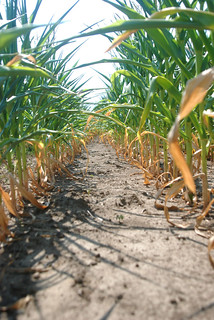
DSC_1460

New Dust Bowl?

Extreme heat, drought leave parched fields, desperate farmers in Midwest

- Common Dreams staff
As record temperatures and drought leave corn fields parched in the Midwest, some farmers fear a new Dust Bowl is lurking, the New York Times reports.
The Times notes that that acreage of corn planted this year was the highest in 75 years, and warm spring temperatures had allowed earlier planting and had risen farmers' hopes of high returns.
But Illinois farmer Don Duvall told the Times, “It all quickly went from ideal to tragic.”
The ongoing heat and lack of rainfall have left corn crops in some midwestern states far smaller than usual for this time of year, if not clinging to life.  And with the pollination time for the crop soon approaching, the viability of much of the corn to survive is chancy, as stressed crops may not pollinate. 
The Times ends with an eerie image of a farmer picking up his soil which turns to "a dusty powder."
The Dust Bowl that struck the Plains in the 1930s as a result of heat, drought and ecologically devastating agricultural practices left highly eroded lands and hundreds of thousands of people displaced. With the ongoing extreme temperatures as well as a lack of widespread agroecological approaches, a new dust bowl may indeed be upon us.
Dust storm approaching Stratford, Texas on April 18, 1935. (photo: NOAA George E. Marsh Album)
* * *

DAVID REFUSES TO BACK DOWN FROM FRANKENGOLIATH MONSTER

Farmers Continue Fight Against Monsanto

Appeal filed to reverse Feb. 2012 decision allowing "Monsanto’s scorched earth legal campaign of threats and intimidation against America’s farmers" to continue

- Common Dreams staff
Organic farmers' fight against Monsanto continues as they filed an appeal against the agricultural giant on Thursday hoping to reverse a February decision dismissing their protective legal action against the company.
Seventy-five family farmers, seed businesses, and agricultural organizations originally filed suit in March 2011 in an act of self-protection against what Food Democracy Now!'s founder and executive director Dave Murphy calls "Monsanto's scorched earth legal campaign of threats and intimidation against America’s farmers." In this campaign, Monsanto has threatened and filed suit against farmers for patent infringement when its genetically modified seeds reach unsuspecting farmers' fields.
But in February 2012 a district court sided with Monsanto, dismissing farmers' unwanted genetic contamination of their crops and documented threats against the farmers by Monsanto.
Attorney Dan Ravicher of Public Patent Foundation (PUBPAT), which is representing the plaintiffs, says that Monsanto's bullying practices are known. “They’ve sued and harassed many other farmers who wanted nothing to do with their genetically modified seed and now that organic and conventional farmers are fighting back, they claim they would never do such a thing without backing up their words with an enforceable promise.”
“We have a right to farm the way we choose,” said Maine organic seed farmer Jim Gerritsen, President of lead plaintiff Organic Seed Growers and Trade Association (OSGATA). “Yet Monsanto is unwilling to control their GMO pollution and they refuse to sign a binding covenant not-to-sue our family farmers for patent infringement should their seed contaminate our crops. Monsanto’s publicized ‘Commitment’ promising that they would not sue farmers was described by Monsanto’s own lawyers as being ‘vague.’"
"The law says we deserve protection under the Declaratory Judgment Act. We will continue to pursue our right to farm, and the right of our customers to have access to good clean food and seed,” says Gerritsen.
Urging the rights of farmers, Food Democracy Now!'s Murphy adds, “No company should be allowed to violate the property rights of America’s farmers or threaten their livelihoods through the use of frivolous patent infringement lawsuits designed to control farmers and the food supply, while protecting Monsanto’s flawed seed technology and corporate profits.”
SOURCE:   http://www.commondreams.org/headline/2012/07/06-4

Friday, July 6, 2012

USDA: NO LABELS ON OUR MILK ON CLONED GROWTH HORMONES AND ANTIBIOTICS

cowface 235x147 Monsantos Cloned Growth Hormone rBST Still Contaminates US MilkMonsanto’s Cloned Growth Hormone rBST Still Contaminates US Milk

Share
Elizabeth Renter
NaturalSociety
July 2, 2012
Breast-feeding mothers are often cautioned against eating and drinking certain things; it’s because some of these things can find their way into their breast milk and then their baby. Wouldn’t it make sense, then, that some of the hormones and antibiotics given to dairy cattle would make their way into your milk carton? One hormone, recombinant bovine somatotropin, or rBST, is given to about 20% of dairy cattle in the United States, having unknown effects on individuals who consume their milk.

Is rBST safe?

IS rBST safe? That depends on who you ask. Companies like Monsanto, the original producer of Posilac (an rBST) product had to reluctantly put safety warnings on the sides of their packages—admitting that it has about 20 “toxic effects” on the cows.
It’s a hormone that forces cows to produce more milk. More milk = more money, but the hormone makes the cows sick. Among other things, it causes mastitis which is an infection of the udder. This infection causes pus to be released into the milk. Yes, pus is in your milk.
In turn, large scale dairy operations that use rBST must use more antibiotics in the cows to counter the infection causing effects of the hormones.
According to the Organic Consumers Association, Dr. Samuel S. Epstein of the Cancer Prevention Coalition warns:
  • rBST milk is chemically and nutritionally different than natural milk.
  • Milk from cows injected with rBST is contaminated with the hormone, traces of which are absorbed through the gut into the blood of people who consume this milk or products made from it.
  • rBST milk is supercharged with high levels of the natural growth factor (IGF-1), which is readily absorbed through the gut.
  • Excess levels of IGF-1 have been incriminated in well-documented scientific publications as causes of breast, colon, and prostate cancers. Additionally, IGF-1 blocks natural defense mechanisms against early submicroscopic cancers.
Interestingly, numerous large and wealthy countries have banned the use of hormones in milk including all countries of the European Union, Norway, Switzerland, Japan, Canada, and New Zealand. The United States, obviously has not.
What does this mean for you?
It simply gives you another reason to buy organic, hormone-free dairy products (if you must consume dairy). And if you think you can do without dairy—it’s just another reason to go vegan or simply avoid dairy.

Source:  http://naturalsociety.com/monsantos-growth-hormone-rbst-us-milk/

Thursday, July 5, 2012

POLITICALLY INCORRECT MAHER RIPS OBAMA ON GMO REVERSAL

Organic Consumers Association

In 2007, Sen. Obama, campaigning for the presidency in the Democratic primary, promised to label genetically engineered food.
Now, if you write the Obama for America campaign about genetically modified organism (GMO) labels, you get this response:
“Genetically modified crops hold out the promise of benefits like increased production and reduced reliance on pesticides. At the same time, some Americans want more information to help them choose their food. President Obama understands these concerns and is considering additional steps in this area.”
What? How can he flip his position like that? What makes him believe Monsanto’s lies? Why isn’t he listening to the 9 out of 10 voters who want GMOs labeled? Is there anything we can do to get him back on our side before November?
The first step is to give President Obama a piece of our minds. Bill Maher did on his show last week, when he called the president out for breaking his campaign promise on GMO labels and putting Monsanto’s Michael Taylor in charge of food safety. Tell the Obama for America campaign what you think about broken promises. 
VIDEO:  http://youtu.be/7H_Xe25Ub0k

SOURCE:  http://ecowatch.org/2012/bill-maher/

MAUI, KAUAI & OAHU TO MONSANTO: GET YOUR GMO'S OUT!


Beyond Pesticides

A protestor sums it up for Monsanto outside its corporate headquarters in Oahu on June 28.
Several organizations, including Occupy Wall Street Maui and GMO-Free Maui, as well as more than 100 concerned citizens, held a protest on June 28 in front of the Monsanto Corporation headquarters in Kunia on the Island of Oahu, Hawaii. According to the organizers, the protesters met in Kunia and marched more than half a mile to the Monsanto compound for two hours of roadside sign-waving and chanting, demanding that Monsanto leave Hawaii and saying they need real food, not exported GMO seeds and chemical contamination. The group also demands that genetically engineered (GE) food be labeled.
The protesters wore masks to protect themselves from pesticide drift and GE spores, received lots of support from many in passing cars that honked their horns and waved in support. A nearby resident came to find out what was going on and soon donned a mask himself as he was unaware of the dangers so close to his house. The resident expressed concern about the large trucks and equipment operating at night at Monsanto’s fields.
Monsanto operates about 8,000 acres in Hawaii for GE seed production. According to organizers, these operations use the most valuable agricultural lands and water in food production, as well as large amounts of chemicals and pesticides that are required to grow these crops. Hawaii is a global center for the open-air field testing of experimental GE crops, but no impact studies have been conducted.
Food security is a growing concern in Hawaii as the majority of the food is imported while the biotech industry grows GE seeds for export. The need for locally grown, wholesome, natural, non-toxic food is high on everyone’s priority list. Walter Ritte of “Label It Hawaii” offers a strong message for Monsanto: “Get out of Hawaii, grow food, stop growing seeds and chemicals, grow food, we need food security over here.”
Monsanto stopped operations for the afternoon because of the protest and allowed most workers to leave early. Monsanto erected a barrier and manned a security station at the entrance to their compound. There were several Monsanto employees filming the protesters throughout the event.
This protest follows similar protests recently held on the islands of Maui and Kauai against Monsanto. Activist organizations on the other islands vowed solidarity and stated that they are planning more protests until Monsanto leaves the islands.
Recently, the U.S. has moved to deregulate several varieties of GE crops. However, these decisions fail to take into account several scientifically-validated environmental concerns, such as the indiscriminate nature of genetically modified gene flow in crops, a heavy reliance on faulty data and a high degree of uncertainty in making safety determinations. They also overlook the problem of pesticide-resistant weeds and insects, as well as the widespread corruption of conventional seed varieties by GE strains and documented severe economic injury to farmers and markets. Overlooked as well are possible health consequences from eating GE food, still largely unstudied and unknown.
Fortunately, GE crops are not permitted in organic food production. For more information about why organic is the right choice, see our Organic Food: Eating with a Conscience Guide and visit the Organic Program page. For more information on the failure of genetically engineered food, read Genetically Engineered Food Failed promises and hazardous outcomes, from the Summer 2011 issue of Pesticides and You, or go to our Genetic Engineering Web page.
For more photos and videos of the event, follow the links below:

Tuesday, July 3, 2012

BIG AG LOSING BILLIONS DUE TO LACK OF CHEAP IMMIGRANT LABOR

US Agriculture Industry in Trouble as Migrant Labor Dwindles

Common Dreams staff
Harsh anti-immigration policies in the US and more job opportunities in Mexico are factors which have begun to affect the US agricultural industry in negative ways -- less migrant labor to exploit.
According to McClatchy news today, migrant workers traveling from Mexico previously consisted of more than 60 percent of US farm-workers -- jobs which unemployed people in the US are increasingly less willing to do. As less workers are willing to cross the border, farmers in the US are beginning to feel the pinch.
The American Farm Bureau Federation estimates a $5 billion to $9 billion annual loss in the produce-industry due to a recent labor shortage, as growers cannot keep up with the harvest.
According to McClatchy, many say a solution could include an overhaul of what is know as the 'H-2A federal guest worker program' which allows employers to hire temporary foreign workers to fill seasonal labor shortages. An overhaul would mean allowing visiting farm-workers in the US to work towards legal immigration status and thus a more promising opportunity.
However, currently growers already largely avoid the program, claiming the process is too time consuming, according to a recent survey by the National Council of Agricultural Employers.
Additionally, the growing labor shortage has also begun to negatively affect surrounding communities, as convenience stores, gas stations and restaurants that cater to farm-workers have begun to lose business and are increasingly forced to to close or fire local employees.
Last year, Republican Gov. Nathan Deal of Georgia publicly requested Georgia residents to start taking jobs in the fields but the initiative fell flat when many rejected the 'grueling nature of the work', according to the McClatchy report.
* * *