Friday, September 2, 2011

ORGANIC FOOD- PART OF SOCIAL JUSTICE- FOR ALL!

 Will the real food movement please stand up?
Farmer Bob Comis recently suggested that the food movement is suffering from "multiple personality disorder." He argued that several vocal factions -- foodies, locavores, and "smallists" -- tend to dominate the food movement discussion, unrealistically distracting us from our ultimate objective: bringing affordable, organic food to all as part of a broader commitment to social justice.
For decades now, organic farmers and sustainable food activists of all stripes have been vexed by the question: Is this a movement? Can it scale and have meaningful impact?
At one eloquent and entrepreneurially-impeccably-credentialed end of the spectrum stands farmer Joel Salatin:
Don't let them confuse you. Organic farming is not an industry. It is a movement. It is part of a movement that began when the first indigenous peoples fought against the Conquistadors. It is fighting back against the modern Conquistadors, the multinational corporations, those who would patent and genetically modify life and destroy diversity.
At the other eloquent and entrepreneurially-impeccably-credentialed end of the spectrum stands Stonyfield Farm CEO Gary Hirshberg: "I hate the 'm' word. Organics is an industry. We must build and utilize industrial-scaled enterprises, if we are going to get toxics out of the food chain in one generation."
There are 6,132 farmers markets in the U.S., up 350 percent since 1994. There were 60 CSAs in 1990; today there are almost 13,000. Some 400,000 people belong to them. That seems movement-ish, until you consider some countervailing data. 50,000 in Copenhagen, alone, belong to a single box scheme. More than 60 million people play Farmville online. McDonald's first quarter profits in 2011 were $1.21 billion, up 11 percent from Q1 2010. So, despite Food Inc.'s nomination for an Oscar, Michael Pollan's single-handed splicing of the local, organic food gene into the American consciousness, and Jamie Oliver's much ballyhooed Food Revolution on TV, where's the (grass-fed, organic) beef? Where's the movement?  
The beginning of an answer lies with Paul Hawken, who beautifully argues in Blessed Unrest that it is a fool's game to try to put a single name on the millions of initiatives emerging around the globe as an immune response to the destruction of natural systems. Add to Hawken's prognosis Wendell Berry's disdain for movements. Berry fears that movements, however well-intentioned, devolve into warring special interests, abstractions that deflect us from reducing, in our daily lives, our complicity in the destructiveness of the modern economy.
Where does that leave us? 
Well, being stubborn, slogan-loving Americans, we could try to come up with names anyway: Foodie, locavore, vegan, localism, smallism, anti-GMOism, anti-Conquistadorism, anti-Twinkie-ism, raw milkism, school lunchism, ethical treatment of animalism, family farmism, urban farmism, farmers market vs. Walmartism, heirloom variety-ism, real foodism, slow foodism, indigenous culturism, nurture capitalism, biocharism, terroirism.
Or we can zoom out, and zoom down, and look for the broader and deeper process of which all this food related activism is a part. Here are some of the persectives of people who have been working for decades to transform the food system (or create new ones):
Think: Eliot Coleman's advice, "Feed the soil, not the plant." 
Think: Gary Snyder's observation: "Food is the field in which we daily explore our harming of the world."  
Think: Joan Gussow's aphorism, "I prefer butter to margarine, because I trust cows more than I trust chemists." 
Think: Odessa Piper's insight, "Local is the distance the heart can travel."
Along this Coleman-Snyder-Gussow-Piper axis lies the connection between the food movement and its deepest roots, which reach all the way to the nonviolent ethics of Gandhi and King.
This enterprise that we are a part of, with its new organic farmers and the host of small food enterprises that are emerging to bring their produce to market, is about an economy that does less harm. It's about rebuilding trust and reconnecting to one another and the places where we live. It's about healing the social and ecological relationships that have been broken by hundreds of years of linear, extractive pursuit of economic growth, industrialization, globalization, and consumerism. It's about pulling some of our money out of ever-accelerating financial markets and its myriad abstractions -- called, with more than a little irony, securities -- and putting it to work near where we live, in things that we understand, starting with food -- creating a more immediate and tangible kind of security.
This attention to and, even, celebration of the small, the slow and the local can seem, at times, rather precious against the scale of global economic, political, and environmental challenges. But it was agriculture that gave birth to the modern economy, and, as Paul Ehrlich recognizes, it must be agriculture that we fix if there is to be a postmodern economy:
The agricultural revolution led to a period of cultural evolution unprecedented in its rapidity and scale ... It is a story that starts with the obtaining of food but returns us to two aspects of human behavior that, although present in hunter-gatherers, became even more important in sedentary groups-religion and violence.
Can we imagine a pro-soil, pro-earthworm, pro-small farmer, anti-fiduciary-razzmatazz, pro non-capitalist-pig movement that becomes as robust in this second decade of the 21st century as the anti-war movement was in the 1960s? 
Peace Now. Fertility Now. Food Here Now. Slow Money.
Woody Tasch is president of Slow Money and Chairman Emeritus of Investor's Circle, a nonprofit network of angel investors, venture capitalists, foundations, and family offices that, since 1992, has facilitated the flow of $130 million to 200 early-stage companies and venture funds dedicated to sustainability. He lives in northern New Mexico.
SOURCE:   http://www.grist.org/sustainable-food/2011-05-02-will-the-real-food-movement-please-stand-up

THE STUDENT LEARNS WELL FROM THE TEACHER!

The triumph of Jamie Oliver’s ‘nemesis’...
      School Lunches

Cross-posted from Gilt Taste.
It was all I could do not to scarf the entire stromboli, neatly packaged for me in a Styrofoam clamshell, while in the car. The dough was soft. The balance of ham and mozzarella, just right. And so, only about half was left when I parked on Third Avenue, the main drag in Huntington, W.Va., and offered a bite to some friends.
"Wow. That's great," said one.
"Yeah, where'd you get that?" asked another.
"You'll never believe it," I told them. "This is school lunch."
Times have changed since celebrity chef Jamie Oliver broadcast startling and deliberately inflammatory -- this was reality TV, after all -- images of kids here dumping trays of fresh food untouched into the trash. For those of you who missed Oliver's prime-time program, Food Revolution, the British chef arrived in Huntington in 2009 after it was named the most unhealthy metropolitan area in America and went to work ousting greasy burgers and pizza in favor of from-scratch meals made with fresh ingredients. Two years later, on the first week of school, which began in mid-August, students in Cabell County sat down to meals of from-scratch chicken quesadillas and brown rice and, on the day I visited, creamy chicken and noodles served with freshly made coleslaw, steamed broccoli with parmesan, an orange, and hot rolls, the smell of which floated enticingly through the halls.
And that stromboli? Well, it's not one of the meals that the school district is most proud of. The dough is made from scratch, of course. But school cooks would be happier if they actually made the ham or cheese. As I said, times have changed.
School officials repeatedly point out that the county's food already was 50 percent made from scratch before Oliver rolled into town. And you can't blame them for wanting a little credit. The culinary crusader may have focused the national klieg lights on this otherwise quiet Appalachian city, but it's local officials that have done the real work of overhauling school food. Over the last two years, Rhonda McCoy -- the school food service director who was portrayed on the show as an aloof bureaucrat more concerned with budgets and caloric counts than kids' health -- has redeveloped recipes, held after-hours taste tests, sourced fresh and unprocessed ingredients at affordable prices, bought new equipment and trained school cooks. She also endured an unprecedented four regulatory audits to ensure that the new meals met federal nutritional and caloric standards. She passed.  
potatoesPhoto: Jedd FlowersMcCoy hasn't stopped there. This year, she introduced free meals for all low-income students and free meals for all students at one county elementary school. She also plans to introduce lower-sugar flavored milk, and to buy a projected 12,000 pounds of sweet potatoes for the district, grown by a county high school's vocational agriculture students.  
Now, deservedly, McCoy's county is a model in the state. Last spring, Dr. Jorea Marple, the state schools superintendent, visited Cabell County and decided that other districts need to follow its path. As a result, eight counties -- most of which are in the poor, southern coal fields -- this fall will introduce 100 percent from-scratch meals at breakfast and lunch -- and provide them to all students, regardless of their family's income, free of charge.
It's easy to imagine how this kind of warp-speed transition might be painful for those eight lucky counties. My husband and I spent six months in Huntington researching a book about how and if the town can change its food culture, and in meeting after meeting, McCoy told me that she never objected to the changes that Oliver suggested, just the way and speed at which she was forced to implement them.
But this new set of cooks won't be starting from scratch. McCoy provided a binder full of USDA-approved recipes and order forms with all the ingredients they need to purchase. She also organized a two-day training where the now-experienced Cabell County cooks demonstrated recipes: rotisserie chicken, roasted potatoes, sugar snap peas, pizza sauce, and homemade salad dressings and croutons, among others. They also imparted tips and techniques for, say, quickly chopping dozens of heads of romaine lettuce or cabbage for coleslaw rather than just opening a bag.
salad barThe school salad bar Photo: Jedd FlowersAlice Gue, the school cook who Food Revolution viewers will remember as Oliver's grumpy nemesis, was one of the trainers. (And, for the record, she's one of the warmest, cuddliest school cooks I've met in years of covering the subject.) "It's a lot for them to take on but most were really excited," she told me after serving stromboli to almost 200 students. "You always get some people who will say, 'I can't do that. We have no time. We don't this or we don't do that.' Just like you get some people who say: 'Well, why do the extra work when the kids are just going to throw away the food?' And sure, some of them will. And if they don't eat it today, okay they didn't today. But down the road they will.  You have to take pride in what you do and what you put out there for these kids."
Pride is one thing. Money is another. And a lack of federal funds is the perennial reason for the piles of cheap, processed food that end up on children's trays. And so I asked McCoy: Where would West Virginia get the money for new equipment, better ingredients, and free lunches for all low-income students?
"I don't know," she said. "They're just going to find it."
It's a non-answer. But, in a way, it doesn't really matter. What does is that state and county leaders in West Virginia now agree that good food in schools is so important that they'll find some way to put it on students' plates. Or, to put it another way, remaking school food is more about leadership than cash. While chef-advocate Alice Waters and others would like to see the federal government spend $5 per student for organic, sustainable, and local school lunch, the Cabell County school district is proving that it's possible -- with dedication and a little ingenuity -- to put out tasty, from-scratch meals that both kids and a discriminating food writer will happily eat.
That's not to say that more money wouldn't help. Doling out money is how Congress leads. And school food would be a popular cause if children suddenly got the vote. But the experience in Cabell County proves that sometimes what schools need most is a push to change. "If I had to do it my way, we would have gone slower," McCoy told me. "But now that it's all done, I think, yes, it was worth it."
This article originally appeared on Gilt Taste.
Jane Black is a Brooklyn-based food writer who covers food politics, trends and sustainability issues. Her work has appeared in the Washington Post (where she was a staff writer), the New York Times, Slate, New York magazine and other publications. To read more, visit janeblack.net.

A DEBATE ON ORGANICS FUTURE

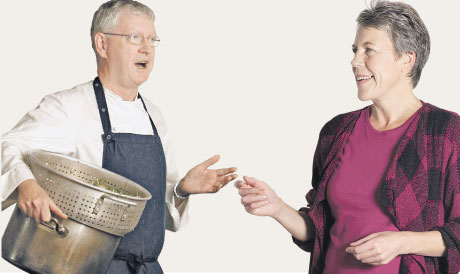
Shaun Hill and Helen Browning

Is it all over for organic food?

Is it still worthwhile buying organic? Farmer Helen Browning and Michelin-starred chef Shaun Hill debate the pros and cons
  • Is the future still organic? … Shaun Hill and Helen Browning. Photograph: SWNS.COM for the Guardian
    Farming and purchase of organic produce is on the decline with sales falling by 5.9% in the UK last year. Oliver Laughland brings together Helen Browning, organic farmer and director of the Soil Assocation, with Michelin-starred chef Shaun Hill to discuss what's driving people away.
    Helen Browning: The big dynamic going on is that the price of non-organic food is rising very fast. The price that farmers could get for conventional grain or milk is much higher than it has been, so the gap between the two is closing rapidly and those people who aren't really committed to producing organic might well think they've got an easier life going back to standard production. I'm worried we're going to end up with some quite big shortages in the next year or two of our key ingredients, if we don't keep our farmers farming this way.
    Shaun Hill: I use quite a few small producers and for them it's not possible to pay the fees for organic certification inspections. I use them and it's fine by me, but isn't the organic movement maybe losing out a bit?
    HB: We've bent over backwards to try to make sure that it's affordable for very small producers, but that's hard. There's a limit to how affordable you can make it. In an ideal world, you wouldn't need to certify things because we'd all be visiting our farms and buying directly from producers. We're not living in that world.
    SH: I'm broadly in favour of the organic movement, I just don't think it covers all the options. The veg box movement, for example, was a pain for people such as me because I don't want somebody else to choose what veg I have on a weekly basis. The ingredients I buy specifically because they are organic are meats such as chicken where there is an enormous difference in the welfare and the feed that the animals get. But organic has been a bit of a victim of its own success, you can get Zimbabwean courgettes in January with thousands of air miles on them because they tick all the organic boxes.
    HB: We looked quite hard at banning air trade a few years ago and decided not to. We know that the developing world needs to generate cash. Air trade isn't perfect, but less than 1% of our food is air traded. Organic certification gives you the guarantee that even if it's come from Kenya, you know it has been grown in the right way, and that people are likely to have been rewarded fairly for growing it; the soil would have been looked after and it would have been a much better and more sustainable system.
    SH: Do you not think though, with the expansion of organic food, producers whose hearts aren't in it are able to jump on the bandwagon and tick boxes that aren't actually doing us much more good? A lot of the quality of a vegetable or poultry is to do with the breed or variety. I'm not sure under this system whether we're getting the right varieties of vegetable and the right breeds of pig and chickens with an organic label.
    HB: It's hard to specify, "You must grow this particular variety". It's one of the reasons we run the organic foods award. We're trying to showcase fantastic taste.
    SH: But the next difficulty is when you move away from production to manufacture of, say, organic wine. There's a lot of pretty awful organic wine out there that is presumably there because it's organic rather than because it's good.
    HB: I think a lot of the organic wines that were dreadful have gone because people stopped buying them. I'd be interested to think about how we could help. Is there a way that we could put up taste barriers? Whose taste buds do we use to evaluate?
    SH: You can borrow mine!
    HB: It's always in our interest to make sure that our produce is as great to eat as it can be. Anybody, whether they're organic or not, who doesn't think about the quality of what they're producing and whether people are going to eat it, is bonkers. It's common sense that's gone out of farming for a long time. If you look at what's happened to the pork industry over the past 30 years, we've bred lean, lean pigs that grow at a million miles a day and they don't taste of anything and so people have stopped eating pork.
    SH: They've stopped eating pork because pork is bloody awful. You can sometimes imagine that you're not cooking it properly but it's just rubbish materials.
    HB: They are. I run a farm and pub, and we produce and sell a lot of pork because once people come to eat great pork again, they love it. And I think there is a demand, you just need to introduce people to things and you need to build the market up.
    Oliver Laughland: What can be done to make organic and better produce more affordable?
    SH: I don't think it should be a more affordable option. I think the cheap food lobby has done a huge disservice to people by giving expectations of having chicken the same price as the packaging.
    HB: One of the things we're attempting to do is to launch a campaign that is very much about trying to make sure that people most in need will benefit from a better, more organic diet and are not prevented from doing that by accessibility and affordability. We've got schools in Hackney 40% organic on 60p a day. It can be done. I agree with you that the cheap food culture is one that has dogged us terribly, but we also need to be aware that there are people who are on really tight budgets and we need to make sure that organic food is accessible to them.
    OL: Do restaurateurs have an obligation to encourage awareness?
    SH: The main obligation of a restaurateur is to stay in business despite rocketing overheads. I manage but it's a tough call for anybody who's attempting to do anything a bit better than the rest because you're competing with people who are less scrupulous than yourself. You've got to hope for the best, really. But you still get people in restaurants looking for a children's menu full of alphabet spaghetti and chicken nuggets – how on earth do you think these poor devils are going to appreciate a decent meal 10 years down the line?
    HB: For all of us, wherever you're coming from, farming or owning a restaurant, it's quite hard to be doing something that's better, and to make a success of it. Luckily, I think the world is changing. More and more people appreciate the value of food in its widest sense.
    SH: Well, we'll live in hope!

DEFINE: "TECHNOLOGICAL ADVANCEMENT" OF AGRICULTURE

MDG : UN Rio+20 Executive Coordinator  French Brice Lalonde

Rio+20 summit co-ordinator seeks to put agriculture centre stage

UN executive Brice Lalonde says pinpointing one key area will focus minds and boost progress on other development goals
  • guardian.co.uk,
  • Rio+20 co-ordinator Brice Lalonde wants to focus on agriculture at next year's summit in Brazil. Photograph: Antonio Scorza/AFP
    The Rio+20 global development summit co-ordinator is pushing for a tight focus on agriculture in an attempt to inject new energy into the landmark event, the Guardian has learned. Such a departure from UN tradition could be controversial, but Brice Lalonde, the UN's co-ordinator for the meeting, argues it would be more effective than the traditional laundry list of aspirations in pushing countries to meet clearly defined goals. Agriculture is a dominant concern in a year of famine and rising global food prices, and Lalonde believes focusing on the subject would help concentrate minds on the summit. He also argues it is impossible to work on agriculture in isolation; countries would, by default, have to make progress on other development goals. "My personal view is to concentrate on one major, overarching topic," Lalonde said. "When you work on agriculture, you can do it with all the goals associated with it: land use, biodiversity, women's empowerment, energy and water." In Washington, as in other world capitals, officials are now beginning to think ahead to the Rio summit, which will be held in June next year. The summit organisers have settled on a slogan: "The future we want." They held their first real meeting in Rio last week, and countries are due to submit their proposals for the conference by 1 November. The Brookings Institution had its first discussion on Rio+20 this week. But there is already debate about how the summit can rise above the deep disappointments of the UN's other big experiments in global action – implementing the millennium development goals and acting on climate change. Earlier summits, such as the meeting on biodiversity, set impossibly lofty goals like bringing ecosystem degradation to a halt by 2020. The climate talks have stalled, not least because it now looks very unlikely governments or the private sector will come up with a $100bn green fund by 2020. Some have even questioned whether existing UN institutions help or hinder efforts to reduce poverty and protect the environment. The UN's original mission was peace and security, the argument goes. It is not set up to promote sustainable development. However, the immediate preoccupation is how to get the most out of Rio. While Lalonde favours a focus on agriculture, others are pushing for the summit to focus on energy, women's empowerment and social justice. Some would like Rio to concentrate on protecting the oceans, or improving life in cities. Lalonde believes, however, that the most effective strategy would be to push for an agricultural revolution incorporating technological advances. In support of his view that adopting an overarching goal would by default require progress in other areas, he points to Africa, where most farmers are women; any gains in agriculture will automatically improve the status of women, Lalonde argues. But his proposals made only passing mention of education, and there was little directly on climate change. Lalonde's ideas, though generating interest, also remain controversial. Many see Rio as a moment to redefine the entire idea of development, making it less about GDP and growth and more about quality of life and environment. William Brown, a former scientific advisor to the interior secretary who is now a fellow at Brookings, said it would be difficult to refocus Rio at this stage, having originally billed it as an event on the green economy and better governance. "They can't drop the governance issue, and a regulatory global or world environmental organisation won't fly with the US (or others, who would be delighted to nod quietly as the US objected), " he wrote in an email.

Wednesday, August 31, 2011

WHAT'S IT GONNA BE, AMERICA???

Profits Before Environment

Mark Bittman on food and all things related.
I wasn’t surprised when the administration of George W. Bush sacrificed the environment for corporate profits. But when the same thing happens under a Democratic administration, it’s depressing. With little or no public input, policies that benefit corporations regardless of the consequences continue to be enacted.
No wonder an April 2010 poll from the Pew Research Center found that about only 20 percent of Americans have faith in the government (it’s one thing upon which the left and right and maybe even the center agree). But maybe this is nothing new: as Glenda Farrell, as Genevieve “Gen” Larkin, put it in “Gold Diggers of 1937,” “It’s so hard to be good under the capitalistic system.”
But is anyone in power even trying? Last winter, the Department of Agriculture deregulated Monsanto’s genetically modified alfalfa, despite concerns about cross-pollination of non-genetically modified crops. It then defied a court order banning the planting of genetically modified sugar beets pending completion of an environmental impact study.
Monsanto engineers these plants and makes Roundup, the herbicide they resist. But Roundup-ready crops don’t increase long-term yields, a host of farmers are now dealing with “superweeds” and there is worry about superbugs, nearly all courtesy of Monsanto. In fact, this system doesn’t contribute to much of anything except Monsanto’s bottom line. Yet Agriculture Secretary Tom Vilsack gave Monsanto the nod, perhaps yielding to pressure from the White House.
The United States exerts that same kind of pressure abroad. WikiLeaks cables show that U.S. “biotechnology outreach programs” have promoted genetically modified crops in Africa, Asia and South America; they’ve also revealed that diplomats schemed to retaliate against any European Union countries that oppose those crops.
Sacrificing the environment for profits didn’t stop with Bush, and it doesn’t stop with genetically modified organisms. Take, for example, the Keystone XL pipeline extension. XL is right: the 36-inch-wide pipeline, which will stretch from the Alberta tar sands across the Great Plains to the Gulf Coast, will cost $7 billion and run for 1,711 miles — more than twice as long as the Alaska pipeline. It will cross nearly 2,000 rivers, the huge wetlands ecosystem called the Nebraska Sandhills and the Ogallala aquifer, the country’s biggest underground freshwater supply.
If Keystone is built, we’ll see rising greenhouse gas emissions right away (tar sands production creates three times as many greenhouse gases as does conventional oil), and our increased dependence on fossil fuels will further the likelihood of climate-change disaster. Then there is the disastrous potential of leaks of the non-Wiki-variety. (It’s happened before.)
Proponents say the pipeline will ease gas prices and oil “insecurity.” But domestic drilling has raised, not lowered, oil prices, and as for the insecurity — what we need is to develop wiser ways to use the oil we have.
They say, too, that the pipeline could create 100,000 new jobs. But even the Amalgamated Transit Union and the Transport Workers Union oppose the pipeline, saying, “We need jobs, but not ones based on increasing our reliance on Tar Sands oil.”
Sounds as if union officials have been reading the writer and activist Bill McKibben, who calls the pipeline “a fuse to the biggest carbon bomb on the continent,” and NASA scientist Jim Hansen, who says the oil Keystone will deliver “is essentially game over” for the planet.
Game over? No problem, says the State Department, which concluded that the project will have no significant impact on “most resources along the proposed pipeline corridor.” The Sierra Club quickly responded by calling the report “an insult to anyone who expects government to work for the interests of the American people.”
I do expect that, and I am insulted. President Obama can deny Keystone the permit. A truly environmentally friendly president (like the one candidate Obama appeared to be) would be looking for creative ways to leave fossil fuels underground, not extract them. Perhaps he doesn’t “believe in” global warming at this point, like many Republicans?
When government defends corporate interests, citizens must fight. McKibben has helped organize protests at the White House against Keystone, and he’s one of hundreds who’ve been arrested in the last couple of weeks. These people are showing that the role of government as corporate ally must be challenged.
As it will be in the fight against carte blanche for genetically modified organisms: From Oct. 1 to Oct. 16, there will be a march from New York City to Washington to demand that genetically modified foods be labeled, something a majority of Americans want. This small, perfectly reasonable request has run into joint opposition from the biotech industry and (here we go again) the Food and Drug Administration.
Why are most of us are filled with mistrust of the government? Maybe because we, like Gen Larkin, know it’s so hard to be good under the capitalistic system.
Source:   http://opinionator.blogs.nytimes.com/2011/08/30/profits-before-environment/?hp

Tuesday, August 30, 2011

SUPERPESTS LOVE GMO CORN....FARMERS SPRAY MORE AND MORE KILLER CHEMICALS

Monsanto Corn Plant Losing Bug Resistance
by Scott Kilman
Widely grown corn plants that Monsanto Co. genetically modified to thwart a voracious bug are falling prey to that very pest in a few Iowa fields, the first time a major Midwest scourge has developed resistance to a genetically modified crop.
Corn earworm larva feasting on a corn ear. Iowa State University entomologist Aaron Gassmann's discovery that western corn rootworms in four northeast Iowa fields have evolved to resist the natural pesticide made by Monsanto's corn plant could encourage some farmers to switch to insect-proof seeds sold by competitors of the St. Louis crop biotechnology giant, and to return to spraying harsher synthetic insecticides on their fields. The discovery raises concerns that the way some farmers are using biotech crops could spawn superbugs.
Iowa State University entomologist Aaron Gassmann's discovery that western corn rootworms in four northeast Iowa fields have evolved to resist the natural pesticide made by Monsanto's corn plant could encourage some farmers to switch to insect-proof seeds sold by competitors of the St. Louis crop biotechnology giant, and to return to spraying harsher synthetic insecticides on their fields.
"These are isolated cases, and it isn't clear how widespread the problem will become," said Dr. Gassmann in an interview. "But it is an early warning that management practices need to change."
The finding adds fuel to the race among crop biotechnology rivals to locate the next generation of genes that can protect plants from insects. Scientists at Monsanto and Syngenta AG of Basel, Switzerland, are already researching how to use a medical breakthrough called RNA interference to, among other things, make crops deadly for insects to eat. If this works, a bug munching on such a plant could ingest genetic code that turns off one of its essential genes.
Monsanto said its rootworm-resistant corn seed lines are working as it expected "on more than 99% of the acres planted with this technology" and that it is too early to know what the Iowa State University study means for farmers.
The discovery comes amid a debate about whether the genetically modified crops that now saturate the Farm Belt are changing how some farmers operate in undesirable ways.
These insect-proof and herbicide-resistant crops make farming so much easier that many growers rely heavily on the technology, violating a basic tenet of pest management, which warns that using one method year after year gives more opportunity for pests to adapt.
Monsanto is already at the center of this issue because of its success since the 1990s marketing seeds that grow into crops that can survive exposure to its Roundup herbicide, a glyphosate-based chemical known for its ability to kill almost anything green.
These seeds made it so convenient for farmers to spray Roundup that many farmers stopped using other weedkillers. As a result, say many scientists, superweeds immune to Roundup have spread to millions of acres in more than 20 states in the South and Midwest.
Monsanto became the first company to sell rootworm-resistant biotech corn to farmers in 2003. The seed contains a gene from a common soil microorganism called Bacillus thuringiensis, or Bt, from which crop biotechnology has been used to mine several genes for making insecticidal proteins.
One of the genes Monsanto developed makes a crystalline protein called Cry3Bb1. It rips apart the gut of the rootworm but is harmless to mammals, birds and most beneficial insects. Competitors, which use other Bt genes to attack the rootworm, estimate that roughly one-third of the corn grown in the U.S. carries Monsanto's Cry3Bb1 gene.
Monsanto said it generated world-wide sales of $4.26 billion from corn seed and biotechnology traits, about 40% of its overall sales, in its last full year.
Until insecticide-producing corn plants arrived, Midwest farmers typically tried to keep pests like the corn borer and the rootworm in check by changing what they grew in a field each year, often rotating between corn and soybeans. That way, the offspring of corn-loving insects would starve the next year.
Some farmers began to plant corn in the same field year after year. The financial incentive to grow corn has increased in recent years in part because the ethanol-fuel industry's exploding appetite for corn has helped to lift prices to very profitable levels for growers.
According to Dr. Gassmann, the Iowa fields in which he found rootworms resistant to the Cry3Bb1 toxin had been producing Monsanto's Bt-expressing corn continuously for at least three years. Dr. Gassmann collected rootworm beetles from four Iowa cornfields with plant damage in 2009. Their larvae were then fed corn containing Monsanto's Cry3Bb1 toxin. They had a survival rate three times that of control larvae that ate the same corn.
Dr. Gassmann found that Monsanto's Bt toxin still had some lethal impact on the larvae from the problem Iowa fields, and that the bugs were still highly susceptible to a rootworm-resistant corn plant from a competitor that uses a different Bt toxin, called Cry34/35Ab1.
Scientists in other Farm Belt states are also looking for signs that Monsanto's Bt corn might be losing its effectiveness. Mike Gray, a University of Illinois entomologist, said he is studying rootworm beetles he collected in northwest Illinois earlier this month from fields where Monsanto's Bt-expressing corn had suffered extensive rootworm damage.
The government requires that farmers who plant the genetically modified corn take certain steps aimed at preventing insects from developing resistance. Farmers are told to create a refuge for the bugs by planting non-modified corn in part of their fields. The refuge, which can be as much as 20% of a farmer's field, is supposed to reduce the chances that two toxin-resistant bugs mate and pass along that trait to their offspring.
Dr. Gray said the confirmation of toxin-resistant rootworms in Iowa could force the U.S. Environmental Protection Agency to revisit its policy of allowing the size of these insect refuges to shrink to as little as 5% of a cornfield as crop biotechnology companies begin to sell seed for corn plants that can make two different rootworm-killing toxins.
Part of what has attracted some farmers to Monsanto's new SmartStax corn line is that it allows them to plant a smaller refuge. But one of the two anti-rootworm toxins in that variety is the Cry3Bb1 protein at the center of Dr. Gassmann's study.
The EPA said it is too early to comment on any implications arising from Dr. Gassmann's paper.

Friday, August 26, 2011

TAKE THE SURVEY: HOW HAPPY ARE YOU WITH OUR FOOD CHOICES?

FOOD DEMOCRACY NOW! HOW'S OBAMA DOING?
Last week President Obama and Secretary Vilsack traveled to the Midwest for a three-day Rural Tour to talk about jobs and economic security for rural America. During the 2007 primary season, then Senator Barack Obama laid out a series of progressive agricultural policies that if enacted would do more to help keep farmers on the land and rebuild rural America than anything he mentioned on his entire trip.
His recent visit here gave us the opportunity to reflect on the campaign promises that he made back then here in Iowa to stimulate rural economies, regulate factory farms and protect farmers from massive food industry consolidation. 

We'd like to know your thoughts on how you think President Obama and Secretary Vilsack have done in the past two and a half years. Please take just a 30 second survey right now? We have over 250,000 members --- letting them know how you feel can send a powerful message.
A few of the pending issues...
Organic and GMOs: Coexistence or the Road to Contamination?
While President Obama did make a stop at the Seed Savers Exchange, a famous heirloom seed bank, in Decorah, Iowa, he also made sure to balance that with a stop at a genetically engineered seed corn dealer in Atkinson, Illinois. Clearly, it would appear that President Obama is still hoping to have it both ways. What type of food do you want your family to eat?
Even so, there are a number of pending decisions on significant structural issues that President Obama and his administration need to make soon and they need to be made right. Compromise can be an important part of a democracy, but not when the livelihood of family farmers and rural America and the integrity of our food supply is on the line.
Antitrust Hearings: Incomplete
Last year the Obama administration held a series of important workshops looking into anti-competition abuses in food and agriculture sectors. That these hearings occurred in the first place were historic, but unfortunately the administration has failed to issue a report or take significant action against powerful corporate interests.
Food Democracy Now! delivered more than 200,000 comments to DOJ antitrust chief Christine Varney last December. Varney was widely praised for her commitment to enforcing antitrust violations, but last month she announced that she was leaving the DOJ for a white glove law firm without finishing the job.

Let us know if you think the Obama administration needs to do more to protect America’s farmers and consumers from massive food industry consolidation and the negative impact it has on our food supply.

Fair Market Livestock Rules: Incomplete
The other key area that President Obama promised farmers during the 2008 campaign was enforcing fair market livestock rules that would protect farmers from abusive contracts and price manipulation. But what seems like a reasonable and common sense solution is being blocked in Washington by the usual cartel of giant agribusiness lobbyists who would rather see the current unfair system continue so they can keep skimming all the farmer’s profits for themselves.
The truth is, Secretary Vilsack and the USDA have done the right thing and written a set of strong and fair rules that would offer livestock farmers legal protections in the marketplace for the first time. And for this, they’ve been vilified by Big Meat lobbyists who used their power to manipulate Congress in an effort to block this vital reform.
In order for America to grow we need to expand the circle so they hear the voice of the American people.
Please take a moment to tell them what you think. We will take the 10 most engaging and inovative responses telling the administration what they can do better and post them on our website. Those that are chosen will receive a FREE Food Democracy Now! t-shirt!
Thanks for participating in food democracy, 
Dave, Lisa and the Food Democracy Now! Team
Sources:
1. Politics, Farmers and Change: The End of Rural America, Huffington Post, 08/18/2011
http://action.fooddemocracynow.org/go/406?akid=366.160877.lDZZbw&t=11
2. Food Stamp Usage Across the Country, New York Times, 11/28/11
http://action.fooddemocracynow.org/go/407?akid=366.160877.lDZZbw&t=13
3. The Obama-Biden Plan for Rural America, Change.gov, 10/2007
http://action.fooddemocracynow.org/go/333?akid=366.160877.lDZZbw&t=15
4. President Obama's Wednesday Bus Tour Schedule: Town Halls in Atkinson & Alpha, Illinois, Obama Foodorama, August 17, 2011
http://action.fooddemocracynow.org/go/410?akid=366.160877.lDZZbw&t=17
5. Why Christine Varney Left the Justice Department, Suckerpunched on Anti-Trust, Counterpunch, 07/07/2011
http://action.fooddemocracynow.org/go/408?akid=366.160877.lDZZbw&t=19