Wednesday, September 29, 2010


Dear Ms. Earth Woman:

Thank you for expressing your concerns about genetic engineering and the safety of the food we consume. I agree with the majority of Americans who insist that they have the right to know which foods are genetically engineered.

On January 15, 2009, the Food and Drug Administration issued its final guidance for regulating food and products from genetically engineered animals. Unfortunately, the rules do not require genetically engineered food to be labeled as such unless it is deemed "materially different" from unmodified food.

I strongly support requiring that genetically engineered food bear a neutral label indicating that fact. Transparency is necessary to give consumers the tools they need to make wise, informed decisions. In addition, I believe we must increase our efforts to study the health and environmental risks that genetically engineered foods may present.

Please be assured that I will continue to fight for the safest and most environmentally responsible food supply possible.

Thank you again for taking the time to write to me. Please feel free to contact me again regarding this or any other issue of concern to you.

Barbara Boxer
United States Senator


Please do not respond to this message. If you would like to comment on legislation, please visit my website and use the correspondence form at http://www.boxer.senate.gov/en/contact/policycomments.cfm

Monday, September 27, 2010

LET THEM EAT....GOLD

Will the meeting in Rome result in action against food speculation? by Madeleine Bunting Friday 24 September 2010 18.21 BST guardian.co.uk

The idea that speculating on food prices has become a way for western financial institutions to make money at the cost of lives is abhorrent

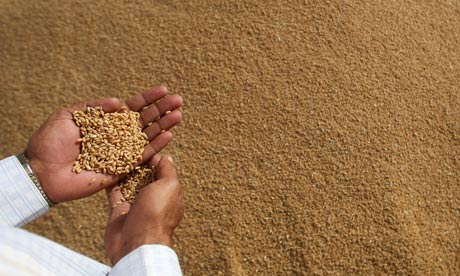
Food crisis: wheat grain at a wholesale grain market A prospective Indian buyer checks the quality of wheat grain at a wholesale grain market, in New Delhi.
Photograph: Manan Vatsyayana/AFP/Getty Images

Momentum is building to get some really tough action on the speculation pushing up food prices. At a conference today in London organised by the UK Food Group, Olivier De Schutter, the UN special rapporteur on the right to food, warned that a food crisis is inevitable unless we tighten up regulations on markets.

"The problem with the current system is when there is one [bit of] bad news, such as wildfires in Russia... speculators bet on higher prices, which leads those holding the food stocks not to sell in the hope of prices going up. This leads states to impose export bans, this leads buyers of commodities to buy as soon as possible in the fear of prices climbing and this leads to a chain reaction on the markets, which is dictated by panic rather than by the fundamentals and by the realities of stocks. That will continue happening until we better regulate the activity of financial investors on those markets for derivatives and agricultural commodities," he told the Guardian this afternoon.

There was already enough suspicion about risky financial products given how they brought the global economy to the brink of meltdown two years ago. But the idea that speculating on food prices has become a way for western financial institutions to make money at the cost of lives is really abhorrent. We've heard a lot recently about famine in west Africa and hunger in many other parts of the world; this is not about the availability of food, it's about the cost.

Look at the clip of Michel Barnier, the single market commissioner for the EU.

I don't think I have ever seen such passionate abhorrence and acknowledgement of responsibility from a politician. At least this is a political figure who still seems human – but can he live up to his rhetoric?

De Schutter warned today that the proposals being considered by the EU are not tough enough. It will be interesting to see if the UK is prepared to take on this issue; regulation is not something this coalition government has been too keen on, let alone regulation coming from Europe, but this issue could really fuel public anger with the banks.

My colleague Simon Rogers sketches out how food prices are rising. And John Vidal is reporting on the Food and Agriculture Organisation (FAO) summit in Rome, but the World Development Movement is arguing that the FAO must come out more strongly against speculation. The NGO has been pushing for action for months.

FOOD FIGHTS TO GET REAL FOOD IN SCHOOL LUNCHES!

School Food Wars by Ruth Conniff
Published on Friday, September 24, 2010 by The Progressive
My kids' school is awash in fresh fruits and vegetables this year.

As one of a handful of schools in our community that received the federal Fresh Fruits and Vegetables grant--available through the USDA for largely low-income schools--we are spending Sunday mornings buying produce at the local farmers' market, a few blocks from our school. Monday nights a group of parents gets together at a church across the street from the school building and washes and chops the produce, then loads it in the school fridge so the fourth and fifth graders can pass it out three mornings a week.

As labor-intensive as this whole process is, it is intensely rewarding. Watching the kids gobble up watermelon on the playground, or try cherry tomatoes for the first time in class, and hearing the comments about snack: "Cool! Green beans!" is a big lift.

It is especially gratifying since so many of the kids who are getting this snack are not familiar with fruits and vegetables. Many have never seen a fresh tomato before, let alone some of the more exotic veggies we are trying this year, like jicama and kohlrabi.

Certainly they are not getting that sort of thing at lunch in school.

For years, parents in our school district have been complaining about the deep fried French toast sticks and cocoa puffs in the breakfast program and the hot dogs and fries and cheese sauce at lunch.

Across the country, school lunch programs are under tight budgetary pressures. “The big issue is money,” Frank Kelly, the director of the Madison Metropolitan School District's food services department told the Wisconsin State Journal recently. “You can’t serve gourmet food for $3 a lunch. We’re squabbling over pennies for meals.”

But there is another issue, too, and that is a cultural and ideological one.

For Kelly and other people who serve food to kids in the public schools, there is a real sense of antagonism toward what they perceive as a bunch of high-income, helicopter moms with too much time on their hands--that is, the folks who want the lunches to be healthier. As Kelly sees it, these people just don't understand kids.

“We have two customers — parents and kids — and they want totally different things,” Kelly told the Wisconsin State Journal. “Parents want us to serve big chunks of vegetables, but kids won’t eat that."

For kids who rely on free and reduced breakfast and lunch programs, the thinking goes, just getting something to eat is so important, we can't afford to be fussy about nutrition. People who think you can make kids eat vegetables, in this view, are kidding themselves.

In fact, Kelly went so far as to suggest that these health-conscious parents don't even know what their own kids eat.

“I see so many kids walk into cafeterias and throw their sack lunches in the trash can. Who knows what they’re actually eating," Kelly says. "We have to offer things kids will actually eat.”

In a nation that is experiencing an unprecedented childhood obesity epidemic, that is a sobering thought.

I actually have some sympathy for Kelly's point of view. Like Michael Moore, he sees himself as a champion of regular folks with a lot of suspicion for elite liberal ideas about making poor people better themselves.

And as a parent, I am familiar with the idea that the "eat your vegetables!" approach to trying to make kids healthy can backfire.

But I also know that not ALL kids eat only junk food, and that what we put in front of them makes a difference.

I sat with my daughter at lunchtime once, and watched a classmate of hers eat the bag of peanut M&Ms and drink the soda she'd brought to school. That was her lunch.

Fast-food and convenience-store eating have taken deep root in our culture, especially for kids of busy, stressed parents who don't have the time or inclination to cook.

But it doesn't seem to me that this is driven by kids' refusal to eat differently. It is simply what they are used to, what they are surrounded by, and what even school officials seem convinced they want.

I sat in a second-grade classroom yesterday, and watched a kid demolish a pile of cherry tomatoes as big as his head. He liked them. His teacher also happened to think they were awesome, and spent the class period talking about how great our fruit and veggie snack is, as she served it up, with a quiet, non-pushy expectation that the kids would enjoy it.

We know kids need healthy food. We know the way we are feeding them is leading to a rate of type-2 diabetes previously found only in extremely overweight adults.

What IS the right response?

There are some small changes in the school district's hot lunch program this year. They have added a pasta salad with some veggies. I recently heard a food services employee and a farm-to-school advocate disagreeing about whether the kids are eating it or throwing it in the trash. It sometimes seems as though people see what they expect to see.

What we expect kids to do is often self-fulfilling.

At our school, there is a large population of Hmong immigrants. Many of the Hmong families have garden plots and farms. Many of them are on the free and reduced breakfast and lunch program. I've noticed that my daughters' Hmong classmates bring containers of vegetables and rice to lunch.

Why do you suppose children raised in a different food culture are eating those
vegetables? Are they somehow different? Are non-immigrant children somehow hard-wired to eat only mac and cheese?

Some of our Hmong families have relatives who are selling us the cucumbers and jicama we are serving in our snack program.

We have only been doing this for a couple of weeks so far, but I am really interested to see what we learn as a community, sharing food together.

As a school, a district, and a nation, we have so much to learn about nourishing
ourselves and our children.

One thing is clear from all the evidence about our children's health: we need to make a change.
© 2010 The Progressive

Ruth Conniff covers national politics for The Progressive and is a voice of The Progressive on many TV and radio programs. Conniff was a regular on CNN’s Sunday Capital Gang and is now a regular on PBS’s To the Contrary. She also has appeared frequently on C-SPAN’s Washington Journal and on NPR and Pacifica.

Sunday, September 26, 2010

FISH ON STEROIDS- NO!!!

Published on Saturday, September 25, 2010 by the Boston Globe
Keep Frankenfish Fiction

by Derrick Z. Jackson

I'M NOT getting anywhere near Frankenfish. I mean, do I really want to eat an aquatic Roger Clemens?

The Food and Drug Administration is close to approving a farm-raised salmon jacked up with enough growth hormone to come to market in 18 months instead of three years. In a publicity photo, the genetically-modified salmon is a battleship to the dinghy of a normal one. I do not care that the FDA says it is safe. We seethe at athletes on steroids and growth hormones, yet we're about to digest a food that is the equivalent of Shaquille O'Neal growing to seven feet by fourth grade? I don't think so.

But there is a far more important reason to shun Frankenfish. We need to rethink farmed fish, period. Aquaculture messes with Mother Nature far too much for the convenience of having fish available 24/7.

Farmed salmon are a classic case. For each pound it weighs, the fish consumed up to five pounds of smaller "forage fish'' caught around the world such as anchovies, sardines and herring, according to Stanford University researcher Rosamond Naylor, lead author of a 2009 aquaculture report in the Proceedings of the National Academy of Sciences. The reports says those forage fisheries "are either fully exploited or are in the process of recovering from overexploitation.''

That amplifies a 2008 report by Canadian and German scientists in Annual Reviews in Environment and Resources that said forage fish "play a crucial role in marine ecosystems,'' transferring energy from plankton to larger fish and marine mammals. The recent International Penguin Conference in Boston reported that 10 of 18 species of penguins were in decline, with the African penguin on an extinction track. A key reason is the commercial fishing of anchovies and sardines, which are penguin food.

Nothing about Frankenfish changes that. The Massachusetts inventors of the tinkered salmon, AquAdvantage, told the Globe editorial board recently that while its fish will come to market fast it will eat just 10 percent less fishmeal than a conventional salmon. That is virtually nothing when aquaculture's share of the world's fish meal and fish oil consumption has more than doubled in the past decade, causing the United Nations Food and Agriculture Organization to warn last year that "the amount of fish that can be produced annually from the world is finite.''

Besides salmon, another huge reason to rethink fish is the level to which aquaculture destroys mangroves and fouls coastal waters. In July, the United Nations Environment Program said the planet has lost nearly 20 percent of mangrove forests since 1980, equal to the size of Illinois, with aquaculture being one of the three big drivers for loss.

This is ironic, as mangroves are protective nurseries for wild fish. Studies say mangrove forests offer far more value for wild fisheries, hurricane protection, erosion control, and tourism than fish farms or development. The July UN report said, "Where vast tracts of mangroves have been cleared for shrimp aquaculture, fast profits often left a legacy of long-term debts and poverty, which are hard to reverse.''

If that is not enough, another 2009 Stanford study said the rapid expansion of marine aquaculture is a "major threat to ocean ecosystems'' because it is "expanding rapidly without reliable quantification'' of its waste. The study press release said, "All those fish penned up together consume massive amounts of commercial feed, some of which drifts off uneaten in the currents. And the crowded fish, naturally, defecate and urinate by the tens of thousands, creating another unpleasant waste stream.''

AquAdvantage grows its salmon inland, which could be an advance, but you still have to do something with all that poop. Those unpleasant facts had me avoiding farmed salmon long before Frankenfish. Aquaculture represents the illusion of an infinite bounty, our denial that our resources are finite. I love wild salmon in its summer season. Sustainability means accepting that there is a season and nothing more. Even if Frankenfish does not harm our bodies, it will continue the silent horror in our seas.
© 2010 Boston Globe

Saturday, September 25, 2010

Take Food Away from the Grip of the WTO, UN CALLS FOR "AGRO-ECOLOGICAL" FARMING!

Published on Friday, September 24, 2010 by The Guardian/UK
UN Warned of Major New Food Crisis at Emergency Meeting in Rome
Environmental disasters and speculative investors are to blame for volatile food commodities markets, says UN's special adviser


by John Vidal and agencies
The world may be on the brink of a major new food crisis caused by environmental disasters and rampant market speculators, the UN was warned today at an emergency meeting on food price inflation.

The UN's Food and Agriculture Organisation (FAO) meeting in Rome today was called last month after a heatwave and wildfires in Russia led to a draconian wheat export ban and food riots broke out in Mozambique, killing 13 people. But UN experts heard that pension and hedge funds, sovereign wealth funds and large banks who speculate on commodity markets may also be responsible for inflation in food prices being seen across all continents.

[July's wildfires in Russia have led to a draconian wheat ban, pushing up prices. (Photograph: Maxim Shipenkov/EPA)]July's wildfires in Russia have led to a draconian wheat ban, pushing up prices. (Photograph: Maxim Shipenkov/EPA)

In a new paper released this week, Olivier De Schutter, the UN's special rapporteur on food, says that the increases in price and the volatility of food commodities can only be explained by the emergence of a "speculative bubble" which he traces back to the early noughties.

"[Beginning in ]2001, food commodities derivatives markets, and commodities indexes began to see an influx of non-traditional investors," De Schutter writes. "The reason for this was because other markets dried up one by one: the dotcoms vanished at the end of 2001, the stock market soon after, and the US housing market in August 2007. As each bubble burst, these large institutional investors moved into other markets, each traditionally considered more stable than the last. Strong similarities can be seen between the price behaviour of food commodities and other refuge values, such as gold."

He continues: "A significant contributory cause of the price spike [has been] speculation by institutional investors who did not have any expertise or interest in agricultural commodities, and who invested in commodities index funds or in order to hedge speculative bets."

A near doubling of many staple food prices in 2007 and 2008 led to riots in more than 30 countries and an estimated 150 million extra people going hungry. While some commodity prices have since reduced, the majority are well over 50% higher than pre-2007 figures – and are now rising quickly upwards again.

"Once again we find ourselves in a situation where basic food commodities are undergoing supply shocks. World wheat futures and spot prices climbed steadily until the beginning of August 2010, when Russia – faced with massive wildfires that destroyed its wheat harvest – imposed an export ban on that commodity. In addition, other markets such as sugar and oilseeds are witnessing significant price increases," said De Schutter, who spoke today at The UK Food Group's conference in London.

Gregory Barrow of the UN World Food Program said: "What we have seen over the past few weeks is a period of volatility driven partly by the announcement from Russia of an export ban on grain food until next year, and this has driven prices up. They have fallen back again, but this has had an impact."

Sergei Sukhov, from Russia's agriculture ministry, told the Associated Press during a break in the meeting in Rome that the market for grains "should be stable and predictable for all participants." He said no efforts should be spared "to the effect that the production of food be sufficient."

"The emergency UN meeting in Rome is a clear warning sign that we could be on the brink of another food price crisis unless swift action is taken. Already, nearly a billion people go to bed hungry every night – another food crisis would be catastrophic for millions of poor people," said Alex Wijeratna, ActionAid's hunger campaigner.

An ActionAid report released last week revealed that hunger could be costing poor nations $450bn a year – more than 10 times the amount needed to halve hunger by 2015 and meet Millennium Development Goal One.

Food prices are rising around 15% a year in India and Nepal, and similarly in Latin America and China. US maize prices this week broke through the $5-a-bushel level for the first time since September 2008, fuelled by reports from US farmers of disappointing yields in the early stages of their harvests. The surge in the corn price also pushed up European wheat prices to a two-year high of €238 a tonne.

Elsewhere, the threat of civil unrest led Egypt this week to announce measures to increase food self-sufficiency to 70%. Partly as a result of food price rises, many middle eastern and other water-scarce countries have begun to invest heavily in farmland in Africa and elsewhere to guarantee supplies.

Although the FAO has rejected the notion of a food crisis on the scale of 2007-2008, it this week warned of greater volatility in food commodities markets in the years ahead.

At the meeting in London today, De Schutter said the only long term way to resolve the crisis would be to shift to "agro-ecological" ways of growing food. This farming, which does not depend on fossil fuels, pesticides or heavy machinery has been shown to protect soils and use less water.

"A growing number of experts are calling for a major shift in food security policies, and support the development of agroecology approaches, which have shown very promising results where implemented," he said.

Green MP Caroline Lucas called for tighter regulation of the food trade. "Food has become a commodity to be traded. The only thing that matters under the current system is profit. Trading in food must not be treated as simply another form of business as usual: for many people it is a matter of life and death. We must insist on the complete removal of agriculture from the remit of the World Trade Organisation," she said.
© Guardian News and Media Limited 2010

Wooo-Hooo, Oahu!!!!! Alooooooooooooha!!!!!


by Mark Fergusson, Chief Vegetarian Officer, Down to Earth -Honolulu, Hawaii

GMO stands for Genetically Modified Organism. GMO, also known as genetically engineered, bio-engineered, or biotech crop, is a term commonly used to refer to crops that have been genetically altered using gene-splicing technology (See the sidebar, "What Does GMO Mean, and Why Should I Be Concerned?).

I am excited to tell you that on Sunday Oct. 10th, 2010, Down to Earth Honolulu, Hawaii, will have a big Non-GMO sale! You'll get at least 40% off on a wide variety of Non-GMO Verified products including entrées, pasta sauce, breakfast foods, beverages, snacks, gluten-free products, and baking items.

The sale will be the high point of our participation in the natural food industry's first Non-GMO Month. The goal of Non-GMO Month is to build awareness of the new "Non-GMO Project Verified" logo that is starting to appear on non-GMO tested product packaging across the U.S. The new logo will empower consumers to exercise their right to choose non-GMO foods. We firmly believe you have a right to choose what you eat and feed your families, and the logo will help you make an informed decision about whether you want to eat GMO foods.

The new Non-GMO logo and the protocols governing the right to use it on product packaging were developed by The Non-GMO Project. This is a non-profit organization that Down to Earth has been a part of since inception.
-------------------------------------------------------------------------

What Does GMO Mean, and Why Should I Be Concerned?

GMO means Genetically Modified Organism -- also known as genetically engineered, bio-engineered, or biotech crops.

GMOs have been created in a laboratory using gene-splicing biotechnology. This process allows scientists to create combinations of plant, animal, bacteria and viral genes that do not occur in nature or through traditional crossbreeding. The process is haphazard, and can lead to unintended and uncontrolled changes in the organism’s DNA.

The vast majority of GMOs on the market are bred for herbicide tolerance and insecticide production. Despite biotech industry messages to the contrary, there are no GMOs available that have demonstrated increased yields, drought tolerance, nutritional superiority or any other consumer benefits. At the same time, there is a growing body of peer-reviewed research linking GMO consumption with decreased fertility, allergies, abnormalities in organs and immune response, and more.

In the European Union, all products containing more than 0.9% GMO are required by law to be labeled as such. Due to our own government’s lack of initiative with similar consumer protections, the Non-GMO Project was created. If you are concerned about GMOs and would like to see them more completely researched before feeding them to yourself and your family, you can now choose “Non-GMO Project Verified” products. Find out more at www.nongmoproject.org

The tenth of the month, or 10.10.10, is Non-GMO Day. On this day retailers throughout the nation will conduct educational activities to raise consumer awareness about the new "Non-GMO Project Verified" logo while also raising funds for the Non-GMO Project. We are donating 5% of sales that day to the Non-GMO Project. The proceeds will help advance consumers' right to choose and will help support the long-term availability of non-GMO food and ingredients.

October 2010 Is First Ever Non-GMO Month
As retailers, Non-GMO Month and 10.10.10 are great events for us to participate in, as we have first hand experience dealing with consumer frustration and confusion regarding GMOs, how to identify them, and how to avoid them while shopping for food. We experience the same frustration when buying products for our stores. So, Down to Earth is pleased to join this industry-wide effort to establish the Non-GMO Project.

We are motivated by a simple idea. We believe that consumers in North America should have access to clearly labeled non-GMO food and products. That conviction is the guiding mission of the Non-GMO Project. It’s a lot easier said than done! In the beginning, a huge part of the challenge was that—by the time the Project was started—GMOs had already been in production across the U.S. and Canada for nearly 10 years. Contamination risks to seeds, crops, ingredients and products had been steadily increasing without a standardized set of best practices to identify and stop contamination.

While this situation had previously paralyzed all efforts to address the problem, the Non-GMO Project took a different approach. They decided that the lack of a perfect solution was no excuse not to try to do something. They believed that with enough hard work and collaborative spirit they could improve the situation.

New Seal Backed by Third-Party Testing
Before the introduction of the Non-GMO Project, North America had no third-party verification program to test products for their GMO content. Many manufactures made non-GMO claims, but there was no way for you, as the consumer, to know whether or not the claims were actually true. Ideally, such claims would be backed by third-party testing. This idea is the heart of the Non-GMO Project—an independent Product Verification Program (PVP).

The PVP was designed to verify that participating companies or organizations are capable of producing and delivering products that comply with the Non-GMO Project’s Standard. It verifies that participants’ operations and systems comply with requirements of the Standard.

Nearly 900 products have been verified to date, with thousands more in the process. After "Verification" they are authorized to display this new logo on their packaging:

During the next few months, as manufacturers begin to include the Non-GMO Project Verification logo on their packaging, you will see more and more of the verified products on our shelves. A complete list of participating products is available on the Non-GMO Project’s website: www.nongmoproject.org

Down to Earth is proud to be a charter member of the Non-GMO Project. We feel strongly that our customers have a right to choose what they eat and feed their families. Many of them want to know whether the food they are purchasing contains GMO ingredients. Since Organic Certification prohibits the use of GMOs, selecting foods with the Organic label has been the only way customers could choose non-GMO foods. However, Organic Certification covers how a food is grown, not the content of the food itself. And, since food production has become increasingly compromised by cross pollination and cross contamination in processing and handling, even Organic Certification is not enough to ensure that a product is non-GMO.

What does the “Non-GMO Project Verified” logo mean?
The "Non-GMO Project Verified" logo is not a guarantee that the product is 100% GMO free. But it's close!

The protocols to grant Verification involve a comprehensive set of best practices to avoid contamination. All the ingredients must pass a test indicating that the ingredient is below 0.9% GMO (in alignment with laws in the European Union). After testing, the Project ensures that its rigorous traceability and segregation practices are followed to ensure that the tested ingredients are what get used in the product. In short, this seal means that a product has been produced according to rigorous best practices for GMO avoidance, including testing of risk ingredients.

The logo tells the consumer that GMO contamination has been avoided throughout the growth and harvesting of crops, their processing, storage and packaging. By making this information available to the public, the “Non-GMO Project Verified” label helps ensure that the customer will have the final say.

The supply of GMO-laden foods and products is increasing, although consumers remain skeptical. Often they are not aware of the meaning and potential effects of GMOs. According to the USDA, plantings of GM soybeans, corn, and cotton this year are at all-time highs: 93% of soybeans, 86% of corn, and 93% of the cotton planted in the United States is GMO. And with as much as 80% of processed foods in the country at risk for GMO contamination (according to the Grocery Manufacturers Association), it has been nearly impossible to make it out of the grocery store without GMOs in your cart!

But don’t give up hope just yet…the “Non-GMO Project Verified” seal will, for the first time, give you an opportunity to make informed choices when it comes to GMOs.

For more information about Non-GMO Month visit: http://www.nongmoproject.org/consumers/non-gmo-month/

To see Down to Earth's position statement on GMOs click here: http://www.downtoearth.org/about-us/position-statements/risks-genetic-engineering

Friday, September 24, 2010

OVERWHELMING DEMAND TO STOP FRANKENFISH!

Coalition Demands FDA Deny Approval Of Controversial Genetically Engineered Fish
Posted on August 27, 2010 by Heather
FDA Considers Approval of GE Salmon–the First GE Food Animal–Yet Fails to Inform the Public of Environmental and Economic Risks

A coalition of 31 consumer, animal welfare and environmental groups, along with commercial and recreational fisheries associations and food retailers submitted a joint statement criticizing an announcement this week by the U.S. Food and Drug Administration (FDA) that it will potentially approve the long-shelved AquAdvantage transgenic salmon as the first genetically engineered (GE) animal intended for human consumption.

The engineered Atlantic salmon being considered was developed by AquaBounty Technologies, which artificially combined growth hormone genes from an unrelated Pacific salmon, (Oncorhynchus tshawytscha) with DNA from the anti-freeze genes of an eelpout (Zoarces americanus). This modification causes production of growth-hormone year-round, creating a fish the company claims grows at twice the normal rate. This could allow factory fish farms to crowd fish into pens and still get high production rates.

Each year millions of farmed salmon escape from open-water net pens, outcompeting wild populations for resources and straining ecosystems. “We believe any approval of GE salmon would represent a serious threat to the survival of native salmon populations, many of which have already suffered severe declines related to salmon farms and other man-made impacts,” Marianne Cufone, director of Food and Water Watch’s fish program said.

If the FDA opens this door, GE fish will likely be among the millions of salmon that currently escape from open ocean pens every year. This could be the last blow to wild salmon stocks and in turn the thousands of men and women who depend on fishing for their livelihoods. “Approving genetically engineered salmon is a sharp contradiction to the agreements the United States has signed at NASCO, where transgenic salmonids are considered a serious threat to wild salmon” said Boyce Thorne Miller, Science and Policy Coordinator for the Northwest Atlantic Marine Alliance and accredited observer at the North Atlantic Salmon Conservation Organization.

Escaped GE salmon can pose an additional threat – genetic pollution resulting from what scientists call the “Trojan gene” effect.” Research published in the Proceedings of the National Academy of Sciences notes that a release of just sixty GE salmon into a wild population of 60,000 would lead to the extinction of the wild population in less than 40 generations.

Anticipating the stark danger to our fisheries and ocean environments – and trying to circumvent analyses of those dangers – AquaBounty has claimed that they will only raise their fish in land-based facilities. However most salmon farmers in the real world ply their trade in low-lying coastal areas and competing corporations will no doubt race to produce GE fish in crowded open ocean facilities already in use for fish production. Backsliding on its original claims, reports have circulated that AquaBounty may only suggest producers raise GE fish in “inland waters” – presenting novel threats to our nation’s lakes, rivers, and estuaries – many of which are already under attack by invasive fish species like the Asian carp and Northern snakehead.

“FDA’s decision to go ahead with this approval process is misguided and dangerous, and is made worse by its complete lack of data to review” said Andrew Kimbrell, Executive Director for the Center for Food Safety. “FDA has been sitting on this application for 10 years and yet it has chosen not to disclose any data about its decision until just a few days before the public meeting.”

On Wednesday, FDA officials announced that they had begun the approval process for the engineered salmon and have scheduled public meetings beginning Sunday, September 19. Speakers wishing to present oral comments are expected to submit their requests in writing by September 7th; one day after the FDA has said it may post “some” of the data to its website. “This is not a process that leads to full and informed public participation,” said Charles Margulis, Sustainable Food Program Coordinator for the Center for Environmental Health.

FDA announced the same day that it will hold a public comment period and a hearing on labeling for the transgenic salmon, which seems to presuppose that the controversial GE fish will be approved. If the GE fish is approved, Agency officials are undecided as to whether they will require any product labeling.

“We all know there is a great appetite for salmon, but the solution is not to ‘farm’ genetically engineered versions to put more on our dinner tables; the solution is to work to bring our wild salmon populations back” said Jonathan Rosenfield, PhD, a Conservation Biologist and President of the SalmonAID Foundation, a 28-member coalition of commercial, tribal, and sportfishing interests, conservation organizations and chefs. “The approval of these transgenic fish will only exacerbate the problems facing our wild fisheries.”

The statement was signed by the following:

CENTER FOR FOOD SAFETY – FOOD AND WATER WATCH – SALMONAID – NORTHWEST ATLANTIC MARINE ALLIANCE – ORGANIC CONSUMERS ASSOCIATION – FRIENDS OF THE EARTH – THE LIVING OCEANS SOCIETY – SMALL BOAT COMMERCIAL SALMON FISHERMEN’S ASSOCIATION – THE GEORGIA STRAIT ALLIANCE – CALIFORNIANS FOR GE-FREE AGRICULTURE – THE ORGANIC & NON-GMO REPORT – PLANETARY HEALTH, INC. – SIERRA CLUB – SAY NO TO GMOS! – CENTER FOR ENVIRONMENTAL HEALTH – CANADIAN BIOTECHNOLOGY ACTION NETWORK – INSTITUTE FOR FISHERIES RESOURCES – AMERICAN ANTI-VIVISECTION SOCIETY – PACIFIC COAST FEDERATION OF FISHERMEN’S ASSOCIATION – MANGROVE ACTION PROJECT – FOOD FIRST / INSTITUTE FOR FOOD AND DEVELOPMENT POLICY – EDEN FOODS, INC. – THE NON-GMO PROJECT – NORTHWEST RESISTANCE AGAINST GENETIC ENGINEERING – PCC NATURAL MARKETS – AMBERWAVES – GLOUSTER FISHERMEN’S WIVES ASSOCIATION – FRESH THE MOVIE – WASHINGTON BIOTECHNOLOGY ACTION COUNCIL – OREGON PHYSICIANS FOR SOCIAL RESPONSIBILITY