Monday, September 20, 2010

AMERICANS SAY NO TO GMO "FRANKENFISH" SALMON!!!


FOR IMMEDIATE RELEASE
September 20, 2010
2:08 PM

CONTACT: Food & Water Watch
Darcey Rakestraw, 202-683-2467;
drakestraw (at) fwwatch.org
National Consumer Organization: Halt Approval of Genetically Engineered Salmon Until FDA Conducts Tests on Long-Term Health Effects of Consuming Genetically Engineered (GE) Meat
78 % of Americans Don’t Want GE Salmon Approved Without More Research; Opposition Grows Stronger for Other Transgenic Meat
WASHINGTON - September 20 - Today national consumer organization Food & Water Watch will tell the FDA it must halt the approval of AquaBounty’s AquaAdvantage salmon until the agency could do its own studies regarding the long-term effects of human consumption of genetically engineered (GE) meat.

In its public comments today at the agency’s headquarters, the organization will note the results of a recent poll it conducted with Lake Research Partners showing that 78 % of Americans believe AquaBounty’s GE product should not be approved for human consumption. Opposition grows even stronger for genetically engineered meat, with 91 % saying the FDA should not allow transgenic pigs, chicken and cattle into the food supply until the agency could perform its own safety studies.

“The FDA is on the verge of approving a product that an overwhelming number of Americans will reject unless the agency can conduct its own studies showing that it’s safe, which it hasn’t done,” says Wenonah Hauter, Executive Director of Food & Water Watch. “The FDA has publicly disclosed four studies that it considered in this process. One was nearly 20 years old, and the other three were from AquaBounty itself—that hardly qualifies as independent analysis of the safety risks involved with this untested method.”

Americans are in near unanimity in their disapproval of genetically engineered fish and meat in the marketplace. The unusually high number of people polled who disapprove of the FDA’s process of approving transgenic animals prompted Joshua Ulibarri of Lake Research Partners to note, “I can’t remember a time when so many people polled were of one mind on an outcome. It’s pretty clear that people are not buying what the FDA is selling here.”

To make matters worse for consumers, the FDA could put it on the market without requiring labeling. “Based on past experience with FDA’s regulation of GE food like soy, corn and other food products, there would be no way to tell real salmon from GE salmon at the supermarket,” says Hauter.

The FDA relies on the very industries that it regulates for the data that it analyzes when approving new drugs or genetically engineered animals destined for the food supply. The background documents released by the agency contain multiple examples of how the limited data supplied to the agency limited the conclusions that could be drawn.

The nutrition and allergenicity studies the FDA mentioned in its publicly released brief on the issue earlier this month looked at relatively small numbers of fish. The nutritional composition study looked at 144 fish. The allergenicity study included only six GE salmon (out of a total of 18 fish). Both studies were conducted by AquaBounty or its contractors.

“The FDA is relying on company data from only a handful of fish,” says Hauter. “Such flimsy science isn’t good enough to assure the public that this product is safe to eat. This approval should be halted until the FDA can show the public that it has done a thorough review to make sure this product is safe.”

For more information on the poll, please see the memo: Attitudes Toward the FDA’s Plan on Genetically Engineered Fish
###
Food & Water Watch is a nonprofit consumer organization that works to ensure clean water and safe food. We challenge the corporate control and abuse of our food and water resources by empowering people to take action and by transforming the public consciousness about what we eat and drink.

Friday, September 17, 2010

WHAT'S IN A NAME? POISON BY ANY OTHER NAME IS (STILL) POISON!

High Fructose Corn Syrup Wants A New Name
By Meredith Melnick Tuesday, September 14th, 2010


High fructose corn syrup — an ingredient in everything from soda to ketchup to pickles — has such a bad reputation that the Corn Refiners Association (CRA) wants to change the name of the popular sweetener to “corn sugar.”

The CRA argues that high fructose corn syrup is simply sugar and is no more harmful than any other popular full-calorie sweetener, like sugars derived from beets or sugar cane.

While some data links high fructose corn syrup to higher rates of obesity, some cancers and diabetes, compared with sugar, the evidence is inconclusive — though that doesn’t ease the public’s fears. The AP reports that “Americans’ consumption of corn syrup has fallen to a 20-year low on consumer concerns that it is more harmful or more likely to cause obesity than ordinary sugar, perceptions for which there is little scientific evidence.”

But some nutritionists and endocrinologists who specialize in diabetes argue that high fructose corn syrup tricks people into eating more food. When glucose (contained in sugar) enters the bloodstream, it stimulates production of insulin and of a hormone called leptin, which signals to the brain that the body has eaten enough. By contrast, the fructose contained in high fructose corn syrup doesn’t stimulate the production of leptin. Studies also show that fructose is processed into fat more quickly than is glucose.

Due to manufacturing, high fructose corn syrup contains 45% glucose, which is found naturally in corn, and 55% fructose. The body processes these sugars differently.

The American Medical Association says there is not enough evidence to suggest that high fructose corn syrup is linked to poor health. And other experts argue that other full-calorie sweeteners are no better.

“Soda pop sweetened with sugar is every bit as conducive to obesity as soda pop sweetened with high fructose corn syrup,” Michael Jacobson, executive director of the Center for Science in the Public Interest, told the AP.

The real problem is getting sugar — of all kinds — out of our diet. Because high fructose corn syrup has a long shelf life and is cheaper to produce than cane sugar, it’s a popular ingredient in wide variety of processed and packaged foods. The U.S. Department of Agriculture calculated that the average American consumes 35.7 pounds of high fructose corn syrup per year.

For more, see the Mayo Clinic’s advice on high fructose corn syrup consumption.

Read more: http://healthland.time.com/2010/09/14/high-fructose-corn-syrup-might-get-a-makeover/#ixzz0znPbDk1P
Source: http://healthland.time.com/2010/09/14/high-fructose-corn-syrup-might-get-a-makeover/

Wednesday, September 8, 2010

S 510 Is ANYTHING BUT a FOOD SAFETY or MODERNIZATION ACT!

S 510 is hissing in the grass
Posted on April 24, 2010 by Rady

By Steve Green

S 510, the Food Safety Modernization Act, may be the most dangerous bill in the history of the US. It is to our food what the bailout was to our economy, only we can live without money.

“If accepted [S 510] would preclude the public’s right to grow, own, trade, transport, share, feed and eat each and every food that nature makes. It will become the most offensive authority against the cultivation, trade and consumption of food and agricultural products of one’s choice. It will be unconstitutional and contrary to natural law or, if you like, the will of God.” ~Dr. Shiv Chopra, Canada Health whistleblower


It is similar to what India faced with imposition of the salt tax during British rule, only S 510 extends control over all food in the US, violating the fundamental human right to food.

Monsanto says it has no interest in the bill and would not benefit from it, but Monsanto’s Michael Taylor who gave us rBGH and unregulated genetically modified (GM) organisms, appears to have designed it and is waiting as an appointed Food Czar to the FDA (a position unapproved by Congress) to administer the agency it would create — without judicial review — if it passes. S 510 would give Monsanto unlimited power over all US seed, food supplements, food and farming.
History

In the 1990s, Bill Clinton introduced HACCP (Hazardous Analysis Critical Control Points) purportedly to deal with contamination in the meat industry. Clinton’s HACCP delighted the offending corporate (World Trade Organization “WTO”) meat packers since it allowed them to inspect themselves, eliminated thousands of local food processors (with no history of contamination), and centralized meat into their control. Monsanto promoted HACCP.

In 2008, Hillary Clinton, urged a powerful centralized food safety agency as part of her campaign for president. Her advisor was Mark Penn, CEO of Burson Marsteller*, a giant PR firm representing Monsanto. Clinton lost, but Clinton friends such as Rosa DeLauro, whose husband’s firm lists Monsanto as a progressive client and globalization as an area of expertise, introduced early versions of S 510.
S 510 fails on moral, social, economic, political, constitutional, and human survival grounds.

1. It puts all US food and all US farms under Homeland Security and the Department of Defense, in the event of contamination or an ill-defined emergency. It resembles the Kissinger Plan.

2. It would end US sovereignty over its own food supply by insisting on compliance with the WTO, thus threatening national security. It would end the Uruguay Round Agreement Act of 1994, which put US sovereignty and US law under perfect protection. Instead, S 510 says:

COMPLIANCE WITH INTERNATIONAL AGREEMENTS.

Nothing in this Act (or an amendment made by this Act) shall be construed in a manner inconsistent with the agreement establishing the World Trade Organization or any other treaty or international agreement to which the United States is a party.

3. It would allow the government, under Maritime Law, to define the introduction of any food into commerce (even direct sales between individuals) as smuggling into “the United States.” Since under that law, the US is a corporate entity and not a location, “entry of food into the US” covers food produced anywhere within the land mass of this country and “entering into” it by virtue of being produced.

4. It imposes Codex Alimentarius on the US, a global system of control over food. It allows the United Nations (UN), World Health Organization (WHO), UN Food and Agriculture Organization (FAO), and the WTO to take control of every food on earth and remove access to natural food supplements. Its bizarre history and its expected impact in limiting access to adequate nutrition (while mandating GM food, GM animals, pesticides, hormones, irradiation of food, etc.) threatens all safe and organic food and health itself, since the world knows now it needs vitamins to survive, not just to treat illnesses.

5. It would remove the right to clean, store and thus own seed in the US, putting control of seeds in the hands of Monsanto and other multinationals, threatening US security. See Seeds – How to criminalize them, for more details.

6. It includes NAIS, an animal traceability program that threatens all small farmers and ranchers raising animals. The UN is participating through the WHO, FAO, WTO, and World Organisation for Animal Health (OIE) in allowing mass slaughter of even heritage breeds of animals and without proof of disease. Biodiversity in farm animals is being wiped out to substitute genetically engineered animals on which corporations hold patents. Animal diseases can be falsely declared. S 510 includes the Centers for Disease Control (CDC), despite its corrupt involvement in the H1N1 scandal, which is now said to have been concocted by the corporations.

7. It extends a failed and destructive HACCP to all food, thus threatening to do to all local food production and farming what HACCP did to meat production – put it in corporate hands and worsen food safety.

8. It deconstructs what is left of the American economy. It takes agriculture and food, which are the cornerstone of all economies, out of the hands of the citizenry, and puts them under the total control of multinational corporations influencing the UN, WHO, FAO and WTO, with HHS, and CDC, acting as agents, with Homeland Security as the enforcer. The chance to rebuild the economy based on farming, ranching, gardens, food production, natural health, and all the jobs, tools and connected occupations would be eliminated.

9. It would allow the government to mandate antibiotics, hormones, slaughterhouse waste, pesticides and GMOs. This would industrialize every farm in the US, eliminate local organic farming, greatly increase global warming from increased use of oil-based products and long-distance delivery of foods, and make food even more unsafe. The five items listed — the Five Pillars of Food Safety — are precisely the items in the food supply which are the primary source of its danger.

10. It uses food crimes as the entry into police state power and control. The bill postpones defining all the regulations to be imposed; postpones defining crimes to be punished, postpones defining penalties to be applied. It removes fundamental constitutional protections from all citizens in the country, making them subject to a corporate tribunal with unlimited power and penalties, and without judicial review. It is (similar to C-6 in Canada) the end of Rule of Law in the US.

For further information, watch these videos:

Food Laws – Forcing people to globalize
http://www.youtube.com/watch?v=Ia-P4rL2IWc

State Imposed Violence … to snatch resources of ordinary people
http://www.youtube.com/watch?v=onw_PkVvpts&feature=related

Corporate Rule
http://www.youtube.com/watch?v=6PwqUQ_HIlg&feature=related

Reclaiming Economies
http://www.youtube.com/watch?v=hXoJHG-er7A&feature=related

Oak snake image at Alfred B. Maclay Gardens State Park, Florida
http://snipurl.com/vrg6p

Ed. Note: Also see this piece by lawyers: Food Safety: The Worst of Both Bills (HR 2749 and S 510).

10 DAYS TO TELL THE FDA NO GMO FRANKENFISH SALMON!!!

EXTRACT: "No new data relating to the environmental and economic risks that transgenic salmon will pose if they escape into the wild was included in the materials released today."

PUBLIC STILL IN THE DARK ON TRANSGENIC SALMON

FDA's Incomplete Data Release is "Too Little, Too Late"

Fails to Uphold President Obama’s Call for Openness and Transparency

FOR IMMEDIATE RELEASE: September 3 2010
JOINT PRESS STATEMENT

Washington DC - A broad coalition of consumer and environmental groups, along with commercial and recreational fisheries associations, chefs, and food retailers, declared today’s partial data release by the U.S. Food and Drug Administration (FDA) on the genetically engineered salmon up for approval as a human food product insufficient and unacceptable.

"For the millions of consumers, fishermen, and stakeholders who will be affected by the FDA's decision, FDA's release of incomplete information today is simply too little, too late," said Andrew Kimbrell, Executive Director for the Center for Food Safety. "FDA's fundamentally flawed process flies directly in the face of President Obama's executive order for openness and transparency in government."

Materials made available today on FDA’s website relate to an announcement by FDA officials on August 25 that the agency will potentially approve the long-shelved AquAdvantage transgenic salmon as the first genetically engineered (GE) animal intended for human consumption.

The data provided by FDA today is rather scant given that the FDA has had 10 years to review the product. The study on changes in the morphology of the new GE salmon involved only 12 fish. The limited study on possible allergic reactions involved only 6 fertile GE fish and 6 infertile fish.

These small sample sizes are inadequate for a full review of the health and safety of these fish when they are raised in a commercial operation. Rather than tell the company to run new studies with adequate samples sizes, the FDA is recommending the fish not be raised in the US, but that the eggs be produced in Canada and the fish be grown in Panama and imported into the US.

The GE Atlantic salmon under consideration was developed by AquaBounty Technologies, which artificially combined growth hormone genes from an unrelated Pacific salmon, (Oncorhynchus tshawytscha) with DNA from the anti-freeze genes of an eelpout (Zoarces americanus). This modification causes continuous production of growth-hormone year-round, creating a fish the company claims grows to full size at twice the normal rate of non-GE farmed salmon. This could allow factory fish farms to crowd fish and still get high production rates despite the stressful conditions found there.

While some materials released today relate to the transfer of the genes and DNA construct, and the chemistry of small samples of the flesh of the GE fish were compared to that of other farmed salmon, no data from long-term clinical feeding trials were required.

"Without the required testing and safety data we have no way to prove the transgenic salmon is safe to eat," said Michael Hansen, Senior Scientist at Consumers Union.

Moreover, while the FDA is only recommending approval of sterile females for meat, the data released today show that up to 5 percent of the eggs produced may be fertile. They did not list what protocols they will require of the company to assure that only infertile eggs are shipped to produce the salmon. Moreover, there is no discussion of potential sex changes in the fish.

One of the most serious issues regarding AquaBounty's GE salmon is that FDA currently has no adequate means to assess the fish as a GE animal intended as a human food product. Rather than developing an appropriate evaluation method, FDA is currently proceeding to approve the GE fish through its process for reviewing a new animal drug.

"By choosing to use the animal drug process for reviewing this GE fish, basic health and safety data was kept a secret until just before the hearing on its approval,' said Wenonah Hauter, Executive Director of Food & Water Watch. 'It is outrageous to keep this vital information secret - consumers have a right to know what FDA is trying to allow into our food supply."

Additionally, the materials released by FDA may not include anything claimed by AquaBounty as "confidential business information.”

"This is not a process that leads to full and informed public participation," said Charles Margulis, Food Program Director at the Center for Environmental Health. "After 10 years of this application sitting at the FDA, failure to give the public all available data in a timely manner shows just how misguided and deficient FDA's approval process truly is."

"No new data relating to the environmental and economic risks that transgenic salmon will pose if they escape into the wild was included in the materials released today," said Erich Pica, President of Friends of the Earth US.

Despite being slated for widespread commercial production, the Environmental Assessment conducted by AquaBounty only focuses on two locations - Canada and Panama. If approved, GE fish could be the last blow to wild Atlantic salmon stocks. The US FDA maintains the fiction that producing the eggs on a Canadian island in a gulf of the Atlantic Ocean will assure that the fertile fish won’t escape into the wild.

"This conclusion is based on a flawed assessment completed by Aquabounty itself and wrongly assumes nothing will go wrong when in reality there are countless points where GE salmon can escape into the wild from this system" said Pica.

Contacts:
Jaydee Hanson, Center for Food Safety: 202-547-9359 (w); 703-231-5956 (c)
Lauren Wright, Food and Water Watch: 703 447-7106
Michael Hansen, Consumers Union: 917-774-3801

Monday, September 6, 2010

DEFINITION OF INSANITY: BURNING FOSSIL FUELS to grow THEN DIVERT FOOD CROPS TO MAKE (You MUST be JOKING) FUELS!

Friends of the Earth urges end to 'land grab' for biofuels

Charity predicts more food shortages in Africa because of EU target to produce 10% of all transport fuels from biofuels by 2020

* By Katie Allen
* The Guardian, Monday 30 August 2010


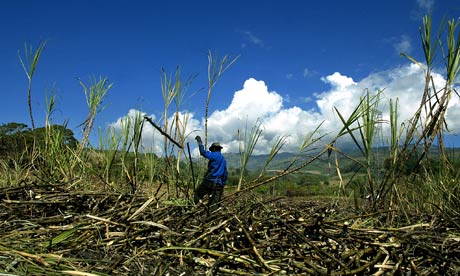
Cane cutter wields machete Friends of the Earth says that biofuel crops, including sugar cane, 'are competing directly with food crops for fertile land'. Photograph: Juan Carlos Ulate/Reuters

European Union countries must drop their biofuels targets or else risk plunging more Africans into hunger and raising carbon emissions, according to Friends of the Earth (FoE).

In a campaign launching today, the charity accuses European companies of land-grabbing throughout Africa to grow biofuel crops that directly compete with food crops. Biofuel companies counter that they consult with local governments, bring investment and jobs, and often produce fuels for the local market.

FoE has added its voice to an NGO lobby that claims local communities are not properly consulted and that forests are being cleared in a pattern that echoes decades of exploitation of other natural resources in Africa.

In its report "Africa: Up for Grabs", the group says that the key to halting the land-grab is for EU countries to drop a goal to produce 10% of all transport fuels from biofuels by 2020.

"The amount of land being taken in Africa to meet Europe's increasing demand for biofuels is underestimated and out of control," Kirtana Chandrasekaran, food campaigner for FoE in the UK, said. "Especially in Africa, as long as there's massive demand for biofuels from the European market, it will be hard to control. If we implement the biofuels targets it will only get worse. This is just a small taste of what's to come."

A number of European companies have planted biofuel crops such as jatropha, sugar cane and palm oil in Africa and elsewhere to tap into rising demand. But the trend has coincided with soaring food prices and ignited a debate over the dangers of using agricultural land for fuel.

Producers argue they typically farm land not destined, or suitable for, food crops. But campaigners reject those claims, with FoE saying that biofuel crops, including non-edible ones such as jatropha, "are competing directly with food crops for fertile land".

ActionAid claimed this year that European biofuel targets could result in up to 100 million more hungry people, increased food prices and landlessness.

Natural disasters including floods in Pakistan and a heatwave in Russia have wiped out crops in recent weeks and intensified fears of widespread food shortages.

The United Nations has singled out biofuel demand as a factor in what it estimates will be as much as a 40% jump in food prices over the coming decade.

Estimates of how much land in Africa is being farmed by foreign companies and governments, either for food or fuel crops, vary significantly. The FoE report focuses on 11 African countries in what it sees as a rush by foreign companies to farm there. In Tanzania, for example, it says that about 40 foreign-owned companies, including some from the UK, have invested in agrofuel developments. It argues that such activities are actually raising carbon emissions in many cases because virgin forests are being cut down.
Lip service

The report concludes: "While foreign companies pay lip service to the need for 'sustainable development', agrofuel production and demand for land is resulting in the loss of pasture and forests, destroying natural habitat and probably causing an increase in greenhouse gas emissions."

Sun Biofuels, a British company farming land in Mozambique and Tanzania and named in the report, criticised the charity's research as "emotional and anecdotal" and said that its time would be better spent looking into ways to develop equitable farming models in Africa.

Sun's chief executive, Richard Morgan, said his company's leasing of land in Tanzania had taken three years, during which 11 communities, comprising about 11,000 people, were consulted.

"I find it insulting from Friends of the Earth. Somehow it's indirect criticism of Mozambiquan and Tanzanian governments that they would allow this dispossession to take place," he said.

Morgan conceded that such a protracted process could raise expectations among local people of jobs and investment that could not be met, and said that it was often those negative testimonies that were collected by newspapers and NGOs. But he insisted that Sun was creating jobs where possible and that much of the biofuel production was destined for domestic markets in Africa rather than Europe.

"There's an opportunity here to get investment into local communities in an ethical way," he said.

In many cases, biofuel production was replacing or reducing illegal tree felling, Morgan added. "Tanzania has a large landless community felling forest land. If you give employment to those people as an alternative, there is a chance you can intervene commercially there in a good way."

Biofuel crops were being grown on land that was not intended for food production, he said: "Often we are growing trees on land already cut down for charcoal or in some cases tobacco. We haven't displaced anyone."

But FoE argues that "most of the foreign companies are developing agrofuels to sell on the international market". Its campaigners in Africa are demanding that African states should immediately suspend further land acquisitions and investments in agrofuels. Instead, they want to see fundamental changes in consumption habits in developed countries – be it making more use of public transport or adopting different diets.

Chandrasekaran said: "Biofuels is just a small part of what is happening. What needs to change are consumption patterns in the west. That means [eating less] meat and dairy, given more than a third of the world's agricultural land goes to feeding meat and dairy production. It also means [reducing] consumption of fuel."

Source: http://www.guardian.co.uk/environment/2010/aug/30/biofuels-land-grab-friends-of-the-earth

Friday, September 3, 2010


GATES FOUNDATION INVESTS IN MONSANTO
Both will profit at expense of small-scale African farmers

August 25, 2010
Seattle, WA – Farmers and civil society organizations around the world are outraged by the recent discovery of further connections between the Bill and Melinda Gates Foundation and agribusiness titan Monsanto. Last week, a financial website published the Gates Foundation’s investment portfolio, including 500,000 shares of Monsanto stock with an estimated worth of $23.1 million purchased in the second quarter of 2010 (see the filing with the Securities and Exchange Commission). This marks a substantial increase from its previous holdings, valued at just over $360,000 (see the Foundation’s 2008 990 Form).

“The Foundation’s direct investment in Monsanto is problematic on two primary levels,” said Dr. Phil Bereano, University of Washington Professor Emeritus and recognized expert on genetic engineering. “First, Monsanto has a history of blatant disregard for the interests and well-being of small farmers around the world, as well as an appalling environmental track record. The strong connections to Monsanto cast serious doubt on the Foundation’s heavy funding of agricultural development in Africa and purported goal of alleviating poverty and hunger among small-scale farmers. Second, this investment represents an enormous conflict of interests.”

Monsanto has already negatively impacted agriculture in African countries. For example, in South Africa in 2009, Monsanto’s genetically modified maize failed to produce kernels and hundreds of farmers were devastated. According to Mariam Mayet, environmental attorney and director of the Africa Centre for Biosafety in Johannesburg, some farmers suffered up to an 80% crop failure. While Monsanto compensated the large-scale farmers to whom it directly sold the faulty product, it gave nothing to the small-scale farmers to whom it had handed out free sachets of seeds. “When the economic power of Gates is coupled with the irresponsibility of Monsanto, the outlook for African smallholders is not very promising,” said Mayet. Monsanto’s aggressive patenting practices have also monopolized control over seed in ways that deny farmers control over their own harvest, going so far as to sue—and bankrupt—farmers for “patent infringement.”

News of the Foundation’s recent Monsanto investment has confirmed the misgivings of many farmers and sustainable agriculture advocates in Africa, among them the Kenya Biodiversity Coalition, who commented, “We have long suspected that the founders of AGRA—the Bill and Melinda Gates Foundation—had a long and more intimate affair with Monsanto.” Indeed, according to Travis English, researcher with AGRA Watch, “The Foundation’s ownership of Monsanto stock is emblematic of a deeper, more long-standing involvement with the corporation, particularly in Africa.” In 2008, AGRA Watch, a project of the Seattle-based organization Community Alliance for Global Justice, uncovered many linkages between the Foundation’s grantees and Monsanto. For example, some grantees (in particular about 70% of grantees in Kenya) of the Alliance for a Green Revolution in Africa (AGRA)—considered by the Foundation to be its “African face”—work directly with Monsanto on agricultural development projects. Other prominent links include high-level Foundation staff members who were once senior officials for Monsanto, such as Rob Horsch, formerly Monsanto Vice President of International Development Partnerships and current Senior Program Officer of the Gates Agricultural Development Program.

Transnational corporations like Monsanto have been key collaborators with the Foundation and AGRA’s grantees in promoting the spread of industrial agriculture on the continent. This model of production relies on expensive inputs such as chemical fertilizers, genetically modified seeds, and herbicides. Though this package represents enticing market development opportunities for the private sector, many civil society organizations contend it will lead to further displacement of farmers from the land, an actual increase in hunger, and migration to already swollen cities unable to provide employment opportunities. In the words of a representative from the Kenya Biodiversity Coalition, “AGRA is poison for our farming systems and livelihoods. Under the philanthropic banner of greening agriculture, AGRA will eventually eat away what little is left of sustainable small-scale farming in Africa.”

A 2008 report initiated by the World Bank and the UN, the International Assessment of Agricultural Knowledge, Science and Technology for Development (IAASTD), promotes alternative solutions to the problems of hunger and poverty that emphasize their social and economic roots. The IAASTD concluded that small-scale agroecological farming is more suitable for the third world than the industrial agricultural model favored by Gates and Monsanto. In a summary of the key findings of IAASTD, the Pesticide Action Network North America (PANNA) emphasizes the report’s warning that “continued reliance on simplistic technological fixes—including transgenic crops—will not reduce persistent hunger and poverty and could exacerbate environmental problems and worsen social inequity.” Furthermore, PANNA explains, “The Assessment’s 21 key findings suggest that small-scale agroecological farming may offer one of the best means to feed the hungry while protecting the planet.”

The Gates Foundation has been challenged in the past for its questionable investments; in 2007, the L.A. Times exposed the Foundation for investing in its own grantees and for its “holdings in many companies that have failed tests of social responsibility because of environmental lapses, employment discrimination, disregard for worker rights, or unethical practices.” The Times chastised the Foundation for what it called “blind-eye investing,” with at least 41% of its assets invested in “companies that countered the foundation’s charitable goals or socially-concerned philosophy.”

Although the Foundation announced it would reassess its practices, it decided to retain them. As reported by the L.A. Times, chief executive of the Foundation Patty Stonesifer defended their investments, stating, “It would be naïve…to think that changing the foundation’s investment policy could stop the human suffering blamed on the practices of companies in which it invests billions of dollars.” This decision is in direct contradiction to the Foundation’s official “Investment Philosophy”, which, according to its website, “defined areas in which the endowment will not invest, such as companies whose profit model is centrally tied to corporate activity that [Bill and Melinda] find egregious. This is why the endowment does not invest in tobacco stocks.”

More recently, the Foundation has come under fire in its own hometown. This week, 250 Seattle residents sent postcards expressing their concern that the Foundation’s approach to agricultural development, rather than reducing hunger as pledged, would instead “increase farmer debt, enrich agribusiness corporations like Monsanto and Syngenta, degrade the environment, and dispossess small farmers.” In addition to demanding that the Foundation instead fund “socially and ecologically appropriate practices determined locally by African farmers and scientists” and support African food sovereignty, they urged the Foundation to cut all ties to Monsanto and the biotechnology industry.

AGRA Watch, a program of Seattle-based Community Alliance for Global Justice, supports African initiatives and programs that foster farmers’ self-determination and food sovereignty. AGRA Watch also supports public engagement in fighting genetic engineering and exploitative agricultural policies, and demands transparency and accountability on the part of the Bill and Melinda Gates Foundation and AGRA.
Contact:
Travis English, AGRA Watch
(206) 335-4405
Brenda Biddle, The Evergreen State College & AGRA Watch
(360) 878-7833

http://www.seattleglobaljustice.org/agra-watch

CORN WARS


In the Fields of Italy, a Conflict Over Corn

By ELISABETH ROSENTHAL
The New York Times Published: August 23, 2010
VIVARO, Italy — Giorgio Fidenato declared war on the Italian government and environmental groups in April with a news conference and a YouTube video, which showed him poking six genetically modified corn seeds into Italian soil.

Photo: Nadia Shira Cohen for The New York Times

Last week, Giorgio Fidenato, who had planted genetically modified corn, stood amid stalks that had been trampled by antiglobalization activists.

An ear of corn infested with corn borers. A modified variety is meant to counteract the pest.

In fact, said Mr. Fidenato, 49, an agronomist, he planted two fields of genetically modified corn. But since “corn looks like corn,” as he put it, it took his opponents weeks to find his crop.

The seeds, known as MON810, are modified so that the corn produces a chemical that kills the larvae of the corn borer, a devastating pest. Yet while European Union rules allow this particular seed to be planted, Italy requires farmers to get special permission for any genetically modified, or G.M., crop — and the Agriculture Ministry never said yes.

“We had no choice but to engage in civil disobedience — these seeds are legal in Europe,” said Mr. Fidenato, who has repeatedly applied for permission, adding that he drew more inspiration from Ron Paul than Gandhi.

The World Trade Organization says that general bans on genetically modified crops constitute an unfair trade barrier, because there is no scientific basis for exclusion. But four years after a W.T.O. panel ruled that European Union policies constituted an illegal “de facto moratorium” on the planting of genetically modified seeds, some farmers, like Mr. Fidenato, and seed producers like Monsanto complain that Europe still has not really opened its doors.

It is true that a small but growing number of European countries, including Spain, Portugal and Germany, now allow some cultivation of genetically modified crops. But only two genetically modified seeds (MON810 and the Amflora potato seed) out of dozens on the global market have made it through the European Commission’s laborious approval process, a prerequisite for use.

What is more, some areas of Europe have declared themselves “G.M.O.-free zones,” or free of genetically modified organisms. France, Austria and Germany specifically ban MON810, saying they believe that it could harm local crops. In Italy, a Kafkaesque approval process in which the Agriculture Ministry has never established the requirements for success, makes genetically modified crops a nonstarter.

Such foot-dragging reflects passionate public opposition to the crops in many parts of Europe, even as more than three-quarters of corn, soybeans and sugar beets in the United States are genetically modified. Though the science is at best inconclusive, there is a widespread conviction in Italy that genetically altered foods and crops pose dangers to human health and ecosystems.

After Mr. Fidenato’s provocation, investigators did genetic testing to identify the locations of the offending stalks in the sea of cornfields that surround this tiny town. Officials seized two suspect fields — about 12 acres — and declared the plantings illegal. Greenpeace activists surreptitiously snipped off the stalks’ tassels in the hope of preventing pollen from being disseminated.

On Aug. 9, 100 machete-wielding environmental activists from an antiglobalization group called Ya Basta descended on Vivaro and trampled the field before local police officers could intervene. They left behind placards with a skull and crossbones reading: “Danger — Contaminated — G.M.O.”

Giancarlo Galan, who became agriculture minister in April, called the protesters “vandals,” although he did not say he would allow genetically modified crops. But Luca Zaia, the previous agriculture minister and president of the nearby Veneto region, applauded the rampage, saying: “There is a need to show multinationals that they can’t introduce Frankenstein crops into our country without authorization.”

Over the past decade, genetically modified crops have been a major source of trade friction between Europe and the United States.

Both the United States Food and Drug Administration and the European Food Safety Agency say that there is no scientific evidence that eating MON810 corn is dangerous. But there is greater disagreement on how genetically modified plants affect ecosystems and whether traditional and genetically modified crops can be kept apart to avoid what organic farmers call “contamination” of traditional crops by modified plants or genes. Seed or pollen can travel with the wind or on farm equipment or truck tires, sometimes for hundreds of miles.

This issue is particularly sensitive in Italy, whose farmers rely heavily on specialized organic and heritage crops, like hundreds of varieties of tomatoes. Crops contaminated with genetically modified material can lose its organic designation. Farmers worry that plants with tailor-made survival genes will over time displace tastier traditional varieties.

Greenpeace has called the European Union’s judgment to accept MON810 as safe “fundamentally flawed,” noting, for example, that the chemical that kills corn borer larvae could also harm butterflies that land on the plants. Even in the United States, reservations linger. This month, a federal judge in San Francisco revoked permission for further planting of genetically modified sugar beets, saying that the Agriculture Department had not adequately assessed the environmental consequences; 95 percent of the sugar beets in the United States are genetically modified.

Faced with a W.T.O. judgment on the one hand and a reluctant public on the other, the European Commission has tried in recent years to walk a middle ground. It requires countries to establish procedures for separating traditional and modified crops, like maintaining certain distances between fields. Recent proposals give regions increasing latitude to deny entry to such plants if they provide scientific proof that the seeds could harm the environment, however.

But groups like the American Farm Bureau Federation say that studies used to justify excluding genetically modified crops do not pass muster.

Here in Vivaro, farmers are divided about the issue, said Luca Tornatore, Ya Basta spokesman and an astrophysicist from Trieste, Italy, noting that his group’s “blitz” did not allow much time for talking with local people.

Residents may not know much about the science of genetically modified crops, but they are quite familiar with the corn borer larvae; they tunnel into ears of corn, allowing funguses to fill the holes in their wake. Some of the funguses produce mycotoxins that can end up in places like the milk of corn-fed cows and have been associated with serious health problems, including cancers.

Some farmers spray insecticides on the crops to prevent the boring, but it must be applied at just the right moment and leaves chemical residues as well as an odor in the air. Others simply sell the corn in bulk, ignoring the problem, said Mr. Fidenato, displaying an ear from a field that was alive with worms and covered with patches of white fuzz.

If the Italian government does not relent on the genetically modified seeds, he warned, he commands an army of farmers across Italy who are prepared to plant MON810 to force its hand.

But it is not clear that the battle of Vivaro will have a quick victor. Jail time or at least fines are expected for Mr. Fidenato (illegal planting) and Mr. Tornatore (trespassing and destroying private property).