Monday, June 17, 2013

THE CASE FOR LABELING GMO CROPS & ANIMALS - AND BANNING PATENTS ON LIFE


Label GMOs now.

The Case for No GMO Patents

Friday, 14 June 2013 11:49 By Tony Pereira, Truthout | Op-Ed


(Photo: CT Senate Democrats / Flickr)The June 13, 2013 Supreme Court decision that human genes are not patentable should logically be the first step in reversing three decades of decisions that flouted the previously general understanding that Section 101 of Title 35 U.S.C. prohibited patenting of living organisms.
In the case of genetically modified seeds, strands of DNA from flowers, fish and animals and/or a virus are loaded into a gene gun - sort of a specialized pellet gun - and literally shot into the new seed to be modified in hopes that the inserted DNA will be incorporated by it without further intervention, mix with the seed and take hold, and the "new" plant that will grow from this new seed will replicate and reproduce the new DNA in the new seeds after harvesting.
Anything is fair game here; the possible combinations are exponentially high, infinite. GMO patents that have been granted for genetically modified (GM) corn, canola, cotton, sugar beets and soy have their roots in a first case for a patent application filed with the US Patent Office by General Electric (GE), which developed a bacterium capable of breaking down crude oil, to be used in treating oil spills. GE listed one of its genetic engineers, Chakrabarty, as the inventor. [1]

The application was rejected by the patent examiner, Sidney Diamond, because under patent law it was generally understood that living things were not patentable subject matter under Section 101 of Title 35 U.S.C.[2]

GE appealed to The Board of Patent Appeals and Interferences, which agreed with the original decision. On a subsequent appeal, the US Court of Customs and Patent Appeals overturned the case in GE's and Chakrabarty's favor, writing that "the fact that micro-organisms are alive is without legal significance for purposes of the patent law," thus blatantly disregarding Title 35. Sidney A. Diamond, commissioner of Patents and Trademarks, appealed to the Supreme Court of the United States (SCOTUS) in the Chakrabarty v. Diamond case, which was argued on March 17, 1980. A narrow 5-4 decision was issued on June 16, 1980. The patent was granted by the USPTO on March 31, 1981. [3]

SCOTUS thereby handed corporations the right to patent life, bacteria, seeds, plants, and animals in a misguided decision, which again ignored Title 35's exclusion of all patents on life and living organisms. While the manipulation process was new, all of the original existing DNA and all receiving DNA from whatever provenance are not.

Genetic material constitutes the inalienable property and inheritance of all humankind, as it has evolved in a wondrous process in nature that took billions of years, a process in which corporations did not participate in the least - nor could they have. Neither the receiving gene-spliced DNA, which constitutes 99.999% of all the genetic material involved in the process, nor the spliced infinitesimal amount of DNA used in the process can be claimed as the inventor's property. In this light, patents on life constitute the theft, in plain daylight, of the natural patrimony and inheritance of the world, which belongs to all of humanity, by and for the exclusive use and profit of a very few. The words do exist in the vocabulary and in the historical record for this type of action: dictatorial fascism, the collusion of corporate interests with the dictatorial coercive powers of the State. [4]

On June 13, 2013, the SCOTUS light bulbs suddenly went on, and on a unanimous vote (9-0), the court rejected a patent application for two cancer genes isolated by Myriad Genetics, Inc. In the court's opinion written by Justice Clarence Thomas, Title 35 was repeatedly invoked as "...we hold that a naturally occurring DNA segment is a product of nature and not patent eligible merely because it has been isolated..." This is, finally, the right decision. [5]

GMOs are just the reverse of this case, i.e., DNA is combined instead of being isolated, thus logically also not patentable just because two or more DNA segments have been mixed together.

The doors are now open to reverse all previous 30 years of wrongdoings and false GMO patents and end the absurdity that everything in life, the food that we eat, plants, microbes, viruses, fish and animals can ultimately be patented and owned by someone else. GMO patent insanity has already led to crimes against humanity, and crimes against the planet.

The horrifying Frankensteinian effects of GMO foods on animals and plants are now being discovered by Serallini, Carman and other studies. The case is not over; it just started. So let's get busy. Maybe this is a good time to be an attorney. Life, nature, all living things, the human body, whole or in parts are not patentable, ever.

Never were, never will be. May this be a lesson to all who foolishly thought they could steal from the patrimony of life.

References:

CROPS NOT CONDOS HUMMINGBIRD TREE-SIT - BAY AREA

Allenshummingbird

Hummingbird tree-sit could stop San Fran developers where occupiers failed

When dozens of police officers in riot gear raided the occupied Hayes Valley Farm in San Francisco early last Thursday morning, it seemed like the end of the road for this garden space. Activists from around the Bay Area had moved in on June 1 with the hopes of holding off the developers set to raze the farm and replace it with 182 condo units, retail space, and a parking garage. But after the early raid, a handful of arrests, and one activist falling 30 feet from a protest platform hung in a tree, it looked like time had run out.
That was before everyone met the Allen’s hummingbird.
Susie Cagle

After developers moved in and began toppling trees, someone alerted them to nesting hummingbirds on the land, and the project was put on hold while biologists and wardens from the Department of Fish and Wildlife investigated.
The Allen’s hummingbird is hardly endangered — it enjoys a pretty significant West Coast population in California and Oregon. Nonetheless, it is protected under the 1918 Federal Migratory Bird Treaty Act along with, well, all other non-pet birds. It’s not illegal to destroy migratory bird habitat — otherwise no condos would ever get built! — but it is illegal to destroy their eggs and nests.
“The developers might get a fine, or the project might be on ice for now,” said farm activist Effie Rawlins. The Department of Fish and Wildlife didn’t respond to a request for comment.
Could a little bird really slow San Francisco’s epic apartment construction boom? Probably not for long: It may be springtime now, but those cute little Allen’s all migrate south to Mexico for the winter …
Susie Cagle writes and draws news for Grist. She also writes and draws tweets for Twitter.
SOURCE:  http://grist.org/cities/hummingbird-tree-sit-could-stop-san-fran-developers-where-occupiers-failed/

GMO CONTAMINATION - LET US COUNT THE WAYS

Doug Gurian-ShermanThe many ways of GM contamination


Date:Jun 17, 2013


Doug Gurian-Sherman, a senior scientist in the food and environment programme at the Union of Concerned Scientists (UCS), is among the most frequently cited experts on agricultural biotechnology. There is a reason for this. Gurian-Sherman is objective and meticulous in his analysis that is enriched by a long and varied experience with US government institutions and later with public interest and environmental advocacy organizations such as Center for Food Safety and UCS.

At the Environmental Protection Agency (EPA), Gurian-Sherman was responsible for assessing human health and environmental risks from transgenic plants and microorganisms and developing biotechnology policy and at the Food and Drug Administration he was on its inaugural advisory food biotechnology subcommittee.

In an interview to Latha Jishnu, the plant pathologist who has conducted post-doctoral research on rice and wheat molecular biology at the US Department of Agriculture laboratory in Albany, California, explains how biotech giant Monsanto’s unapproved GM wheat could have contaminated a farmer’s field in Oregon. Gurian-Sherman also explains why GM contamination is widespread across the world. Excerpts:
 

Doug Gurian-ShermanWe understand that Monsanto scrapped its trials in 2004. Why has it taken this long for the contamination to occur? Could you explain how it could have taken place?
The contamination is likely to have occurred at the time of the field trials, that is, before it concluded in 2004. It could have been carried along since then, either by the farmer if he or she saves seed every year, or more likely, was part of contaminated seed that the farmer bought from a seed company or some other possible, but less likely scenario. We cannot know which until widespread testing of our wheat supply is done, which could take weeks.
Could there be other instances of contamination which have not come to light or have been hushed up?
It is quite possible that this is not an isolated incident – for this or other genes in any number of crops that have gone through field trials over the past 26 years. This is for two reasons. First, the provisions for preventing contamination that USDA recommends, such as providing certain isolation distances from non-GMO crops, cannot ensure that contamination will not happen. This assessment is based both on the many incidents that have already occurred and been documented and on what we know about the biology of gene flow, the possibility of human error (accidental mixing of seed), and so on.
Second, there is no routine testing for possible contamination from genes from experimental field tests. And the tools, for example, DNA probes to run tests, are not generally available since they are maintained in secret as confidential business information by companies. There are typically over a thousand field tests per year in the US for numerous experimental genes for many crops although most by far are for a handful of large acreage crops like corn, and most genes are for herbicide tolerance or insect resistance. And many field trials consist of several different actual fields, often in several different states. That is a lot of opportunities for possible contamination.
If you add all of this together, it suggests a real possibility that other experimental engineered genes could have contaminated crops in the past, but have never been detected. Usually, if this has occurred, it would be at very low levels, although there are some scenarios where contamination could be much higher.
It is also possible for field tests to be conducted in the US before any food safety assessment by our FDA although I do not know what percentage has occurred in that order.

Are you're saying is that this instance of an illegal GM wheat is just the tip of the iceberg?

It may be the tip of the iceberg. We simply do not know because testing for contamination from experimental field tests is minimal and possibly non-existent for experimental genes that do not have a commercial counterpart. We are in the dark about that, and I find that troubling.
Monsanto says its field trials of Roundup Ready wheat in Oregon were conducted on spring wheat and not winter wheat. What is the difference and how does it exonerate Monsanto?
There are several general types of wheat, including spring wheat (planted in spring), winter wheat (planted in fall, harvested in late spring), soft, hard, red and wheat, including combinations of these traits. These can then also be bread wheat or durum wheat.
I do not believe that Monsanto’s statement exonerates them or implies somehow that this is not widespread. First, if this GM wheat is in the seed supply, it is not necessarily from a field trial in Oregon. That seems to be an assumption that some are making but I see no reason that this would necessarily be the case. It could be from other trials in the US northwest, which produce similar types of wheat, or even elsewhere. I have seen nothing so far to suggest that they have not tested in other types of wheat. And in any case, a spring wheat might contaminate winter wheat although there are a few aspects related to germination and time to maturity that could make that less likely, but may not rule it out.
According to news agency reports, Monsanto "conducted at least 279 field tests of herbicide-resistant wheat on over 4,000 acres (one acre equals 0.4 hectare)”.  That seems like a lot to us in India. Is this the norm for field tests in the US?
For crops like soybeans and corn, it is very much higher. For most crops, like vegetables that are grown commercially on smaller acreage, it is much lower.
Is the USDA equipped to ensure there is no contamination from such field tests?
No, as I explained earlier. It is hard to predict how often it may occur, but it has been detected a number of times when, unlike for most experimental genes, someone actually looks for it. Most of the prominent incidents of contamination in the past, for example, Liberty Link 601 rice, BT10 corn, have been detected because there were tools to detect it, and people were looking for these. For experimental genes that have no commercialized similar counterpart we would not know about possible contamination.
What are the lessons for India from this? If contamination could occur in the US what are the chances it won't happen here or in other countries?
It is very difficult to have a high confidence that contamination will not happen. A number of things would need to be done differently during field trial than countries typically require—and it would be more costly.


Interviewee: 

Walmart Supercenter Costs Taxpayers $904,542 and $1.7 million a Year

America Feeds the Rich

The Farm Bill that is expected to pass the U.S. House this week explains income inequality in America.
The Republican-sponsored proposal slashes food stamps for poor children and pads farm subsidies for wealthy agri-businessmen.
This comes just a week after Senate Republicans refused to protect the poorest students from doubled college loan interest rates because that required closing tax loopholes that benefit big corporations. It comes just weeks after a new study showed the Walmart heirs, among the richest people in the world, pay their workers so little that taxpayers fork over billions to subsidize Walmart's payroll through programs like -- food stamps.
This all violates America's cherished ideal of equal opportunity. Americans strive to achieve believing they have the same chance at success as everyone else and, more importantly, that the egalitarian American system will provide their children with a level playing field on which to attain their full potential. Americans believe their government should maintain that level field. But it does not. Not when poor students are denied access to low-interest college loans while Washington charges Wall Street virtually no interest. Not when the House farm bill feeds the rich and starves the poor.
Republican Congressman Stephen Fincher of Frog Jump, Tenn., is the ugly face of the feed-the-rich public policy. He is a seventh generation millionaire agri-businessman. He raked in $3.5 million in federal farm subsidies from 1999 to 2012. That averages out to $269,000 a year in farm welfare. It makes him one of the largest farm welfare recipients in Tennessee history as well as among members of Congress.
This politician, who thrived on the government dole, raking in $738 a day in farm welfare over the past 13 years, is among the loudest advocates for increasing subsidies to agribusiness by about $10 billion and slashing food stamps by $20 billion.
That would take food from 2 million poor people. They get an average of $133 a month in food stamps. That's less than $5 a day for the poor -- not the $738 a day that Fincher got.
Fincher justified taking food out of the mouths of poor people by quoting the Bible, 2 Thessalonians 3:10, to be specific: "For even when we were with you, we gave you this command: Anyone unwilling to work should not eat."
Citing that verse shows a frightening level of cluelessness. First, Fincher took it out of context. It was intended as an admonishment of those who'd stopped working in anticipation of the Second Coming, not as a castigation of generic non-workers.
Second, 49 percent of those receiving food stamps are children. Would Fincher have five-year-olds work for their supper? How about infants?
Finally, the food stamp program encourages work, and the number of recipients who do tripled in the first decade of the century.
Among the working poor are Walmart employees. Generally, to qualify for food stamps, a family can't earn more than 130 percent of poverty level, which would be $25,000 for a family of three. A typical Walmart worker earning $8.81 an hour, slightly more than minimum wage, receives $15,576 a year.
An analysis by the Democratic staff of the U.S. House Committee on Education and the Workforce found that such low wages harm families and burden taxpayers. Government benefit programs -- such as food stamps -- enable Walmart's low wage workers to barely scrape by, the report says.
Using data from Wisconsin's Medicaid program, the staff determined that the average Walmart Supercenter there costs taxpayers between $904,542 and $1.7 million each year. That's for programs like Medicaid and food stamps.
The report also notes: "Rising income inequality and wage stagnation threaten the future of America's middle class. While corporate profits break records, the share of national income going to workers' wages has reached record lows."
Walmart provides the perfect example of that. The corporation made $17 billion last year, while paying its workers poverty wages. As Walmart workers use government programs to get by, the six Walmart heirs now have more wealth than the bottom 42 percent of Americans combined. Between 2007 and 2010 the wealth of the six richest Walmart heirs rose from $73 billion to $90 billion while the wealth of the average American declined from $126,000 to $77,000.
This results from government policy. The government doesn't require Walmart to pay a living wage. Instead, the government uses taxpayer dollars to minimally subsidize low-paid Walmart workers while cutting taxes on the wealthy Walmart heirs.
The government subsidizes Walmart the way it does millionaire farmers like Fincher. Though low-income workers receive the food stamps, essentially that government aid is welfare for Walmart. A food stamp applicant must prove poverty to qualify for government aid. But not big business. Not agri-business.
The number of food stamp recipients increased dramatically since 2008 because of the great recession, an event caused by reckless gambling on Wall Street. House Republican policy calls for the victims of the recession to suffer and the perpetrators to continue receiving low interest federal loans.
This policy, this funneling of money to the top, increases inequality and decreases opportunity. A child who goes to school hungry, for example, has a very hard time learning.
Universal Studios is among the corporations that have institutionalized inequity. At its parks, middle-class parents and their children wait for hours for entrance to attractions, but the wealthy and their scions simply cut in line. The children of the wealthy don't have to wait. Universal facilitates this with expensive VIP tickets that entitle rich children to park privileges. The VIP package includes hand sanitizer in case a rich kid accidentally touches a "regular Joe" kid, as Universal called them. Also, VIP families get exclusive breakfast and lunch service.
America feeds the rich. Equal opportunity is dead.

Sunday, June 16, 2013

SEEDS ARE LIFE FORMS - “Monsanto Laws” UPOV 91, PATENTS PROHIBIT FARM-SAVED SEEDS - UNCONSTITUTIONAL?


Via Campesina and the Fight for Seeds

The U.S. Court of Appeals ruled in favor of Monsanto and its patented seeds last Monday by throwing out a case tirelessly petitioned for by organic farmers. That decision dealt yet another blow to the small-scale agricultural community—it was only last month that the U.S. Supreme Court unanimously affirmed the agricultural giant’s “license agreement” yet again.(Photo: Tineke D'haese for Via Campesina)
But Via Campesina, the global agrarian movement made up of more than 200 million peasants in 80 countries, is not ceding to big agriculture. This week, Via Campesina held its VI International Organizing Conference in Jakarta, Indonesia, reaffirming its fundamental commitment to seed sovereignty.
With the Green Revolution came a promise to end hunger through so-called miracle seeds. Instead, it ushered in seed property rights, domination and even criminalization of small-scale farmers, and waves of transnational corporate control of agriculture. Under “Monsanto Laws,” more specifically known as UPOV 91, patents prohibit farm-saved seeds and peasant seeds for which multinational corporations have filed patents. UPOV 91 works hand-in-glove with the Plant Variety Protection Act that asserted heritage seeds counterfeit to standardized industrial varieties.  
These policies, adopted by one country after another, routinely displace peasants in the Global South and wreak havoc on the environment. In the Global North, native seeds have nearly reached extinction while hybrid (and often chemical GMO) varieties take their place.
“After 30 to 40 years of the Green Revolution, we’ve lost our seeds,” said Guy Kastler, a small-scale farmer from France. Kastler explained that he and other agricultural activists from Europe traveled to Latin America, Asia, and Africa to find and learn about peasant seeds. Those learning exchanges led Via Campesina to launch its Seed Campaign in 2001, through which it advocates the recovery, protection, and preservation of peasant seeds in each of its geographic regions—with a specific focus on those hardest hit by corporate seed policy.
Chile—a laboratory for neoliberalism—has churned out some of the worst agricultural policies in Latin America. Francisca “Pancha” Rodriguez defied Pinochet’s unmerciful military regime, literally carrying indigenous seeds in the folds of her skirts across international borders where they could be safely stored while her husband fought on the revolutionary frontlines. Today Pancha plays an integral role in Via Campesina’s Seed Campaign through the National Association of Indigenous and Rural Women (ANAMURI). She has trained countless women at home and across the world. “Locally, we understood what would happen if people lost their seeds,” Pancha offered, “But this is not only our battle. It is a universal struggle that we are turning into a rural revolution.”
Chukki Nanjundaswamy, a farmer who is part of Karnataka State Farmers Association (KRRS), explained that when Green Revolution technology hit India in the ‘60s peasants lost seeds because they were told to use modified high-yield varieties. “At first the companies offered free packets, but then they started charging,” she said. “High-yield seeds don’t grow in the rain-fed regions where sixty percent of Indian farmers work.” Through KRRS and Via Campesina, Nanjundaswamy breeds natural seeds on her own farm, sets up community seed banks with local activists, and advocates Agroecology through zero-budget natural farming.
“Seeds are life,” Nelson Mudzingwa, a farmer from Zimbabwe, passionately explained. “Without seeds there is no food, and without food there is no life.” Nelson’s local grassroots movement, Zimbabwe Small Organic Farmers Forum (ZIMSOFF), was only ratified as a Via Campesina member organization this week—but its advocacy around seeds has been more than a decade in the making. In fact, Nelson himself has been saving heirloom seeds ever since he can remember, and said that it is at the heart of agricultural tradition passed down from his forefathers. “On my farm, not even a single grain grows from outside my fence,” he proudly added.
One of the main events at Via Campesina’s gathering this week was an outdoor Agroecology fair where farmers exchanged experience and practices. That learning opportunity closed with a ceremony in which farmers exchanged their indigenous seeds from five continents. Peasant activists throughout the movement, working on complex interrelated issues—from land grabs to climate change to migration—agree that it all starts with control of their seeds.

Thursday, June 13, 2013

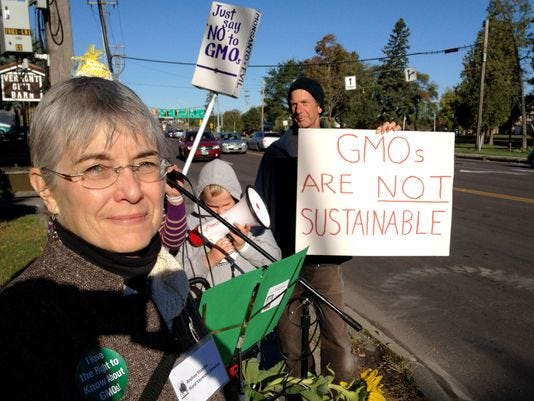
GMO LABELING - NATIONAL DOMINOES START TO FALL - STATE BY STATE

Labels sought for genetically modified food

From Maine to Washington, a growing number of states are taking on the issue of genetically engineered foods, fanning the flames of a decades-old debate about whether the products are dangerous to human health.
This month, Connecticut became the first state to pass a law requiring the labeling of food made from genetically modified organisms (GMOs). In May, the Vermont House passed a similar bill, which will now be taken up by the Senate. Right to Know GMO , a self-described grass-roots coalition with members in 37 states, counts 26 states that have introduced labeling bills.
In Washington state, a referendum on GMO labeling is scheduled for November. Last November, a referendum in California failed 53-47 after the biotech industry spent nearly $45 million on opposition ads.
At the federal level, Sen. Barbara Boxer, D-Calif., introduced a bill in April – separate from the farm bill – that would direct the U.S. Food and Drug Administration (FDA) to "clearly label" genetically engineered foods. Boxer notes she has 11 co-sponsors of the bill, which she first introduced in 2000. Rep. Peter DeFazio, D-Ore., introduced the House version.
Boxer also attached two amendments to the farm bill, one saying that the United States should join the 64 other nations, including those in the European Union, that have labeling requirements for genetically engineered foods. The other amendment requires a report in six months from several federal agency heads reviewing the labeling methods used internationally, and the "probable impacts" of having differing labeling requirements passed by states rather than a federal standard.
"As more and more states take action, I believe lawmakers in Washington will realize that Congress and the FDA must ensure that all Americans know what's in the food they're eating," Boxer said in an e-mail.
"The companies have such complete control over who can do independent research into the nature of these things and their impact that we really don't know very much," said Andrea Stander, executive director of Rural Vermont, a non-profit farm advocacy group. "We don't know nearly as much as we should."
The FDA ruled in 1992 that genetically engineered foods are not "materially different" from their traditional counterparts and therefore do not have to be labeled, a ruling opponents of GMOs won't accept.
Monsanto, based in St. Louis, Mo., is a leading supplier of seeds for genetically engineered crops to farmers in the United States and around the world, and a frequent target of protests against GMOs. The company has clearly stated why it is opposed to labeling, saying mandatory labeling "could imply that food products containing these ingredients are somehow inferior to their conventional or organic counterparts."
About 90% of the corn, cotton, soybeans and sugar beets grown in the United States are genetically engineered, according to BIO, the trade group representing Monsanto, Bayer, Dow, DuPont and other giant firms that dominate the industry.
The modifications to the DNA of seeds, which started in the mid-1990s, fall into two categories: seeds that have built-in genetic resistance to insects, forgoing the need for insecticides, and seeds that tolerate herbicides, making it possible to spray crops, such as soy beans, that are prone to weeds.
Genetic engineering is the fastest growing technology in the history of agriculture, with upward of 17 million farmers around the world using genetically altered seeds, BIO spokeswoman Karen Batra said.
The problem with requiring labels on genetically engineered foods, Batra said, is that they would imply those foods are unsafe.
"In the United States, food packaging labels are reserved to convey food safety information about allergens that might be in a food or to convey nutritional composition," she said. "If the federal government were to mandate by law that a particular food product needed to be labeled that would infer it would be for a safety reason."
D'Ambrosio also reports for The Burlington (Vt.) Free Press

UNANIMOUS! MAINE PASSES GMO LABELING BILL MAKING IT 2ND IN NATION!

BREAKING NEWS FROM AUGUSTA, MAINE
THIS AFTERNOON:

GMO LABELING BILL PASSES IN MAINE SENATE UNANIMOUSLY!
Thank you to all those who made this effort possible. There's a fire growing ever bigger in this country to ensure food sovereignty; taking control of the right to know what's in our food and choose what we wish to eat and feed to our children; the right to have access to food that is nutritionally sound and culturally appropriate.
The bill now goes on to Gov. LePage to sign.
Peace
Lillian Lake

Community Visionary
mobile:
207-557-5196
twitter: @llakelillianlake@gmail.com
lillianlake.com
Weaving people and ideas into a community vision.