Tuesday, February 5, 2013

CALL TO END ETHANOL FUEL STANDARDS, SUBSIDIES


FOR IMMEDIATE RELEASE
February 4, 2013
6:14 PM

CONTACT: Environmental Working Group (EWG)
Sara Sciammacco, ssciammacco@ewg.org, 202-667-6982

Time to Reform Environmentally Damaging Corn Ethanol Mandate

WASHINGTON - February 4 - Environmental Working Group (EWG) joined a diverse group of stakeholders today to call on Congress to reform the federal Renewable Fuel Standard (RFS) because of its negative impact on the environment, farmers and taxpayers. The RFS requires refiners to blend 15 billion gallons of conventional biofuels (i.e. corn ethanol) into the U.S. fuel supply by 2015.
EWG Vice President of Government Affairs Scott Faber released the following statement:
“Corn ethanol has not only been a disaster for consumers, most farmers and taxpayers; it’s also been a disaster for the environment. In fact, it’s worse for the environment than Canadian tar sands.
“By dramatically increasing the price of corn, the corn ethanol mandate has, in just the last four years, contributed to the conversion of 23 million acres of wetland and grassland – an area the size of Indiana – to cropland. Thanks to the mandate, we have lost more wetlands and grasslands in the last four years than in the previous 40.
“By encouraging farmers to plow up wetlands and grasslands, the corn ethanol mandate is causing more carbon to be released into the atmosphere, causing more fertilizers and pesticides to wash off farm fields and destroying more habitat that supports wildlife – and millions of jobs. What’s more, burning more and more corn ethanol in gasoline releases more benzene, a known carcinogen, and other toxic air pollutants that are linked to asthma, bronchitis, and other respiratory ailments.”
###
The mission of the Environmental Working Group (EWG) is to use the power of public information to protect public health and the environment. EWG is a 501(c)(3) non-profit organization, founded in 1993 by Ken Cook and Richard Wiles.

Monday, February 4, 2013

INDIAN WOMEN: MODEL FOR FOOD SOVEREIGNTY? WHO KNEW?


What India Taught Me About How to End Hunger

Back in the ’60s, Frances Moore Lappé realized that hunger is caused by a scarcity of democracy, not food. Then, a collective of courageous women farmers showed her how to change that.

Photo by Tilman Cornelius Dette.In the late ’60s, my life changed forever. I asked, Why are millions of people going hungry? Every other species seemed to have figured out how to feed itself and its offspring. So what's up with us?
Headlines screamed, "scarcity! There's just not enough!" But lo and behold, as I added up the figures, one truth jumped out. There was enough food for all; and today, it's even truer.
So over the decades after Diet for a Small Planet came out, I tugged away at layer after layer of "whys" and finally I came up with a sound bite I loved: Hunger is not caused by a scarcity of food but by a scarcity of democracy.
Where is democracy emerging that's vital, engaging, and empowering enough actually to get to the root of needless hunger?What does it mean?
At root, the problem is one of concentrations of social power so extreme that, from far-flung fields to the global supermarket, people are deprived not only of food, but of dignity and confidence in their own proven capacities.
My sound bite made sense to me, but what good was its "truth" without examples of people actually acting on it? What good was it without real-life proof of people seizing the root and transforming human relationships into true "living democracies"?
Certainly, I knew the weak notion of democracy I'd grown up with—democracy equals markets-plus-elections—wasn't it. So what did I mean? Where is democracy emerging that's vital, engaging, and empowering enough actually to get to the root of needless hunger?
Actually, the answer is: in many places, mostly invisible.
Never would I have imagined that one day I'd be sitting and sharing heart-to-heart with leaders embodying multiple dimensions of living democracy and simultaneously ending—not "alleviating"—hunger in their communities.
"I lived on sorghum and broken rice. Our life was dictated by bigger people."Yet, this fall, there I was. In northern India, I celebrated with Navdanya its 25 years spreading empowering, ecologically renewing farming practices to hundreds of thousands of farmers. Then, in southern India, a few hours from Hyderabad, I sat surrounded by a dozen women in brilliant saris on a straw mat, gazing at beautifully arranged mounds of diverse seeds from their own fields.
These women make up the Deccan Development Society (DDS), a network of 5,000 women in 70 villages. They are farmers growing organic, diverse food crops and creating lives of courage, dignity, inclusion, and ongoing creativity.
I first asked the most basic questions. What was it like 20 years ago?
"We were so poor that in the rainy season our hut floors would turn to mud and we had to pile up branches to sleep on. We were always hungry. We depended on government ration cards. Sometimes the big landowner would pay us for a job with some grains and that would be the only food for our children. We were so poor we had only one sari—not even a second one to change into when we bathe.
My husband was a gambler, he was not ever here. I lived on sorghum and broken rice. Our life was dictated by bigger people. We had to suffer, even if they beat us. It was a dark time."
And what changed?
"We started meeting, talking. Every week now, at nine in the evening our sanghams [groups of women] come together and make decisions together. We tell each other our problems. If someone was abused, all of us go together to confront him. And now if there is a conflict in our village, they call on us. Through the sanghams, we've reclaimed the land. We don't use any chemicals. We grow as many as 25 crops on an acre or two."
"What about the village food security solution I'd read about," I asked, "where you come together as a village and reach consensus on storing enough food so the most vulnerable families get what they need in the lean season?"
"We don't need to do that anymore. Every family has food security now."
"We know what to do. If rainfall is cut by half, we know which seeds will work."The next day I walked into the fields that these women and their families farm. I learned more about their years of effort to rid the fields of rocks, create water conservation trenches, and establish synergistic cropping patterns. The soil still looked pretty dry and rocky to me, but proof of the women's deep knowledge of how to make it productive anyway was waving above my head—yellow, white, brown, and red millet; and lower down, oil seeds and gram. There, too, were essential plants for natural pest control.
Like most of Indian farms, there's no irrigation here. Rain matters a lot. So I asked, "Aren't you worried about climate change bringing more drought?"
"No. We know what to do. If rainfall is cut by half, we know which seeds will work. If it drops more, we have other seeds."
I learned how DDS women enhance biodiversity by saving and sharing seeds; how they create common plots for medicinal plants and learn and teach the healing arts.
A few years ago, DDS calculated that the women's leadership has meant the production of almost 3 million extra meals each year.
Their 3,000-member cooperative market is growing by at least 20 percent a year. And DDS women also run their own "media trust," learning and teaching videography through which they are documenting their journey, as well as their own community radio station that broadcasts tips on ecological farming, health, raising trees, and other relevant information, right along with traditional music.
DDS has calculated that the women's leadership has meant the production of almost 3 million extra meals each year, as well as almost 350,000 additional days of employment in their villages. And that same leadership is re-balancing gender relationships and radically reducing domestic abuse.
We have achieved food sovereignty, they told me. But what struck me were these words: "From the sanghams what we've gained most is courage."
And with courage comes dignity, there before me in full force in the pride of their gleaming smiles.
Today in India 46 percent of children are still stunted by malnutrition, and this state, Andhra Pradesh, has long been known both for its heavy use of agricultural chemicals and high rates of suicide by farmers trapped in debt, because buying seeds, fertilizer, and pesticides can typically eat up half a small farmer's income .
All true. But the women of DDS, and millions of people like them in India and around the world, prove to me that there is a solution to world hunger. They live it.
I see now that it happens when we break free of imposed disconnection, find our courage, and combine our creativity. Then democracy is no longer something done "to us" or "for us." It is our way of life.
Frances Moore Lappé is a contributing editor to YES! Magazine.
Frances Moore Lappé
Frances Moore Lappé is the author of EcoMind: Changing the Way We Think to Create the World We Want (Nation Books) and 17 other books including the acclaimed Diet for a Small Planet.
Source:  http://www.commondreams.org/view/2013/02/03-1s

Saturday, February 2, 2013

THE NEW -30 YEAR OLD GMO - KID IN TOWN (MORE FROM MARK LYNAS)

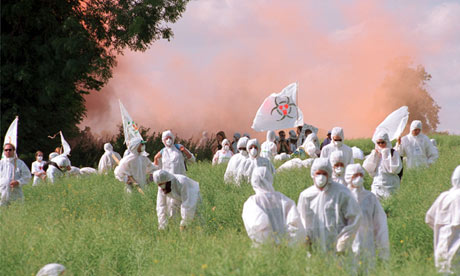
Protesters destroy GM crops.

After 30 years, is a GM food breakthrough finally here?

Golden rice, a new strain that boosts vitamin A levels and reduces blindness in developing countries, is about to be sown in the Philippines – and is the new battleground crop
Sha


Protesters destroy GM crops. Photograph: David Hoffman Photo Library / Al/Alamy

Scientists say they have seen the future of genetically modified foods and have concluded that it is orange or, more precisely, golden. In a few months, golden rice – normal rice that has been genetically modified to provide vitamin A to counter blindness and other diseases in children in the developing world – will be given to farmers in the Philippines for planting in paddy fields.
Thirty years after scientists first revealed they had created the world's first GM crop, hopes that their potential to ease global malnutrition problems may be realised at last. Bangladesh and Indonesia have indicated they are ready to accept golden rice in the wake of the Philippines' decision, and other nations, including India, have also said that they are considering planting it.
"Vitamin A deficiency is deadly," said Adrian Dubock, a member of the Golden Rice project. "It affects children's immune systems and kills around two million every year in developing countries. It is also a major cause of blindness in the third world. Boosting levels of vitamin A in rice provides a simple, straightforward way to put that right."
Recent tests have revealed that a substantial amount of vitamin A can be obtained by eating only 60g of cooked golden rice. "This has enormous potential," said Dubock.
But scientists' satisfaction over the Golden Rice project has been tempered by the fact that it has taken an extraordinarily long time for the GM crop to be approved. Golden rice was created late last century, but its development and cultivation has been opposed vehemently by campaigners who have flatly refused to accept that it could deliver enough vitamin A, and who have also argued that the crop's introduction in the developing world would make farmers increasingly dependent on western industry. The crop has become the cause célèbre of the anti-GM movement, which sees golden rice as a tool of global capitalism.
This view is rejected by the scientists involved. "We have developed this is conjunction with organisations such as the Bill and Melinda Gates Foundation as a way of alleviating a real health problem in the developing world," says Dubock. "No one is going to make money out of it. The companies involved in developing some of the technologies have waived their licences just to get this off the ground."
This view is shared by Mark Lynas, the environmental campaigner and one of the founders of the anti-GM crop movement. He has publicly apologised for opposing the planting of GM crops in Britain. "The first generation of GM crops were suspect, I believed then, but the case for continued opposition to new generations – which provide life-saving vitamins for starving people – is no longer justifiable. You cannot call yourself a humanitarian and be opposed to GM crops today."
Golden rice was created by Peter Beyer, professor for cell biology at Freiburg University in Germany, and Ingo Potrykus of the Institute of Plant Sciences in Switzerland, in the late 1990s. They inserted genes for a chemical known as beta-carotene into the DNA of normal rice. In this way they modified the rice's genes so that the plants started to make beta-carotene, a rich orange-coloured pigment that is also a key precursor chemical that is used by the body to make vitamin A.
By 2000 the plant was ready for trials. However, it took another five years before test fields were grown, such was the resistance to the idea of introducing GM plants in many countries. These trials showed golden rice could stimulate vitamin A uptake but at a low level. New research was launched to create varieties that would provide enhanced amounts of the vitamins.
"All the time, opponents to golden rice insisted, year after year, that it would not be able to produce vitamin A in those who ate it," said Beyer, golden rice's co-creator. "For example, it was alleged by Greenpeace that people would have to eat several kilograms of the stuff to get any benefit."
Two studies, both published in the American Journal of Clinical Nutrition, demolished this claim. The first, in 2009, was based on a group of healthy adult volunteers in the US and showed that golden rice's beta-carotene was easily taken up into the bloodstream. The second trial was carried out by American and Chinese researchers and published last year. It was carried out on Chinese children, aged between six and eight, and showed that a bowl of of cooked golden rice, between 100g and 150g, could provide 60% of the recommended intake of vitamin A for young people. The study also revealed that golden rice is better than spinach at providing vitamin A.
"Given that normal rice has no vitamin A to speak of, that shows the importance of what has been achieved," said Dubock.
The latter study has since been immersed in controversy after it was claimed in a Greenpeace press release that the parents of the Chinese children had not been informed they were being given GM food and had been used as guinea pigs. An investigation by the Chinese authorities led to the sacking of the three Chinese scientists named by Greenpeace, which described the incident as "another example of big business hustling in on one the world's most sacred things: our food supply". For his part, Lynas has described Greenpeace's actions as "immoral and inhumane" because it deprives "the needy of something that would help them and their children because of the aesthetic preferences of rich people far away".
The reactions of bureaucracies to golden rice were also described by Beyer as "hard to believe". "We have had to undergo endless trials and tests and endure endless amounts of bureaucracy. Yet new breeds of standard crops have no such problems, even though they are often created by exposing them to doses of radiation. This is done to create new mutant breeds which you can then grow to see if any have features you like. None of the regulations that we had to meet in creating golden rice were imposed on these plant breeders. Yet this is the standard means by which new crops, including organic crops, are created. It is manifestly unbalanced."
This point was backed by Dubock. "All the time we have been required to show that there are no risks associated with growing golden rice, but at no point did we get a chance to point out its benefits. Everything is about risk assessment and nothing is about benefits assessment." Of course, some doubts about the technology still remain, as my colleague John Vidal makes clear here.
Nevertheless, a warning about consequences of imposing regulations on GM crops and not others was provided by Professor Cathie Martin of the John Innes Centre in Norwich. "At institutes like ours, we can prioritise research to bring new consumer health benefits and environmental benefits to market [via GM], as long as the regulatory process is not prohibitively expensive for publicly funded organisations."
The fate of golden rice is therefore important, as Professor Jonathan Jones of the John Innes Centre points out. "When I started making GM plants 30 years ago I did wonder if there might be "unknown unknowns". But the evidence now is clear. GM food and crops are as safe as non-GM food and crops".
The prospect of further delays preventing future life-saving GM plants going to the field because of carefully orchestrated campaigns of opposition is therefore viewed with concern.
The Golden Rice project has had one beneficial knock-on effect, however. It has triggered a series of similar crop modification programmes that aim to tackle vitamin A deficiency through use of other GM foodstuffs. One example is provided by the golden banana, which has been created by scientists led by Professor James Dale of Queensland University in Australia.
"In Uganda, where the banana is a key source of nutrition, there is considerable vitamin A deficiency and also iron deficiency in diets," he said. "The former not only causes blindness but leaves children less able to fight disease which, in Africa, is particularly serious. The latter, iron deficiency, causes blood disorders."
To put this right, Dale and his team have found ways to boost beta-carotene levels in bananas. Now they are working on boosting iron levels as well. The team expects to have a golden banana that will raise both iron and vitamin A levels, though that will take until the end of the decade. "People in Uganda eat up to a kilogram of mashed banana a day, so we don't need to get a great deal of beta-carotene in our bananas," said Dale.
The result of the team's work will be similar to golden rice: peeled, the pale fruit will be carrot-coloured. And if that sounds strange, it is worth noting that carrots were not originally orange. In the 17th century they were mostly yellow or purple, but were bred to be orange by Dutch farmers in tribute to the ruling House of Orange.
Source:   http://www.guardian.co.uk/environment/2013/feb/02/genetic-modification-breakthrough-golden-rice

Friday, February 1, 2013

GMO LABELING CAMPAIGN- TAKING THE SHOW ON THE ROAD - AND - VIRAL!!

organic-gmo-tomato-carousel

Campaign to label frankenfoods goes viral

Want to be able to tell the difference between a natural fish and a genetically engineered frankensalmon in the dystopian food future? It looks like you may not be required to live on the crunchy West Coast for that.
After California’s GMO-labeling Proposition 37 failed to pass last fall, bills that would require labels for genetically modified food are rolling in Oregon and Washington, and similar initiatives are picking up steam in Minnesota, Missouri, and New Mexico, as well as in Connecticut and Vermont, where GMO-labeling legislation failed to pass last year amid threats of legal action from Monsanto.
New Mexico could be the first state to pass such a law. State Sen. Peter Wirth of Santa Fe, who is sponsoring the legislation, says the bill is aimed at “leveling the playing field” for food actually grown in fields.
Minnesota is home to the headquarters of General Mills, Hormel, Cargill, and Land-O-Lakes, which were all big contributors to the fight against Prop 37, but citizens groups are pushing legislators to pass a label law there too (and the local Fox affiliate covers them pretty appropriately). Meanwhile, Missouri’s legislation would just target genetically modified meat and fish.
The most interesting take on the national GMO label fight comes from the belly of the beast: the International Dairy Foods Association, which just had its annual meeting. From Meat Poultry News:

Connie Tipton, president and chief executive officer of the International Dairy Foods Association, urged food and beverage manufacturers to not rest on their laurels following the defeat of Proposition 37, legislation that would have required the labeling of bioengineered foods sold in California, this past November. Tipton spoke Jan. 28 at the IDFA’s annual Dairy Forum meeting.
“The drumbeat for GMO labeling is as loud as ever and proponents are taking their show on the road,” she said. “They are training their eyes on other states… Moreover, they learned from their mistakes. We anticipate that these new initiatives will be better written with a better ground game to push them forward.”
Tipton added that Walmart’s GMO-labeling efforts were cause for concern.
“It announced this past summer it planned to sell a new crop of genetically modified sweet corn created by Monsanto. Nothing wrong with that, but a lot of us were scratching our heads when Wal-Mart added that it would label the product as containing GMO ingredients – even though the Food and Drug Administration has already said the product is safe. Given Wal-Mart’s size and market share, there are legitimate concerns that its decision on GMO labeling will force other retailers to march in lockstep behind the industry giant.
March in lockstep, eh? This is starting to sound familiar (and fascist), though GMO-labeling fascism seems more appealing than frankenfood-fascism, but maybe that’s just me.
Not to be completely outdone by states with fewer organic quinoa points-of-sale, supporters of California’s Proposition 37 have licked their wounds and swear to be back with another campaign to label GMOs next year.
Susie Cagle writes and draws news for Grist. She also writes and draws tweets for Twitter.

HUGH GRANT OPEN TO GMO LABELS - (NO, NOT THAT HUGH GRANT)

Image (1) monsanto_withered_c.gif for post 40274

Monsanto CEO acknowledges climate change, open to GMO labels, thinks veggies suck

The Wall Street Journal sat down with Monsanto CEO Hugh Grant in what were probably some very nice chairs for this comfy little edited Q&A. The global agriculture giant is “battered, bruised, and still growing,” according to the WSJ, whose cup runneth over with pathos for poor Hugh. The interview kicks off with: “What’s the harm in disclosing genetically modified ingredients to consumers?” Yes, Hugh, please tell us about the harm.
Grant says California’s Proposition 37 — which would have required GMO foods to be labeled, and which Monsanto spent millions to defeat (weird, WSJ, y’all left that bit out!) — “befuddled the issue.” But Grant says he’s personally “up for the dialogue around labeling.” Why? Because he thinks GMOs are so great of course! (Come on, you knew that answer.)
They’re the most-tested food product that the world has ever seen. Europe set up its own Food Standards Agency, which has now spent €300 million ($403.7 million), and has concluded that these technologies are safe. [Recently] France determined there’s no safety issue on a corn line we submitted there. So there’s always a great deal of political noise and turmoil. If you strip that back and you get to the science, the science is very strong around these technologies.
GMO haters gonna GMO hate! And Grant would rather be in the future than in the past. “I think some of the criticism comes with being first in a lot of these spaces. I’d rather be there than at the back of the pack.” On the whole, Monsanto has “mended a lot of fences” and “turned things around” recently with the general public, according to Grant, in part because of “consistent messaging.” I will give him that!
One of Grant’s and Monsanto’s messages, apparently: Vegetables taste crappy. This should definitely help the company with the 18-and-under crowd, at least.

Fresh fruit and high quality vegetables are becoming more important than they ever were. So we see an opportunity there, but the opportunity in veggies is going to be driven by where we are spending our money. We are spending our money on nutrition and taste. A lot of veggies look great, but they don’t taste like much. We think the consumer will pay a premium for improved nutrition and improved taste.
Grant says Monsanto spends a billion-and-a-quarter dollars a year on research and development but only “took a look at” climate change a couple years ago (!!), asking scientists if it was “fact or fiction?”
The conclusions that came back were, ‘There’s definitely something there. This isn’t an anomaly. There’s enough evidence to suggest that it’s getting warmer.’ For agriculture that’s going to absolutely present challenges, at the very time we need to produce more, it’s an environment that’s heated. In the much longer term, we’re going to have to focus on breeding to accommodate those temperature shifts.
Climate change: It’s bad for business. That’s actually not a terrible slogan to reach right-wing climate deniers. Thanks, Monsanto.
Susie Cagle writes and draws news for Grist. She also writes and draws tweets for Twitter.

TUMOR-LINKED NK603 MAIZE STUDY ENOUGH FOR SOUTH AFRICA TO CALL FOR GMO BAN

gmoban 235x147 Monsantos Fading Grasp   Group Calls on South Africa to Ban GMO CornMonsanto’s Fading Grasp – Group Calls on South Africa to Ban GMO Corn

Anthony Gucciardi

Following in the footsteps of nations like France and Russia, South Africa may soon be the latest nation to enact a ban on Monsanto’s GMO corn that was recently linked to tumor development and organ damage in rats. South Africa’s African Centre for Biosafety (ACB), a watchdog organization that was created to protect consumers from various biotechnology dangers, is now calling on South African authorities to enact a ban on Monsanto’s tumor-linked maize crop known as NK603.
This is particularly important when it comes to South Africa as white corn is a large staple food, making up for 80% of the harvest just last year. In the event that the maize were to be banned, it would be a major hit for Monsanto and an even larger victory for the 50,586,757 people who live in South Africa. If authorities take the advice of ACB, then it would not only ban the cultivation of the GMO corn, but the import and export as well. In a letter to the South African minister of agriculture, the ACB said:
“We urge the South African government to take the necessary steps to protect its citizens.”
Nations around the world are currently passing or requesting bans on Monsanto’s crops following the study, which is one of hundreds of studies to identify the dangers of both Monsanto’s herbicide Roundup and GMOs. Coinciding with previous pieces of research that have linked Roundup with conditions such as cancer and infertility, the French GMO study found that around 50% of the males and 70% of the females fed 100% GMO corn died prematurely.
It was also dubbed the most thorough research on the prolonged effects of GMOs and Roundup on rats.
As expected, Monsanto has not taken this news lightly. Previously being busted for paying United States diplomats to extend its campaign for global seed domination and killing over 500,000 innocents with its ‘safe’ Agent Orange weapon, Monsanto’s corruption has been repeatedly exposed by whistleblowers and alternative news media. Each time, however, Monsanto continues to assert that its creations are perfectly safe. Just as it did with Agent Orange, Monsanto is now on the defensive of GMOs despite having only been tested for 90 days before unleashed on the public.
More nations around the globe will continue to call for and enact GMO crop bans around the globe until Monsanto is either banned or labeled (via California’s GMO labeling bill Prop 37) out of existence. It is important that we support and highlight the countries who are making efforts on this front such as South Africa’s ACB.

Read more: http://naturalsociety.com/monsantos-fading-grasp-group-calls-on-south-africa-to-ban-gmo-corn/#ixzz2Jh0AvV4f

THEY EAT HORSES, DON'T THEY? BURGER KING SERVES IT THEIR WAY

Burger King, Leicester Square, London

Burger King Reveals its Burgers were Contaminated in Horsemeat Scandal

Fast food company said test results at production plant revealed 'very small trace levels' of horse DNA in its products


Burger King said test results revealed ‘very small trace levels’ of horse DNA. Photograph: Alex Segre / Alamy/Alamy

Burger King has revealed that some of its burgers were contaminated in the horsemeat scare, as the tainted food crisis threatened to undermine the confidence of consumers, and major retailers tried to protect their reputations.
The fast food company – whose products were not tested in the food standards checks by Irish authorities that sparked the furore – moved production from the Silvercrest plant in Ireland to Germany and Italy as a precaution. On Thursday night it said test results at the plant revealed "very small trace levels" of horse DNA in its products, but burgers taken from restaurants had tested negative.
As governments in Ireland, the UK and Poland, where a supplier used by Silvercrest for a year is thought be the source of the contamination, continued their investigations, Burger King admitted that, contrary to previous assurances made to it by Silvercrest, it too had now been linked to the scandal. Authorities insist there is no health danger to consumers.
Meanwhile Aldi UK became the first major retailer to suspend its contract with a British plant, Dalepak Hambleton in North Yorkshire, which, like Silvercrest, is part of the ABP Food Group, pending further investigations into why three of nine newly tested burger samples had traces of horse and pork DNA. The products were from stock withdrawn in recent weeks as a precaution but made since October, the company said.
The Aldi announcement came a week after tests at Dalepak for ABP and the UK Food Standards Agency had come back negative for horse DNA. The FSA has also previously suggested that its investigations into Dalepak were concentrating on events before October.
Aldi in Ireland has terminated its contract with the Silvercrest plant in County Monaghan where Burger King, Tesco, the Co-op and Asda have all pulled out.
Burger King said: "Our independent DNA test results on product taken from restaurants were negative for any equine DNA. However, four samples recently taken from the Silvercrest plant have shown the presence of very small trace levels of equine DNA. Within the last 36 hours, we have established that Silvercrest used a small percentage of beef imported from a non-approved supplier in Poland. They promised to deliver 100% British and Irish beef patties and have not done so. This is a clear violation of our specifications, and we have terminated our relationship with them."
Diego Beamonte, vice-president for global quality at Burger King, said the company was "deeply troubled by the findings of our investigation and apologise to our guests, who trust us to source only the highest quality 100% beef burgers. Our supplier has failed us and in turn we have failed you".
Beamonte was cautious about answering questions about whether customers might have been exposed to contaminated meat previously because of Silvercrest practices.
"Testing for equine DNA is not a standard practice used in beef production" he said. But the company would look at whether additional checks including DNA testing and enhanced controls to trace food through production were needed. "We will dedicate ourselves to determining what lessons can be learned and what additional measures, including DNA testing and enhanced traceability controls, might be added," he said.
"We received our negative results last week and were advised of the Irish Department of Agriculture's final results this week.
"As you know, ABP and the Polish supplier are subject to an ongoing investigation by the authorities and Burger King continues to support this process. What is clear now is that the January sample which never left the factory tested positive for trace amounts of equine DNA whilst the December sample which was distributed to restaurants tested negative for equine DNA."
All the major supermarkets, including those not implicated in test results by the Food Safety Authority of Ireland published on January 15 which started the scare, withdrew from sale products made at the two ABP plants and Liffey Meats as a precaution.
But Waitrose, which has since restocked, and Sainsbury's, which both use Dalepak, never suspended their contracts there. Aldi UK said one sample of three of its Oakhurst Beef Quarter Pounders had been found to be o.1% pork and 0.1% equine DNA. One Frozen Oakhurst Beefburger 16 pack showed 0.1% equine trace and a similar amount of pig was found in a Specially Selected Aberdeen Angus Quarter Pounder. These were all from stock withdrawn from sale but made since October. A spokesman for Aldi said: "We are deeply angry and feel let down by our supplier and we are pursuing more tests until we are certain that we understand how the production line was contaminated."
Labour called on all supermarkets to introduce routine testing to check that all cheap pork, chicken and turkey products as well as beef were not contaminated by other animal sources. Huw Irranca-Davies, the party's food and farming spokesman, said: "The major supermarkets and processors have a duty to their customers to DNA-check all value-meat products to restore confidence in the supply chain, which has been badly damaged by this scandal. Retailers need to reassure consumers about what checks are being undertaken."
Silvercrest, one of the biggest burger plants in Europe, employing 140 people and normally producing 200m burgers a year, is closed for deepcleaning and a change of management. ABP continued to apologise for its part in the affair.
DNA testing and other inquiries are continuing in Poland. In all, 21 pallets of frozen trimmings, made up of beef and horse off-cuts, are thought to have been delivered to Ireland by a Polish company running a cold store in the centre of the country. It had taken meat from five slaughterhouses, not owned by that company and not licensed to slaughter horses. The identity of these plants has not been revealed.
The legal import of horsemeat to Britain is tiny, 30 tonnes last year from all sources. Poland's contribution was 9kg of offal last year, compared to 1kg of meat in 2011.
SOURCE:  http://www.guardian.co.uk/business/2013/jan/31/burger-king-horsemeat