Friday, March 16, 2012

GMO's: DRIVING YOU NUTS, NOT KNOWING WHAT IS AND WHAT'S NOT?

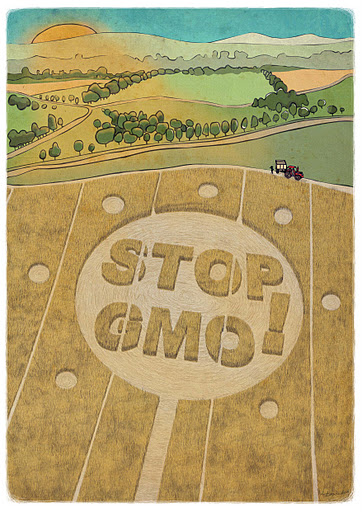
11 Steps for GMO Eradication: Help Grow the “GEM”
11th March 2012
Contributing Writer for Wake Up World
Dear Fellow Sane Human Beings,
Greetings. It’s a pleasure to write to you again.
By now you likely have plenty of information and encouragement for why not to purchase GMOs (Genetically Modified Organisms). What we need now is to band together and take action. So below I have outlined “How” to do this.
If you need more information on GMOs or GM Foods, please search this site for “GMO” or see my articles.
GEM stands for “GMO Eradication Movement.” It of course also refers to our beautiful planet. So to “Grow the GEM” means eradicating GMOs to beautify our world. The 11 Steps for Growing the GEM are divided among three levels of participation. An overview of the three levels for being a GEM (GMO Eradication Mover) are:
Level I: Learning how to identify GMO products and not to buy them.
Level II: Includes Level I knowledge and action and shares it with others: friends, businesses, restaurants, grocery stores, etc.
Level III: Includes Level I & II, and implements public outreach to masses of people, and puts their hands in the soil.
I have also set up a GEM Facebook Page. This will be a crucial resource for us as we go forward, and your participation will help us all. So please join us here to meet and join forces.
As we learn more, the list below will be amended and updated. Please help us “Grow the GEM” by passing on this information. We absolutely need all of us now working together. Time is urgent. We cannot procrastinate.
Feel free to copy and share the 11 Steps and please cite the source provided at the end of the list.
These Steps are the heart of GMO Eradication. Please consider them carefully and implement them as soon as possible. We all have to get down to business and be disciplined about this if we hope to win this thing. We have to do it together; please be a leader.
LEVEL I (Eliminate)
1) Learn which foods are GMO and do not buy them (unless organic). The current GM food crops are:
  • Corn (includes “sweet corn”)
  • Soy  (includes lecithin)
  • Sugar beets
  • Honey (via GMO crops’ pollen)
  • Cotton (including cottonseed oil)
  • Canola (including canola oil)
  • Alfalfa
  • Hawaiian papaya
  • Tobacco
  • Yellow crookneck and zucchini squash,
  • Dairy Products (tainted with rBGH and from animals fed GM food)
  • Meat (all kinds, from animals fed GM food)
  • Salmon (the actual animal is slated to be GMO)
  • (Hydrolyzed Vegetable Protein), TVP (Textured Vegetable Protein), xanthan gum, vanillin, sucrose, lactose, dextrose, lactic acid, maltodextrin, Vitamins A, B2, B6, B12, C, D, E, K may be from GMO.
2) Print out the list and carry it with you; memorize it if you can.
3) Check food labels for GMO ingredients; if they are not listed as organic, they are likely GMO. Don’t buy it. Exceptions are products that bear the “NON GMO Project” label.
a) Example 1: Canola is a GMO crop. If a product contains canola oil and does not specify it is organic, it is likely GMO. Don’t buy it.
b) Example 2: Soy is a GMO crop. Tofu, tempeh, and soy yogurt are all made from soy. Also check for soy in veggie burgers and veggie sausages. If it is not organic don’t buy it.
4) Buy as little commercially farmed processed food and as much organic food as possible. Processed foods are more likely to have GMOs as well as hidden GMO ingredients.
a) Example 1: Corn is a GMO crop. Corn syrup, vitamin E, citric acid, polysorbate 80 and sodium citrate all can be derived from corn, and likely from GMO corn.
b) Example 2: Commercial beef, chicken, and turkey are almost always fed GM food. Only buy organic meat. “Free Range” meat is not necessarily organic.
5) Avoid commercial restaurants. Restaurants that are not specifically organic (far and few between), often use cheap food, which is often GMO and non-organic.
LEVEL II (Outreach)
6) Share information about the dangers of GMO foods with everyone you can. Share with them any of my articles, Jeffrey Smith’s video(s), or just Google it.
7) Ask grocery stores and restaurants, family and friends, not to deal in GM foods. Talk to your children’s’ food director/organizer at school. Everywhere you go, let food-related organizations and people know: NO GMO.
8.) Call or email food companies that do not specify suspect ingredients as GMO and ask if they are GMO.
a) Example 1: Soy lecithin is often GMO. Call companies that make foods with soy lecithin and ask if it is from GMO soybeans. As them to send you verification in writing by email.
b) Example 2: If a label says “sugar” it may come from sugar beets, which are a GMO crop. Call the label’s company and proceed as with lecithin example.
c) Example 3: I recently called Twinlab, Kal, and Lessaffre (makers of Red Star Yeast) companies, all manufacturers of nutritional yeast products. Only one, Kal Brand, told me they guarantee both the yeast and the culture medium for the yeast (often corn and beet, both GMO crops) to be non-GMO. I told the others I would not buy their products until they guarantee non-GMO on the label.
9) Encourage anyone you know not to use Roundup because it is integral to GM food production, much more toxic than once suspected, and buying it supports Monsanto

LEVEL III (Community)
10) Organize rallies, protests, donate to and support organic groups, create and circulate petitions, set up information booths, and begin a public outreach to masses of people to denounce GMOs and support organics.
Additional actions: pass out GMO warning flyers, write articles, post notes at work, go to protests, Google GMO articles and videos. Host movie nights.
11) Plant that organic garden already! And get your family and community involved.
Source: GMO Eradication Movement – GEM (Facebook Page)
Extra Tips/Reminders
In sum, the overall safest, healthiest, and most economical way to empower our GMO Eradication Movement is to buy whole organic foods, grow you own, prepare your own meals, and buy from as many local organic farmers as possible.
If a food is organic it is not GMO. Knowing GM food crops will tell you which foods to look out for in their non-organic form. If not organic, a food may still be non-GMO, but this is becoming more and more unlikely. For example, sugar beets come organic, GMO, and conventionally grown (often grown with pesticides and synthetic fertilizers, but not necessarily GMO). Organic sugar beets are non-GMO. Conventionally grown sugar beets might be GMO (you have to ask), but best to avoid because they are likely laden with pesticides.
If a food ingredient contains “sugar,” it is likely GMO because a lot of sugar comes from GMO sugar beets! If the label reads “cane sugar” it likely has pesticide residues but at this point in time is not GMO. Health tip: stay away from “sugar” for good physical and emotional health and to be a GEM!
VITAMIN SURPRISES:
* Vitamin C (ascorbic acid) can be made from GMO corn
* Vitamin D and vitamin K may have “carriers” derived from GMO corn (such as   glucose, sugar, starch, and maltodextrin)
* Vitamin E is often made from soy
* Vitamins A, B2, B6, and B12 may be derived from GMO sources
Remember “All Natural” and “Natural” labels don’t mean squat. These foods can still be GMO.
Thank you for becoming a GEM, not a GMO! The 11 Steps can be downloaded here on one convenient page, though without the “examples” mentioned in the 11 steps above. Please share the 11 Steps everywhere you can and join us on Facebook.
In Solidarity,
Jack
About the Author

Jack Adam Weber is a licensed acupuncturist, master herbalist, author, organic farmer, celebrated poet, and activist for Earth-centered spirituality. He integrates poetry, ancient wisdom, holistic medicine, and depth psychology into passionate presentations for personal fulfillment as a path to planetary transformation.
Source:    http://wakeup-world.com/2012/03/11/11-steps-for-gmo-eradication-help-grow-the-gem/

NYC FED JUDGE BUCHWALD DOES BIDDING FOR GMO GLOBAL SEED BULLY: GLOBAL PETITION ENSUES

Organic Farmers vs. Monsanto: Update, Petition Comments & What’s Next

6th March 2012
Contributing Writer for Wake Up World
Dear Passionate Hearts of the World,
Last week we posted an open (hearted) letter to the farmers and seed growers who were part of the group (OSGTA) that sued Monsanto. As many of you know, Monsanto has garnered quite the reputation for bullying small organic farmers, filing suit against them, litigating them to no end, and bankrupting them. Witnessing this for years, the organic and commercial seed farms, co-ops and farming groups did not want to be next. So, OSGTA filed this preemptive suit, meaning that they are seeking to protect themselves and their farms (our food) in advance, before getting that harrowing knock on the door by Monster Santo.
As many of you also may know, last week this lawsuit was dismissed by Judge Buchwald in Federal District Court in Manhattan (oh, I’d hate to be her walking down the streets of the Big Apple). In response to this decision, and after reading the farmers’ woes and the national outrage over this decision, a letter to the farmers began to write itself from me, pouring out from my heart during dinner. So, I put down my plate and wrote it down. And I am glad I did. Passionate readers like you began to gravitate around this message, which also spoke directly to Monsanto and our quickly evolving revolution between Big Business and ordinary life-loving citizens like you and me.
We decided to make a petition out of the letter so we could all join our voices into one unified outpouring of love, encouragement and gratitude to the farmers and seed growers. In two days our petition got 2,000 signatures. I go to the petition site frequently to see how our numbers are doing and to read the comments left by signers from all over the world. It’s a rush—so inspiring!
People have signed on from Australia, Cyprus, Italy, Norway, Finland, Japan, Canada, Untied States, New Zealand, South Africa, Romania, West Indies, France, Spain, Denmark, Norway, Portugal, Germany, UK, Hungary, Austria, French Polynesia, Malaysia, Singapore, Botswana, Belgium, Bulgaria, Slovakia, Iceland, Mexico, and more.  Unbelievable.
This shows that GMO pollution and a desire for clean food is a worldwide concern.
Honestly, when I went through the comments I was about moved to tears by so many. I found myself unable to choose just a few. So, without any ultimately good enough reason to choose some and not others, here are a few. We have posted more at the end of the article, and all comments can be viewed at the petition site. We will continue to post more comments each day at the end of this article, so please check back to read more . Thank you all for posting; my heart joins your words and your conviction and your strong spirits…you blow me away.
WE, the people, deserve the truth about the foods we eat.  For too long we’ve allowed the gov’t and big biz to rule our lives.  THAT time is over, expect us.”
I work in healthcare helping people heal from disease, and cannot believe that our government would sign on to something which will affect our health.   The recent ruling is to me, akin to genocide.”
“ I cried when I saw you were standing up to Monsanto, and I cried when the case got dropped. It still means a lot to me that you tried. We need to reword your lawsuit and try again. We can not stand for this sick injustice.”
“One of the highlights of my week is going to the organic farmers market in my neighbourhood with my daughter.  We engage with the farmers, talk about each others lives, and it gives us a real connection to the food we eat.  I do not want this to end and will do my part to be on the side of the farmers, not Monsanto.”
“As a citizen of the world I will not stand by and allow you to destroy the planet that I will leave to my children. Monsanto MUST be stopped!”
Your overwhelming response over the last few days have fueled me to keep spreading the good word. I invite you to every now and then go the petition site and read some of the juicy stuff pouring from everyone. It’s good medicine to juice your own encouragement, activism, love, and hope! I thank you all (and others around the world who signed) for your comments and for contributing to what is ultimately a gift to the OSGTA. All comments will be copied to the farmers group.
An Occupy Our Food group has offered to put us in touch with all the OSGTA plaintiffs so we can share our letter and our comments with them. They have one month to file for appeal, which is about twenty days from now. So we want to get a lot more signatures, soon.
Please share the petition letter along to as many as you can and to any and all media outlets you see fit, no restrictions, for it is your letter as well, if you care to make it so. If you have a large contact base, and can pull this thing out for us, you’ll be a hero. We want to match the number of signatures with the number of persons in the suit—300,000.
As one petition signer put it:
“Monsanto must be stopped and we, the people, can stop them.”
She is so right. To this end, stay tuned for my next article, GMO Takedown (likely in two parts). In it I will share step-by-step how together, through each of our individual efforts, we can relatively swiftly and collectively do just that. But it can only happen TOGETHER.
In love and solidarity, Jack
ADITIONAL PETITION COMMENTS
“I’m signing for the next seven generations.  I support all actions to end Monsanto’s insane disrespect for our dear planet Earth and all the life she sustains.”
“I am so distressed by this outcome…..I am flooded with the sadness this brings to so many and the suffering that will be a result.”
“We must carry on the battle for liberty at every opportunity.  My signature is but a small token of appreciation for what you have given.”
“The future of our children and generally the future in total is at stake.”
“As a citizen of the world I will not stand by and allow you to destroy the planet that I will leave to my children. Monsanto MUST be stopped!”
“One of the highlights of my week is going to the organic farmers market in my neighbourhood with my daughter.  We engage with the farmers, talk about each others lives, and it gives us a real connection to the food we eat.  I do not want this to end and will do my part to be on the side of the farmers, not Monsanto.”
“Because I want healthy and safe food for me and my children. In my country there is a saying “”Nobody is bigger then the bread””…Well, Monsanto obviously wants to be bigger than OUR bread, and not only in the US. Monsanto-making people miserable since 1992-that’s what their slogan should look like.” —Bulgaria
“because I hate those goddamn kike pieces of shit who force their deadly GMO seeds on the world and think that we need to stop them at all costs.”
“it’s the least I can do.”
“Because I care about my children.”
“I applaud the real heroes here…the farmers and producers that stand up to Monsanto and say NO….and to each and every person out there fighting to restore what is real and natural in our world.   History is being written here and will testify you are indeed the heroes against one of the most insidious evils of these modern times…..”  —Excerpt
“I want small farms to survive and THRIVE because they are the answer to good health – for ourselves and our planet, and they connect us to our communities. We won’t give up the fight – it is so important!”
“Please know, that even though I live in Sydney, Australia ~ I stand beside you, as a Warrior for Our Environment and a Warrior for Wellness. NO, gmo in our food. Go Well, Keep fighting the ‘good fight’.”
“Because We are Natural Beings that need Natural, Unaltered and Non-Toxic food that will nurture and heal our bodies instead of making them diseased.”
“Because there is safety in diversity of plant life.” —Excerpt
Because the bees are dying due to them. Einstein said if the bees die we  have seven years. I want to say to anyone as well that this is not political. This is apolitical. Everyone eats and wants their children to eat and to have the beautiful diversity we have been given for our and their safety. I tell my family…do not stand beneath those goliaths (Monsanto, Pharmacia) for God in his justice will eventually bring them down.”
“Farmers deserve to grow their own seeds without fear of being sued for accidental infringements of GMO’s. This dismissal is an outrage! I refuse to be a victim of GMO food, and support Organic farmers.”
Amen to all!
About the Author
Jack Adam Weber is a licensed acupuncturist, master herbalist, author, organic farmer, celebrated poet, and activist for Earth-centered spirituality. He integrates poetry, ancient wisdom, holistic medicine, and depth psychology into passionate presentations for personal fulfillment as a path to planetary transformation. His books, artwork, and provocative poems can be found at his website PoeticHealing.com.  Jack can be reached at Jack@PoeticHealing.com
A copy of Judge Buchwalds ruling can be found here 

Thursday, March 15, 2012

FRANKEN-MOSQUITOS SOON TO BE RELEASED IN THE WILD?

Enviro Groups Fear "Dangerously Misguided" Plan to Unleash Genetically Modified Mosquitoes

Company insists plan is "environment-friendly," that genetic modification is "a well-understood, safe technology"

- Common Dreams staff
The Florida Keys Mosquito Control District is having a town hall meeting tonight about a plan to release genetically modified mosquitoes in order to control the population of Aedes aegypti, the mosquito responsible for the spread of dengue fever.
While the company behind the plan, Oxitec, insists the plant is "environment-friendly," that genetic modification is "a well-understood, safe technology" and that there would be "no permanent change to the wild mosquito population," environmental groups say the plan is "dangerously misguided" and that the company has hidden the fact that the genetically modified mosquitoes could have high survival rate in wild.
* * *
From Oxitec's Q&A for Key West (pdf):
What exactly is the Sterile Insect Technique (“SIT”)?
The Sterile Insect Technique (SIT) is an environment-friendly, species-specific method of insect control, which has been described as “birth control for insects” SIT has been used very successfully in agriculture for over 50 years.
SIT works by releasing sterile insects of a target species. The sterile males compete with the wild males for female insects. If a female mates with a sterile male then it will have no offspring, thus reducing the next generation's population. Repeated release of insects can eventually reduce the insect population to very low levels or zero and hence reduce the damage or spread of disease.
Is Oxitec’s mosquito genetically modified?
Yes.
Is genetic modification inherently bad or dangerous?
No. Genetic modification allows scientists to combine genes or DNA segments in a precise and calculated manner, to achieve a desired outcome: it is a well-understood, safe technology and there is nothing inherently dangerous about the process. This combining, or recombining of DNA segments leads to another name for the same technique – recombinant DNA technology and hence recombinant insulin, recombinant vaccines, etc; genetic engineering is another. GM/recombinant/GE approaches are regularly used, for example, in the production of pharmaceutical drugs or vaccines, new medical approaches (gene therapy) in industry (production of enzymes) and in new biofuel approaches.

  • It is an environmentally friendly approach. No toxic chemicals are used in our approach. The sterile mosquitoes released will only mate with their own species; so off-target effects are minimised; this is far better specificity than an insecticide. “Off-target effects” are effects on species other than the intended target, in this case Aedes aegypti; in other contexts this might be called collateral damage. The potential indirect effects, e.g. the ecological consequences of successfully suppressing the target population, appear minimal and are discussed further below.
What are the likely impacts on the environment and on humans?
The main impact on human health will be to reduce the number of Aedes aegypti mosquitoes that can spread dengue.
There is no permanent change to the wild mosquito population and therefore unlikely to have any impact on the environment compared to the currently used alternatives.
Once the sterilised mosquitoes have mated with the wild female Aedes aegypti mosquitoes, what happens to them? Do they just die off?
Yes. Aedes aegypti is a relatively short-living species. Adult males can live up to around 10 days in the wild. In the laboratory, under ideal conditions, they can live a bit longer, even in extreme cases only up to a month.
* * *
“We cannot stress strongly enough how dangerously misguided this application is. Oxitec hopes to use the neighborhoods and precious ecosystem of the Keys as their private, for-profit laboratory. The shame of it is, the company has no evidence the GE mosquitoes will even work in their stated aim of controlling Dengue fever. This feels much more like Oxitec testing its living, breeding technology than a serious attempt to control disease, and the people of Florida deserve protection.
“The Max Planck Institute for Evolutionary Biology in Germany said in February that the ‘risk assessment’ conducted in advance of the release of Oxitec’s GE mosquitoes in another country has been ‘scientifically deficient’ and made ‘questionable pivotal scientific assertion[s]’. This is simply not good enough, and we strongly urge the Food and Drug Administration to decline the application.
“We are also aware that Oxitec is hoping to conduct a similar outdoor experiment in the UK next year with their GE version of the diamondback moth, which attacks crops like cabbage, broccoli, cauliflower and rapeseed (canola). What impacts will such an experiment have on the birds that eat the moth? What happens to people if they inadvertently eat eggs this GE insect lays on the crop? How will they get the insects back if something goes wrong?
“There are better, safer ways to control Dengue and agricultural pests – we don’t need expensive GE insects. Oxitec badly needs FDA approval to keep their finances flowing. This is why the company downplays any concerns raised, but those concerns are still there and growing with time. The Federal Government must step in and prevent this unnecessary and risky trial.”
* * *
A confidential internal document obtained by civil society groups shows genetically modified mosquitoes described by their manufacturer, UK company Oxitec, as “sterile” are in fact not sterile and their offspring have a 15 percent survival rate in the presence of the common antibiotic tetracycline.
Eric Hoffman of Friends of the Earth U.S. said: “The fact that Oxitec is hiding data from the public has undermined its credibility. Oxitec’s assertions cannot be trusted. Trials of its mosquitoes must not move forward in the absence of comprehensive and impartial reviews of the environmental, human health and ethical risks. Such trials must also await the establishment of a clear and well designed regulatory framework, which does not yet exist.”
 Source:   http://www.commondreams.org/headline/2012/03/15-6

Monday, March 12, 2012

HAWAII FOOD: AGRICULTURAL RENAISSANCE CONFERENCE 3-14-2012


March 12, 2012
Aloha,   

The Environmental Caucus
of the Democratic Party of Hawai‘i presents

The First of a Four Part Series

FOOD SECURITY 101
An Introduction to Food Security in Hawaiʻi Nei

Why is food security such a hot topic at the capital?
What exactly does it mean to be food secure and how venerable is our State?
Please join this live 90-minute call in discussion with some of the States top experts. You may attend either in person or from the comfort of your own home. Call in information will be provided during the event.

This event will air on cable channel 49
March 14, 2012
7:00 p.m. – 8:30 p.m.

or join us in person at
‘Ōlelo Māpunapuna Community Media Center
1122 Māpunapuna Street, Honolulu, Hawai‘i 96819

Neighbor Islanders may attend though
Livestream available at: http://www.olelo.org/live
Channel 49

Topics and featured speakers

The Agricultural Renaissance: Esther Kia‘āina & Giorgio Caldarone, Kamehameha Schools
Ho‘omaopopo Na Mea Ai (Defining Food Self-Sufficiency): Representative Faye Hanohano, Hawai‘i State Legislature
Variables in Food Security: George Kent, Professor Emeritus of Political Science, University of Hawai‘i

Moderated by Gary Hooser
Director Office of Environmental Quality Control

Please let us know if you have any questions, and we hope to see you there.

Lynn Marie Sager
Environmental Caucus Chair 
    

Saturday, March 10, 2012

ROUND-UP HERBICIDE: NOW FOUND IN HUMAN URINE, LINKED TO BIRTH DEFECTS, STERILITY, OBESTIY, ECOCIDE OF MONARCH BUTTERFLIES

Monsanto's Roundup Ravaging Butterfly Populations, Study Shows

by: Mike Barrett, Natural Society | Report

(Photo: Arturo / Flickr)
Monsanto’s Roundup, containing the active ingredient glyphosate, has been tied to more health and environmental problems than you could imagine. Similar to how pesticides have been contributing to the bee decline, Monsanto’s Roundup has been tied to the decrease in the population of monarch butterflies by killing the very plants that the butterflies rely on for habitat and food. What’s been shown to be an even greater threat to the population, though, is Monsanto’s Roundup Ready corn and soybeans.
Roundup Ready Crops and Glyphosate Leading to Downfall of Insect Populations
2011 study published in the journal Insect Conservation and Diversity found that increasing acreage of genetically modified Roundup Ready corn and soybeans is heavily contributing to the decline in monarch butterfly populations within North America. Milkweed, a plant butterflies rely on for habitat and food, is being destroyed by the heavy use of glyphosate-based pesticides and Roundup Ready crops. Over the past 17 years, the monarch butterfly population in central Mexico has declined, reaching an all-time low in 2009-2010.
“This milkweed has disappeared from at least 100 million acres of these row crops,” said Dr. Taylor, an insect ecologist at the University of Kansas and director of the research and conservation program Monarch Watch. “Your milkweed is virtually gone…this [glyphosate use on RR crops] is the one main factor that has happened…you look at parts of the Midwest where there is a tremendous use of these crops and you see monarch populations dropping. It’s hard to deny the conclusion.”
According to the Department of Agriculture, in 2011 94 percent of soybeans and 72 percent of corn grown in the United States were herbicide-tolerant. Due to this increase, the amount of Roundup used on crops in 2007 was 5 times higher than in 1997, only one year after Roundup Ready crops were available.
Another study published int he journal Crop Protection and conducted by Robert G Hartzler, an agronomist at Iowa State, found that milkweed on farms in Iowa declined 90 percent from 1999 to 2009. Additionally, his study found milkweed only on 8 percent of corn and soybean fields surveyed in 2009, which is 51 percent lower than in 1999.
Although the butterfly population may be suffering, humans are taking heat from Monsanto’s creations as well. Past research has shown that Monsanto’s Roundup ready crops are leading to mental illness and obesity, primarily by destroying the amount of good bacteria found in the gut. The corporation’s Roundup, containing glyphosate, has also been shown to cause infertility and birth defects.
Glyphosate is so present today that it has been found to be polluting the world’s drinking water through the widespread contamination of aquifers, wells, and springs. What may be most shocking is that very high concentrations of glyphosate have been found in 100 percent of urine samples tested in a recent study.

Friday, March 9, 2012

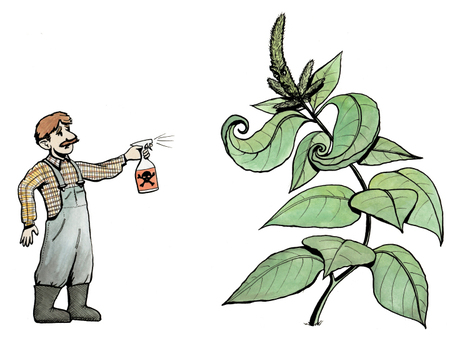
WHEN DEADLY HERBICIDES NO LONGER WORK, WHAT NEXT? DEADLIER (AGENT ORANGE - 2,4-D) HERBICIDES?

Enlarge Adam Cole/NPR
OK, so this story is about weeds and weedkillers, neither of which is ever the hero of a story, but stay with me for a second: It's also about plants with superpowers.
Unless you grow cotton, corn or soybeans for a living, it's hard to appreciate just how amazing and wonderful it seemed, 15 years ago, when Roundup-tolerant crops hit the market. I've seen crusty farmers turn giddy just talking about it.
All they had to do was spray the herbicide Roundup over their fields and everything died — except their remarkable new crops, with their laboratory-inserted genes that made them resistant to that weedkiller.
Alas, the giddiness faded. In more and more places across the country, farmers now are struggling to deal with weeds that their favorite weedkiller won't kill anymore. The weeds, too, have evolved Roundup-resistance superpowers.
Now, a hot debate has erupted over what farmers should do next. Should they adopt a new generation of genetically engineered, herbicide-resistant crops? Or turn away from chemical herbicides altogether? (A national summit on this issue is planned for May, in Washington, D.C.)
 
To get a closer look at this debate, I went to south Georgia, where farmers are fighting one of the most irrepressible of the new superweeds. It's called Palmer amaranth, known to the locals here as pigweed.
"It started just north of us," recalls Randy Bryan, who grows cotton in Irwin County. "And then all of a sudden, it was all over south Georgia. We had it everywhere."
Palmer amaranth can grow 3 inches a day. A single plant can release close to a million seeds. It's a bully; if you let it grow beside cotton seedlings, the poor cotton doesn't stand a chance.
Many farmers still spray glyphosate, but then they have to hire people to go in to the fields and pull pigweed by hand, or chop it down with hoes.
"I have a brother-in-law who told me he spends $120 an acre on hand labor," says Van Grantham, a cotton grower in Coffee County. That's about four times what farmers spent to control weeds five years ago.
Cotton prices are high right now, so nobody is abandoning the crop altogether, but if prices returned to normal levels, the cost of containing Palmer amaranth could make cotton unprofitable.
Farmers are looking for alternate solutions, and in Georgia, they turn to Stanley Culpepper. He's a weed scientist at the University of Georgia and the state's expert on cotton weeds. This time of year, he spends his days driving from county to county, delivering talks to cotton farmers.
Culpepper grew up in North Carolina, and comes from a long line of farmers. He talks to his cotton growers like a football coach giving his players some tough love.
"We all agree: There can be no glyphosate-resistant Palmer amaranth at planting, right? We've crossed the bridge. We know there has to be no Palmer at planting or you won't pick your crop. If you do pick your crop, it won't be economically sustainable," he told a hall filled with about 70 farmers in Coffee County.
And you can't just take your time about it, either. "You go out and look at the field and you say, 'Ahh, I got me a few more days.' And what happens when you say, 'I got a few more days' — those pigweeds come up and they're 4 to 5 inches tall when you get there, and you can't kill 'em."
You're going to have to spray a lot of different chemicals to overwhelm the enemy, Culpepper tells the farmers. Some will kill your cotton if you aren't careful.
Then, Culpepper puts up a new slide. It's a picture of a field that's covered with a layer of rye, flat on the ground.
This residue works as well as any weedkiller, he tells the cotton growers. Pigweed just despises it. So the system would be: Grow a crop of rye, then roll it flat to keep weeds from growing. But leave some narrow gaps in the rye, and that's where you plant your rows of cotton.
Culpepper explains that he's still working out some kinks in this technique. But in just a few years, he says, it could be a big part of the pigweed solution.
"If we can work it out, this is the most sustainable program that we as cotton growers could do, bar none, for resistance management and Palmer amaranth control," he says.
This is Culpepper's recipe for surviving in a world of weeds that could become resistant to your most popular herbicides: Do lots of different things to fight the weeds. Some of them involve chemicals, some don't. Some will mean more work. But the work is worth it.
But Culpepper's is not the only recipe in the room. The one that may prove to be really tempting for farmers is one offered by three other non-farmers in the room this evening. They represent three big cotton seed companies: Dow AgroSciences, Monsanto and Bayer CropScience.
Those companies are selling — or plan to sell, within a few years — crops that have been engineered to tolerate other herbicides that will kill pigweed. Farmers will be able to spray those herbicides — long-established chemicals called 2,4-D and dicamba — right over their crops, just as they do today with glyphosate.
Some environmentalists are angry about these new products. The Natural Resources Defense Council, for instance, says 2,4-D is dangerous and ought to be banned.
And David Mortensen, a weed ecologist at Penn State University, predicts that weeds will evolve resistance to these herbicides, too. He says it's a kind of treadmill, where farmers constantly need new weedkillers.
"When one herbicide fails, you add a second herbicide, and then a third herbicide to the package. And I am convinced that this is not a sustainable path forward," he says.
The University of Georgia's Culpepper, meanwhile, stands somewhere in the middle of this argument.
"Let's be clear: I want all the new technology that's economically and environmentally friendly for our growers that we can get," he says.
The key is not to misuse them; not to rely just on one or two of them, because then the weeds will adapt.
Culpepper thinks his farmers have learned that lesson, and what happened with Roundup doesn't need to happen again.
Source:  http://www.npr.org/blogs/thesalt/2012/03/07/147656157/farmers-face-tough-choice-on-ways-to-fight-new-strains-of-weeds

Wednesday, March 7, 2012

OUR SCHOOLS FEEDING OUR KIDS....FAUX MEAT...NO WAY!!!!!!!

Students Eating "Pink Slime" for Lunch? Fast Foods Have Ditched the "Meat" But Schools Are Still Stuck With It
Ammonia-treated meat "product." Served at a school near you?
 
Cattle graze at a ranch in the marshes of an Argentine province in 2009.
Photo Credit: Agence France-Presse
"PB&J is starting to sound all sorts of good right now," wrote a concerned mom over at Cafe Mom this week. Her point is sound. After all, although it may not be up to the stuffiest gourmet standards, good old fashioned peanut butter is so much better than "pink slime," the faux meat that is about to show up--to the tune of 7 million pounds--in school lunches.
A recent story in the Daily paints a gruesome picture about just what's going into kids' "meat"-based hot lunches. Though "Lean Beef Trimmings" from the Orwellian-titled "Beef Products, Inc," is made from animal flesh, experts maintain it wouldn't exactly qualify as meat. Instead, they have their own names for it: pink slime or soylent pink.
"Pink Slime" is made with a novel food-creating process that the New York Times reported about back in 2009 (highlights mine):
Eight years ago, federal officials were struggling to remove potentially deadly E. coli from hamburgers when an entrepreneurial company from South Dakota came up with a novel idea: injecting beef with ammonia.
The company, Beef Products Inc., had been looking to expand into the hamburger business with a product made from beef that included fatty trimmings the industry once relegated to pet food and cooking oil. The trimmings were particularly susceptible to contamination, but a study commissioned by the company showed that the ammonia process would kill E. coli as well as salmonella.
As the Times noted, "Pink Slime" isn't just ammonia-injected--that's disgusting enough, considering that ammonia is a cleaning agent also used to make bombs.
No, "Pink Slime" is also made of parts of the beef that used to be considered too inferior for eating.
Biologists quoted in the article in The Daily don't think this product is good enough for eating, either. "I have a 2-year-old son,” Gerald Zirnstein, the microbiologist who coined the term "pink slime" told The Daily. “And you better believe I don’t want him eating pink slime when he starts going to school.” 
Zirnstein, the story reports, saw the process used at Beef Products, Inc., back in 2002, when he was investigating salmonella contamination, and later told his colleagues he himself did not and would not classify this brand-new meat product as "ground beef.” And yet, Pink Slime remained available, thanks what appears to be protectionisms in the food processing, labeling, and regulating world.
Zirnstein is not alone. The other microbiologist who spoke to The Daily had an equally evocative name, referring to cultural touchstone Soylent Green: “We originally called it soylent pink. We looked at the product and we objected to it because it used connective tissues instead of muscle. It was simply not nutritionally equivalent [to ground beef]. My main objection was that it was not meat,” Carl Custer told the paper.
Now the news comes that the USDA is okay with putting this stuff in school lunches. As the Huffington Post reports, this would seem to undermine an effort to push kids to eat healthier lunches at school.
News of the USDA's plan to bring 7 million pounds of "pink slime" to school cafeterias nationwide comes just weeks after the government announced new guidelines to ensure students are given healthier options for school meals. The new standards call for more whole grains and produce as well as less sodium and fat in school meals. While the measures mark a step forward from previous years, they still compromise amid push-back from Congress to keep pizza and french fries on the menu -- counting both the tomato paste on pizza and the potatoes that make fries as vegetables.
The children, they are our future.
The Daily's reporting indicates that perhaps it's not the best idea in the world that an inspection agency in charge of passing bare minimum standards and the agency that chooses foods for young children's consumption might wisely be separated: 
The USDA, which plans to buy 7 million pounds of Lean Beef Trimmings from BPI in the coming months for the national school lunch program, said in a statement that all of its ground beef purchases “meet the highest standard for food safety.” USDA officials also noted that the sole role of the food inspection service is to determine the overall safety of the nation’s food supply, not to make judgments on a product’s relative merits. 
But Zirnstein and Custer say that the USDA now finds itself in the odd position of purchasing a product that has recently been dropped by fast-food giants McDonald’s, Burger King and Taco Bell. 
And it may not even be that safe. FoodWhistleBlower.org explains that one of their clients--a former employee of the company--has some beef (pun intended) with his former employers' safety disclosure record:
"Kit Foshee, who worked at BPI for 10 years, said he was terminated for refusing to participate in his company's alleged knowing misrepresentation of microbial data to the USDA and alleged false claims made to customers about the product's safety. For more on his whistleblowing disclosures, visit Foshee's profile." 
Celebrity Chef Jamie Oliver has been one of the leading critics of this form of meat-making. His segment on it, in the video below, is viscerally shocking. In his foodie world, says Oliver, they call these parts of the cow--the part American schoolchildren eat--"the @#$%" (it's bleeped).
Sarah Seltzer is an associate editor at AlterNet and a freelance writer based in New York City. Her work has been published at the Nation, the Christian Science Monitor, Jezebel and the Washington Post. Follow her on Twitter at @fellowette and find her work at sarahmseltzer.com.