Monday, May 10, 2010

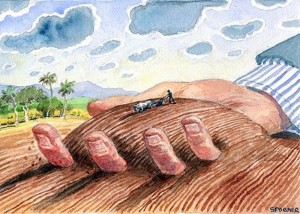
STILL MOWING IT ALL DOWN FOR PROFIT


World Governments Fail to Halt Biodiversity Loss
Published on Monday, May 10, 2010 by Reuters
by Janet Lawrence

LONDON - World governments have failed to meet a 2010 target to halt biodiversity loss and action must be taken to preserve the species and ecosystems upon which human life depends, a United Nations report said on Monday.

In a move endorsed by the U.N. General Assembly, more than 190 countries committed in 2002 to achieve a significant reduction in the rate of biodiversity loss by 2010.
But the report said: "There are multiple indications of continuing decline in biodiversity in all three of its main components -- genes, species and ecosystems."
U.N. Secretary-General Ban Ki-moon said: "The consequences of this collective failure, if it is not quickly corrected, will be severe for us all."

Natural habitats in most parts of the world are shrinking and nearly a quarter of plant species are estimated to be threatened with extinction, said the Global Biodiversity Outlook-3 report.

The abundance of vertebrate species fell by nearly a third between 1970 and 2006 and crop and livestock genetic diversity is declining in farming. "Biodiversity underpins the functioning of the ecosystems on which we depend for food and fresh water...Current trends are bringing us closer to a number of potential tipping points that would catastrophically reduce the capacity of ecosystems to provide these essential services," said Ban.

The report said there had been significant progress in slowing the rate of loss for tropical forests and mangroves in some regions. But freshwater wetlands, sea ice habitats, salt marshes and coral reefs all show serious decline.

FOOD, WATER, MEDICINE

"Business as usual is no longer an option if we are to avoid irreversible damage to the life-support systems of our planet," said Ahmed Djoghlaf, Executive Secretary of the Convention on Biological Diversity.

The report said climate change, pollution, habitat change, overexploitation and invasive alien species were the five main drivers of biodiversity loss and warned the provision of food, medicine, fresh water and crop pollination could be at risk.

The report, based on the work of 110 national reports, also highlighted areas where the 2010 target had prompted action. It said more protected areas on land and in coastal waters had been created and conservation efforts had targeted some species. At least 31 bird species would have become extinct in the past century without them.

Some 170 countries now had national action plans.

"This suggests that with adequate resources and political will, the tools exist for loss of biodiversity to be reduced at wider scales," it said. An international meeting in Nagoya, Japan, in October will consider goals for the next decade.

The U.N. Environment Programme said a lack of economic value attached to the multi-trillion-dollar benefits provided by ecosystems had contributed to the loss of biodiversity. It said restructuring of the global economy after the financial crisis provided an opportunity to introduce regulation and market incentives to help stem the losses.

(Editing by Angus MacSwan)
© 2010 Reuters

Saturday, May 8, 2010

HUNDREDS OF THOUSANDS OF CHILDREN AT WORK IN BIG AG - OUR TAX SUBSIDY $$ HARD AT WORK IN FARM LABOR


Published on Friday, May 7, 2010 by GRITtv
Child Labor Down on the Farm: Report by Laura Flanders
We often assume that child labor in the U.S. ceased after the labor movement fought for and won child labor laws many years ago. But a new report from the Children's Rights Division of Human Rights Watch notes that not only are hundreds of thousands of children working on farms around the country--they are doing so legally because of loopholes in the law.

We speak to Zama Coursen-Neff, Deputy Director of the Children's Rights Division, and via phone, Maria S. Mandujano, a former child farmworker who recently testified before Congress on children working on the farm.
http://www.grittv.org/2010/05/07/child-labor-down-on-the-farm/

Friday, May 7, 2010

BOYCOTT! EVERYONE OFF THE (PLASTIC) BOTTLES!!


Mass. Town Votes to Ban Sale of Bottled Water

Michelle Ruiz
Michelle Ruiz Contributor
AOL News

(May 5) -- Environmentalists have long frowned on bottled water, urging drinkers to go green by sticking to the tap or H20 filtered at home. Now one Massachusetts town has sparked a battle of the bottle with its decision to pull it from shelves altogether.

Residents in Concord, in what seems to be a first for a U.S. town, voted last week to ban the sale of plastic water bottles in their small, affluent municipality effective Jan. 1. The decision has prompted celebration from environmental activists and objection from bottled water industry executives who don't want other cities and states to follow suit.

Ruben Alarcon, of Chicago, buys bottled water at K-Mart.
Phil Velasquez, Chicago Tribune/MCT
Concord, Mass., residents voted to ban the sale of plastic water bottles in their town effective Jan. 1. Here, a man buys bottled water from a Kmart.

The move is a victory for 82-year-old activist and Concord resident Jean Hill, who spearheaded the effort to ban the plastic bottles. She presented the Town Council with a slide show featuring photos of plastic polluting the ocean and mounting in garbage dumps.

"All these discarded bottles are damaging our planet, causing clumps of garbage in the oceans that hurt fish, and are creating more pollution on our streets,'' Hill told the Boston Globe. "This is a great achievement to be the first in the country to do this. This is about addressing an injustice.''

Hill pointed out in her presentation that more than 100 municipalities across the U.S. have cracked down on bottled water. New York, Illinois and Virginia have cut spending on the product. Elsewhere in Massachusetts, Boston, Somerville and Cambridge have pledged to gradually reduce city spending on bottled water. Hill also decried the plastic-fueled garbage dump swirling in the middle of the Atlantic Ocean.

Hill's impassioned presentation swayed Town Council Chairman Stanly Black, who switched his initial vote against the ban. He told the Concord Journal that he was "so moved" by Hill's presentation that he voted in favor of the ban even though he agrees that the council doesn't have the authority to ban the sale of bottled water.

"The statistics about the amount of trash are appalling," Black said. "There's an island bigger than Texas floating around in the Pacific."

Black and Hill had the support of Concord resident Lal Minton, who wrote in a letter to the Concord Journal that bottled water has become a "scourge."

"People older than 75 were obliged by their mothers to give up the bottle when they were babies," he wrote. "They have survived into their 80s."

Concord apparently is the first U.S. municipality to approve a ban on bottled water, Nick Guroff, communications director for Corporate Accountability International, told the Journal.

Selectwoman Virginia McIntyre told the Globe that she supports the ban in theory but has trouble backing it -- and its potential legal fallout -- in practice.

"It's questionable whether Town Meeting even has the authority to ban the sale of plastic water bottles,'' she said. "We understand it's an emotional issue, and probably the right thing to do, but why should we spend scarce public resources on legal fees defending it? I doubt that's the best use of tax dollars.''

The International Bottled Water Association rallied against the ban in a statement that threatened a potential "legal challenge." It says the $10 billion industry promotes health by encouraging people to drink up.

"Bottled water is a safe, healthy, convenient food product," the statement read. "With the current high rates of diabetes, obesity and heart disease, any actions that discourage or prevent consumers from drinking water -- whether tap or bottled -- are not in the public interest."

The association also said that "any efforts to reduce the environmental impact of consumer packaging must focus comprehensively on all product containers and not single out any one product."

Whether the ban will be more than a symbolic move in Concord remains to be seen. Those desperately seeking a sip of bottled water need only cross the Concord town line to buy the bottles at a neighboring Costco.

For Hill, the vote remains a triumph.

"I think it's a disgrace what's going on with these bottles,'' she told the Globe. "This is the starting of making a real change in Massachusetts.''

SAY NO TO GRABBING EVERY LAST ACRE OF AGRICULTURAL LAND ON EARTH!


(photo by Flickr user afromusing)
Published on Friday, May 7, 2010 by GRAIN

The World Bank in the Hot Seat Over Land Grabbing

A curious thing happened last week. A lot of people were under the impression that the World Bank was going to release its long-awaited study on global land grabs at its annual land conference in Washington DC on 26 April 2010. This is what GRAIN was told. It's what many journalists were told. And it's what those involved in producing the study expected. But it didn't happen.
[Environmental impact assessments are rarely carried out, and people are routinely booted off their land, without consultation or compensation. The Bank even revealed that investors are deliberately targeting areas where there is "weak land governance". (photo by Flickr user afromusing)]Environmental impact assessments are rarely carried out, and people are routinely booted off their land, without consultation or compensation. The Bank even revealed that investors are deliberately targeting areas where there is "weak land governance".
Instead, the Bank gave another powerpoint presentation summarising what the study will show, reiterated its proposed seven principles for "socially responsible" land grabs and unveiled its new business-to-business website -- a kind of internet dating service to match up corporate land grabbers and government land givers.

This is not the first time that this study has been delayed. Indeed, ever since the Bank started compiling the data for it, tight political reins have been put on any public sharing of the results. They initially said the report would be out in December 2009. Then it was supposed to be March 2010. Then, we were assured, it would be released at the land conference last week. We do know that all of the research and analysis was completed long ago. So what's holding the Bank back?

Bad news

The partial glimpse of the study presented in Washington last week sheds some light on an answer. The Bank initially wanted to do a comprehensive study of 30 countries, the hot spots for the land grabs. But it had to cut back severely on its expectations because, as it admits, the governments would not provide them with information. The corporations wouldn't talk either, we were told by people writing the country chapters. This in itself is a powerful statement that says volumes about the hush-hush nature of these deals. If the World Bank can't get access to the information, who can?

The Bank decided instead to base its study on the projects that have been reported by the media and captured on the farmlandgrab.org website. The Bank identified nearly 400 projects in 80 countries in this way, nearly one quarter (22%) of which are already being implemented. The study thus makes it plain that the global land grab is very real and moving along faster and further than many have assumed (See box for a basic glimpse of what the study is expected to say.)

BOX: What the World Bank study is expected to say

[NB: GRAIN has not seen the World Bank's report. The following is drawn simply from publicly available documents, plus some verification from World Bank staff and consultants.]

The World Bank study focuses on large-scale farmland acquisitions of the last few years - what we all call land grabbing. While it largely confirms many things we already know, people have been awaiting the release of this report because the Bank was supposed to get access to more information than anyone else up to now. After all, most of these deals are shrouded in secrecy and controversy, and attract accusations of neocolonialism, even genocide.

The Bank inventorised 389 land deals in 80 countries. The bulk (37%) of the so-called investment projects are meant to produce food (crops and livestock), while biofuels come in second place (35%). Unsurprisingly, Africa is the target of half the land grab projects, followed by Asia, Latin America and Eastern Europe.

In terms of countries being approached for their land, the Bank reveals that, in Africa, Sudan comes in first place, followed by Ghana and Madagascar. In Asia-Pacific, Indonesia ranks first, followed by the Philippines and Australia. In Latin America, Brazil is the favoured destination, then Argentina and Paraguay. In terms of country of origin of the land grabbers, China and the UK tie in the top slot, followed by Saudi Arabia.

Finally, the Bank did statistical analysis of what draws land grabbers to certain countries rather than others - the "probability" factors. Three are particularly noteworthy: land availability, low mechanisation and weak land governance. This means that investors will prioritise places where: (a) it is relatively easy to get control over people's land; (b) large-scale holdings are possible; and (c) bringing in machinery will yield quick productivity gains.

The Bank's most significant findings, however, are about the impacts of these projects on local communities. Its overwhelming conclusion, shared at the land conference last week, is that these projects are not providing benefits to local communities. Environmental impact assessments are rarely carried out, and people are routinely booted off their land, without consultation or compensation. The Bank even revealed that investors are deliberately targeting areas where there is "weak land governance".

It is hard to see how, given these damning findings, the Bank could come up with anything positive to say about this new wave of foreign investment in farmland; this probably explains its reluctance to release the report. The Bank, after all, embarked on the study "to provide guidance to Bank clients (in government and the private sector) and partners who may be faced with or interested in large scale land acquisition so as to enable them to maximize the long-term benefits from such investments." 1 And, while its study waits in limbo, the Bank is becoming more and more committed to making the land grabs happen. European investors, for instance, say that they will be using the Bank's Multilateral Investment Guarantee Agency to provide them with political risk insurance for their farmland deals. Should anything backfire, "You'll have the World Bank on your side," says Gary Vaughan-Smith of London-based SilverStreet Capital LLP, which recently launched a US$300-million fund to invest in farmland in Africa. "They're going to have enormous clout if there are any difficulties." 2

Not winning anyone over

The problem for the Bank and the other land grab promoters, however, is that hardly anyone is fooled by talk of "win-win" guidelines or codes or principles to make it all work for everyone's benefit. No matter how hard they try, they can't shake the "land grab" label or stigma off these transactions.

"Here's what I'm sure of", weighs in Howard Buffet, son of Warren Buffet, in an Oakland Institute report released in time for the Bank's conference last week. "These deals will make the rich richer and the poor poorer, creating clear winners who benefit while the losers are denied their livelihoods." 3

If the Bank and its friends at partner UN agencies hoped that last week's events in Washington would finally give them some control over the land grab discussion, they were mistaken. More than 100 groups from more than 100 countries crashed their party by releasing a common declaration a few days before, which denounced their "seven principles" for socially responsible land grabbing. They didn't beat about the bush. As they see it, on the ground, this land grab is nothing but a massive transfer of lands from small food producers to foreign corporations, from sustainable farms to industrial plantations, and these groups were making it crystal clear that they are committed to throwing this trend into reverse. Against this, the Bank's "win-win", or responsible investment initiative, looks hollower than ever.

Going further

The World Bank conference materials are being posted online here: http://go.worldbank.org/IN4QDO1U10

Reports and statements reflecting the social movement against the World Bank's proposals for "socially responsible" land grabbing are available at farmlandgrab.org: http://farmlandgrab.org/cat/world-bank

Anyone can join or respond to the collective statement against win-win land grabbing drawn up by La Vía Campesina and allies at http://farmlandgrab.org/12200 (English), http://farmlandgrab.org/12259 (French), http://farmlandgrab.org/122 (Spanish) and http://farmlandgrab.org/12262(Arabic).

1 World Bank, "Large scale acquisition of land rights for agricultural or natural resource-based use, Concept note", 18 February 2009.

2 Drew Carter, "Fertile ground for investment," Pensions & Investments, 19 April 2010: http://farmlandgrab.org/12218

3 Oakland Institute, "(Mis)investment in agriculture: The role of the International Finance Corporation in the global land grab," 26 April 2010: http://farmlandgrab.org/12429

Wednesday, April 28, 2010

A TOTAL POLICY DISASTER FOR ORGANIC FARMERS

Published on Wednesday, April 28, 2010 by The San Francisco Chronicle
Organic, Small Farmers Fret over FDA Regulation

by Carolyn Lochhead

WASHINGTON - Small farmers in California who have led a national movement away from industrial agriculture face a looming crackdown on food safety that they say is geared to big corporate farms and will make it harder for them to survive.

The small growers, many of whom grow dozens of different kinds of vegetables and fruits, say the inherent benefits of their size, and their sensitivity to extra costs, are being ignored.

They are fighting to carve out a sanctuary in legislation that would bring farmers under the strict purview of the Food and Drug Administration, an agency more familiar with pharmaceuticals than food and local farms.

A bill before the Senate is riding a bipartisan groundswell created by recent outbreaks of E. coli, salmonella and other contamination in everything from fresh spinach to cookie dough.

And the small farmers face opponents in consumer groups, victims of food contamination, large growers and the Obama administration, who say no farm and no food should get a pass on safety.

An even tougher version of the legislation passed the House last summer. Now, a behind-the-scenes battle is raging in the Senate over how to regulate small and organic growers without ruining them - and still protect consumers.

If two versions of the overhaul pass, Congress would work to merge them.

The legislation would mandate a range of programs intended to bolster food safety. The FDA would gain greater authority to regulate how products are grown, stored, transported, inspected, traced from farm to table and recalled when needed.
Pinpointing problems

But biologically diverse and organic growers argue that the problems that have plagued the food industry lie elsewhere.

They point to the sale of bagged vegetables, cut fruit and other processed food in which vast quantities of produce from different farms are mixed, sealed in containers and shipped long distances, creating a host for harmful bacteria.

The legislation does not address what some experts suspect is the source of E. coli contamination: the large, confined animal feeding operations that are breeding grounds for E. coli and are regulated by the U.S. Department of Agriculture, not the FDA.

"It does not take on the industrial animal industry and the abuses going on," said Tom Willey of T&D Willey Farms in Madera, an organic grower of Mediterranean vegetables. "The really dangerous organisms we're dealing with out here, and trying to protect our produce and other foodstuffs from, are coming out the rear end of domestic animals."

No one in Congress or the administration has yielded in a bureaucratic turf battle between the Department of Agriculture, which regulates meat, poultry and eggs, and the FDA, which regulates all other food.

The controversy began with the spinach E. coli outbreak near San Juan Bautista in 2006 that left four people dead, 35 people with acute kidney failure and 103 hospitalized. The bacteria, known as E. coli O157:H7, first appeared in hamburger meat in the early 1980s and migrated to produce, mainly lettuce and other leafy greens that are cut, mixed and bagged for the convenience of shoppers.
Contamination

Since then, there have been dozens of contamination cases, leading Congress to rewrite food safety laws by giving much more power to the FDA. But small growers worry that they, and consumers, will suffer in the sweep of reform.

"How do we trust that the FDA is going to know about things that the San Francisco Bay Area has been very progressive on - the field to fork, fresh, grow local, buy local - all of that?" said Rep. Sam Farr, D-Carmel. "The organic people are feeling that the regulations the FDA may promulgate will be so safety oriented, it'll put them out of business."

Consumer groups say they care about small farmers but that safety comes first.

"Our principle is that food should be safe, whatever the source," said Sandra Eskin, director of the Pew Health Group's food safety campaign, one of the Pew Charitable Trusts, which Monday sponsored a public meeting on the issue with federal officials in Seaside (Monterey County).

"People care profoundly about all these issues: feeding their families, food safety, local agriculture," Eskin said. "It's a passionate discussion and understandably so. Everybody eats."

Tom Nassif, head of Western Growers, which represents large produce growers, said small growers should not be exempt.

"If the small guy who sells to a farmers' market gets a family sick, it's a blip on the radar screen," Nassif said. "There's not a big hue and cry, because it didn't affect hundreds of people. What about those people? Doesn't their food safety count?"
Protocols

The tension that has come with food safety reforms was on display after the spinach outbreak rocked California. Large growers embraced costly science-based safety protocols for all leafy greens - guidelines that federal regulators are considering taking nationwide.

However, a UC Davis study last year by Shermain Hardesty and Yoko Kusunose found that the rules have put smaller growers at a disadvantage because their compliance costs are spread over fewer acres. Hardesty said costs may be as high as $100 an acre.

Large produce buyers such as Wal-Mart and McDonald's have gone much further than the industry standards. They have imposed rules of their own that have forced many California farmers who supply them to fence off waterways, poison wildlife to keep animals out of fields and destroy crop hedgerows that support beneficial insects.

Deputy Agriculture Secretary Kathleen Merrigan said Monday the administration is keeping a "close watch" on these so-called "super metrics," acknowledging that they have harmed the environment but said, "nobody gets a pass on food safety."
Increasing the danger

Willey, the Madera farmer, argued that many food safety rules tend "to push us to embrace a paradigm of sterility," which, in the long run, increases the danger.

"When you create microbial vacuums, they can be even more easily taken over by pathogenic organisms," he said. "In organic agriculture, we depend tremendously on a cooperative effort with beneficial microorganisms. My whole soil fertility system is based on that. Actually, soil fertility planetwide is based on that."

Efforts to modify proposed rules to make compliance easier for biologically diversified farms have been more successful in the Senate than in the House. New language that requires the FDA to consider farm size, crop diversity, organic requirements and other issues has been added.

"While none of these things in themselves solves the cause for concern, they certainly point strongly in the direction of the FDA needing to take into account these considerations," said Ferd Hoefner, policy director for the National Sustainable Agriculture Coalition.

Hoefner called the House bill a one-size-fits-all approach that would be a "complete disaster" for small farms.
© 2010 The San Francisco Chronicle

Monday, April 26, 2010

WHY IRRADIATION & VEGGIES DON'T MIX

Irradiation
Learn more
Zapped Cover Image
http://documents.foodandwaterwatch.org/Zapped.pdf
Read Wenonah Hauter’s book about irradiation.
Irradiation Will Not Solve Food Safety Problems

Food producers need to address the source of the problem – too fast processing lines and dirty conditions at plants – not promote an expensive, impractical and ineffective technology like irradiation.

Heard the irradiation industry claim that they can ensure produce safety? See our factsheet on why Irradiation and Vegetables Don’t Mix.


News Item: Irradiated Mangoes for Motorcycles, a Fair Trade?

Secretary of Agriculture Michael Johanns has kicked off the import of irradiated mangoes from India, with a photo opportunity at the United States Chamber of Commerce building in Washington DC. The event marks the re-introduction of mangoes from India into the United States, after an 18 year absence due to concerns about pests that might travel with the mangoes and hurt domestic crops.

The concern about pests was pushed aside by USDA’s approval of the use of irradiation for Indian mangoes. And concerns about the economic impact of importing more produce on domestic producers were shoved aside with talk of what a great deal the United States Trade Representative had negotiated – in exchange for the United States taking India’s irradiated mangoes, India was supposed to change their air emission standards and tariffs to allow the import of Harley Davidson motorcycles.

That is, until today, when Harley Davidson announced that the deal had fallen through because India did not mangoeslower their tariffs, so the company won’t enter the Indian market after all. But it looks like the mangoes are still on the way to supermarket shelves near you.

So keep an eye out for mangoes that have the irradiation symbol on the label (or a nearby sign.) Tell us if you see them – and tell the store manager you won’t buy irradiated food.